


Despite its rapid expansion, Cairo faces a critical shortage of public parks and green spaces. Historical trends in the city have prioritized commercial infrastructure, highways, and extensive real estate developments, while the vital role of parks and recreational areas in fostering health and sustainability has been forgotten.
Current statistics reveal a stark reality: Cairo possesses only 0.74 square meters of green space per person, far below the World Health Organization’s recommended minimum of nine square meters per resident – an amount considered necessary to support basic public health benefits such as physical activity, mental well-being, and environmental quality – with an ideal target closer to 50 square meters per person to maximize these urban health and ecological benefits.
The loss of over 2.1 million square meters of green spaces since 2006 shows the urgency of this crisis, particularly when considering public health outcomes. Research has consistently shown that access to parks and greenery has a direct impact on physical health.
Why Green Spaces Are So Rare in Cairo
Part of the challenge lies in geography and economics. Egypt is a predominantly desert country where maintaining large green spaces requires significant irrigation, infrastructure, and long-term funding.
Unlike cities located in temperate climates with abundant rainfall, Cairo must sustain its parks through artificial watering systems, making urban greenery more resource-intensive.
However, urban planners argue that this challenge does not make parks unrealistic; rather, it highlights the importance of designing efficient and sustainable green spaces.
This means that while large, water-heavy lawns may not always be feasible, thoughtfully designed parks using drought-resistant plants, shaded walkways, and tree canopies can still provide substantial benefits for residents.
In other words, the question is not whether Cairo can afford parks, but whether it can afford the long-term social and health costs of living without them.
The Role of Urban Planning and Development Priorities
Another reason for Cairo’s shortage of green space lies in the city’s development priorities over the past several decades.
Urban planning has often focused on road expansion, bridges, commercial zones, and large real-estate projects designed to accommodate population growth and economic activity.
A visible example of this trend occurred in eastern Cairo’s Heliopolis district, where roughly 2,500 trees were removed between 2019 and 2020 during road and bridge expansion projects. These projects were largely tied to infrastructure designed to improve traffic flow and connect Cairo more efficiently to the New Administrative Capital.
Therefore, Cairo’s development trajectory has worsened access to these vital resources; for example, a 2022 study by Al-Azhar University found that 40 of 57 parks studied became less reachable because road expansions and overpasses increased walking distances for residents.
Additionally, in the course of several decades, from the mid‑20th century through the early 21st century, Al‑Azbakeya Park lost between 60 percent and 80 percent of its original area due to ongoing urbanization and infrastructure initiatives, exemplifying how green spaces are frequently viewed as expendable rather than essential urban infrastructure.
This deliberate repurposing of park areas and public gardens for development has led to an alarming trend of green space depletion across Cairo.
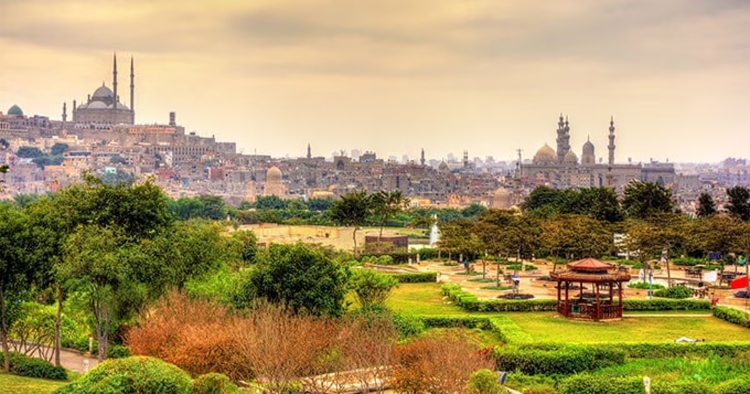
If Cairo needs proof that green spaces can transform urban life, it already has one. Al-Azhar Park, opened in 2005 on a former landfill site, demonstrates the powerful impact a well-designed park can have on a city.
Covering roughly 74 acres, the park has become one of the most beloved public spaces in Cairo that attracts residents and tourists alike who seek a break from the city’s density. Yet the popularity of Al-Azhar Park also highlights the broader problem: parks of this scale remain rare exceptions rather than the norm in Cairo’s urban landscape.
Reclaiming Cairo’s Public Spaces
According to a 2018 study by the National University of Singapore, communities with accessible parks report higher levels of physical activity, which leads to measurable reductions in obesity, cardiovascular diseases, and diabetes.
Parks also encourage outdoor recreation, promoting activities such as walking, running, and cycling, which significantly contribute to healthier lifestyles.
Unlike shopping malls, which are primarily for consumption, parks provide spaces where people can engage in activities beneficial to their well-being.
Beyond physical health, the mental health benefits associated with green spaces are important to focus on.
Urban health research highlights a strong link between access to nature and psychological well-being. Contact with green environments reduces stress hormones, lowers anxiety levels, enhances mood, and improves cognitive functioning, a 2019 study by Scientific Reports shows.
Consequently, parks are vital for mental well-being, providing a necessary escape from the chronic stressors of life in a dense city like Cairo. They provide residents with opportunities for relaxation, social interaction, and recovery from mental fatigue, which are essential elements for maintaining mental health in fast-paced urban environments.
Environmental sustainability significantly amplifies the importance of parks in Cairo.
Urban greenery is crucial for improving air quality and for mitigating pollution, which is an urgent concern in a city where heavy traffic and dense construction magnify hazardous environmental conditions.
Parks also absorb nitrogen dioxide and filter airborne pollutants that directly contribute to cleaner, healthier urban air.
Thus, the incorporation of green spaces is essential for creating healthier living environments in cities struggling with severe air pollution challenges.
Moreover, parks are pivotal in combating the urban heat island effect, a phenomenon where cities experience significantly higher temperatures than surrounding areas due to the predominance of concrete and asphalt.
The factors contributing to this effect include heat absorption by buildings during the day and heat retention by paved surfaces at night.
Green spaces counteract this issue through the provision of shade and lowering local temperatures. In cities like Cairo, where extreme heat poses significant health risks, the cooling effects of parks become crucial for the well-being of residents.
Parks can also create social cohesion and weave society together.
Picture this: bustling public parks transformed into lively social hubs, where families gather, and elderly residents bask in the sun. These green oases become the heart of the community, hosting events that boost neighborhood connections and spark interactions among Cairo’s diverse residents.
Cairenes can then come together to play, celebrate, and forge lasting bonds. In conversations with both older residents and younger people, many expressed a simple desire for spaces where they could relax, meet friends and neighbors, and reconnect with nature; places that offer a sense of calm away from the intensity of the city.
These reflections highlight that such spaces are not merely beneficial but vital for fostering a sense of belonging and well-being.
A Personal Reflection on What Cairo Is Missing
Growing up in a city like Cairo, it is easy to forget how green public spaces can be.
A shaded bench under a tree and a field of grass where children can kick a football, or a quiet garden where friends can sit and talk may seem small, but these spaces shape how people experience their city.
During my visits to several cities in Europe, including Amsterdam, Helsinki, Cologne, and Odessa, I observed that public parks are designed for people of all ages and social classes to coexist, socialize, and rejuvenate.
In Cairo, where daily life feels fast-paced and overwhelming, such spaces could serve as sanctuaries for both individuals and communities.
Finally, beyond the physical benefits, these lush green environments brighten our world and nourish our mental health.
They invite us to step outside, breathe deeply, and connect with one another, cultivating a community that thrives on shared experiences and meaningful relationships.
They are more than just patches of green; they are the lifeblood of our neighborhoods that bring us closer together.
The opinions and ideas expressed in this article are the author’s and do not necessarily reflect the views of Egyptian Streets’ editorial team.
To submit an opinion article, please email [email protected].



Comments (0)