


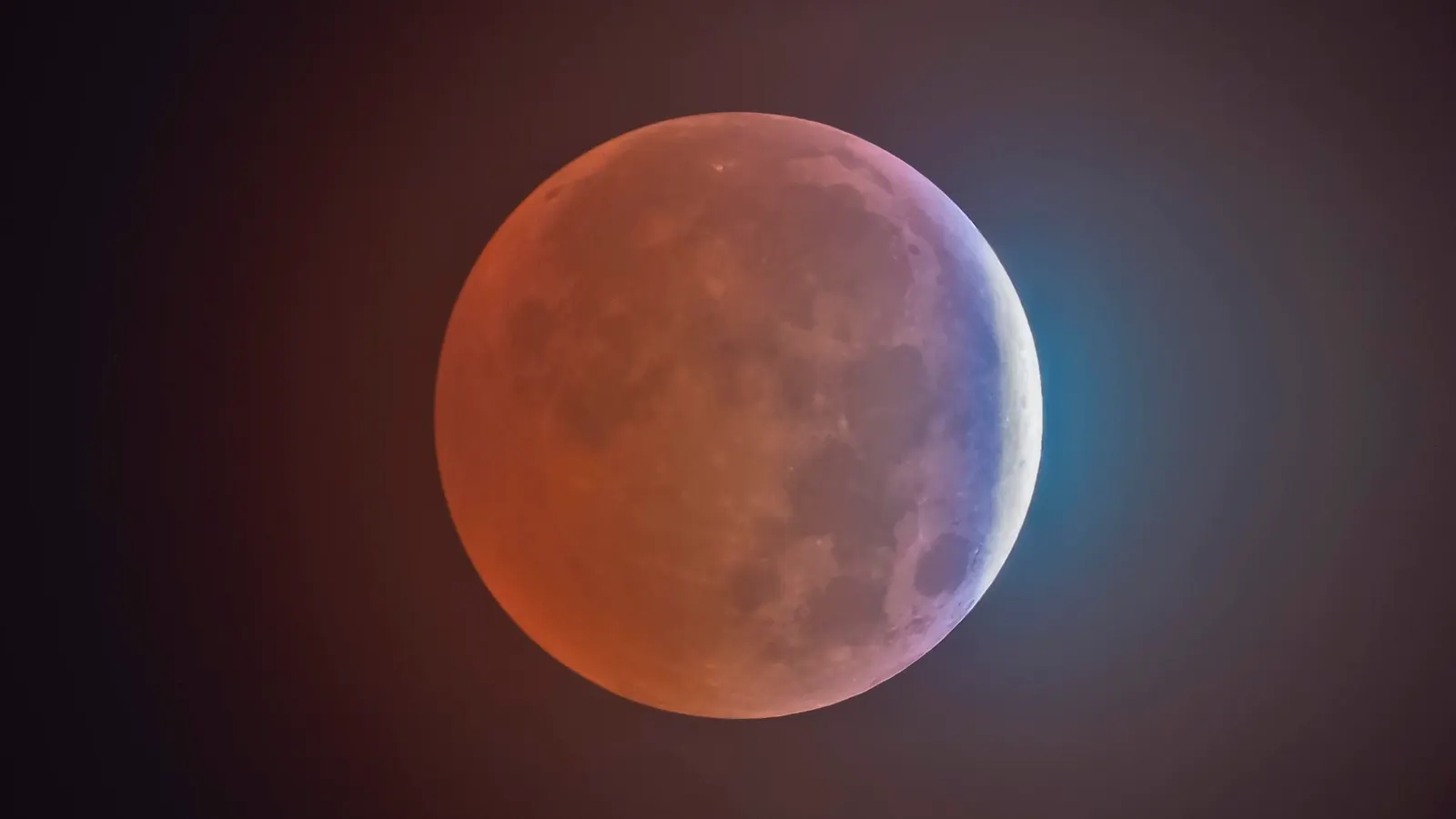
Egypt will witness a partial lunar eclipse in the early hours of Friday, 28 August, with the Earth’s shadow expected to cover around 93 percent of the Moon’s surface at the peak of the phenomenon, according to a statement issued by the National Research Institute of Astronomy and Geophysics (NRIAG) on Monday, 24 August.
The eclipse will coincide with the full moon of Rabi’ al-Awwal 1448 AH, the third month of the Islamic lunar calendar, and will be visible from parts of North and South America, Europe and Africa where the Moon is above the horizon.
In Egypt, the eclipse will begin at 4:24 a.m. with the penumbral phase, which will not be visible to the naked eye. The partial eclipse will begin at 5:34 a.m.
In Cairo, the Sun will rise at 6:29 a.m., marking the last opportunity to observe the eclipse from the capital before daylight makes the Moon no longer visible. The eclipse will continue elsewhere until the partial phase ends at 8:52 a.m., with the entire phenomenon concluding at 10:02 a.m.
The event, from the beginning of the penumbral phase to its end, will last around five hours and 38 minutes, while the partial eclipse itself will last approximately three hours and 18 minutes.
A lunar eclipse occurs when the Earth passes directly between the Sun and a full Moon, causing the Moon to move through Earth’s shadow.
Unlike a solar eclipse, a lunar eclipse can be safely viewed with the naked eye and does not require special protective glasses, according to the institute.
The partial lunar eclipse comes just weeks after a busy August for skywatchers, which included the peak of the Perseid meteor shower and a six-planet alignment visible in the early morning sky.





Comments (0)