


This entry is the first-place winner of Egyptian Streets’ 2025 “Timeless Tales: Cultural Heritage Writing Competition,” in partnership with FairTrade Egypt and Bibliothek Egypt. Entries featured first-person narratives of Egypt’s cultural heritage through Ancient Egypt, Coptic, Islamic, Jewish traditions, and tangible/intangible expressions. Winners were celebrated at Bibliothek Egypt in October 2025, with 13 top stories set to be published.
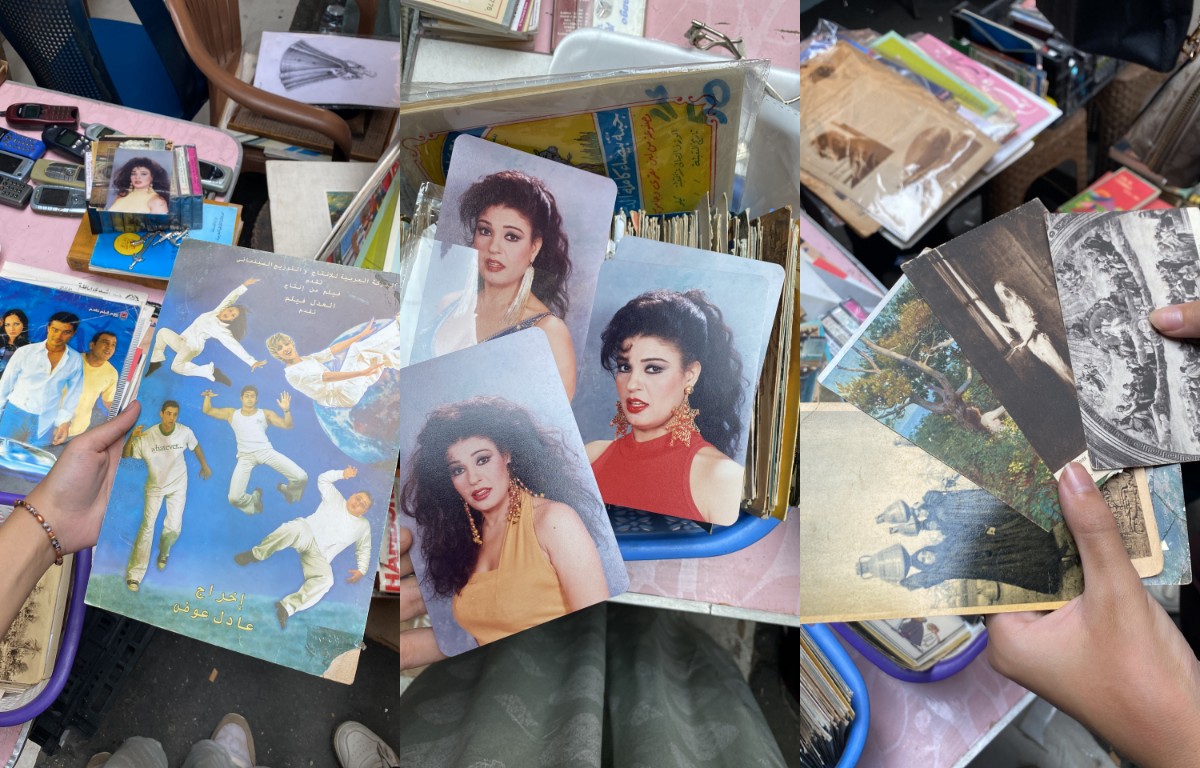
The narrow lanes of Souq Diana in Downtown Cairo come alive with voices on a Saturday afternoon. Tables spill over with treasures from different eras: old vinyl records, yellowed books, Fifi Abdou’s 90s shots, typewriters missing their keys, a collection of Abdelwahab’s cassette tapes and rows of postage stamps neatly arranged by country. The air is thick with dust, sunlight, and stories waiting to be told.
One stall in particular catches my eye. Behind a simple wooden table, an older man stands surrounded by thousands of stamps. He greets me warmly, as if I am not just a passerby but a guest. He began to explain the history behind each stamp. He would tell me who designed it, what year it was made, which queen or king was pictured on it, the story of their family, their marriages, their children, and even their bloodline. He spoke slowly, almost effortlessly, as though the knowledge lived inside him and simply poured out in conversation. He did not seem particularly concerned with selling the stamps; what excited him most was sharing the stories that came with them.
At first, I thought he was only being kind because I had stopped to look at his table. But I quickly realized that he was like this with everyone. For him, speaking about Egypt’s history was not a transaction, it was a joy. He laughed as he recalled complicated details, making them sound lighthearted and alive. Sometimes, he would even gift a stamp to someone who would answer a tricky question he asked, just because they shared in his passion. He wasn’t just a seller. He was a storyteller, a guardian of memory.
This is when it struck me: this is Egypt’s true cultural legacy. Not only the monuments that stand tall against time, but the people who carry stories within them, who pass them down, who breathe life into them. These stories are treasures kept alive not by museums, but by people who hold onto them, whether because it is all they have left, or simply because they love sharing them with strangers.
In Souq Diana that day, I saw more than stamps. I saw history moving quietly through ordinary conversations. I saw decades of Egypt reflected in the eyes of its people. I saw how culture survives not only in books or ruins, but in laughter, in storytelling, in the way a man on the street can teach you about a queen who lived centuries ago.
It made me realize that what my younger self once denied missing was not the streets or the noises, but this spirit. Back then, I tried to protect myself from the sadness of the possibility of leaving by insisting there was nothing to miss. But now I know better. If I ever fly away, it is this I will miss most — the unexplainable presence that lives in the people, the heritage they carry in their voices, and the joy they take in keeping it alive. A spirit that cannot be touched but can always be felt.
Egypt’s heritage is often imagined in stone — the pyramids, temples, mosques, and churches that command the gaze of the world. But there is another heritage, quieter, more fragile, yet no less enduring. It lives in the voice of an old man unfolding the story of how these albums came into his hands. It is the way he turns a stamp into a family tree. It is the way laughter erupts over a 2000s movie poster design. It is carried in voices, passed from one generation to the next, like a secret whispered across time.
Souq Diana, with its rows of forgotten objects and its guardians of memory, is more than a market. It is a breathing archive, where the past refuses to turn to dust. Egypt’s history does not live only in museums or books, but in the warmth of strangers, in the generosity of a seller who slips you a stamp as if passing down a secret, in the joy of stories told for no reward but love.
When I was younger, I thought I would leave Egypt without looking back. Today, I know that even if I do, I will ache for it in ways I cannot name. I will carry fragments, voices, stories, laughter that lingers like an aftertaste, but never the whole. The rest will remain here, breathing in others, alive in streets I may not walk again. And it is in that distance that my longing will always live.


Comment (1)
BEAUTIFUL, aching, alive. This piece is a testament to the writers skill to note detail and the place of the storyteller in retaining memory. INCREDIBLE!