

Is the devil a woman? This was a question that often seemed to permeate some of the earliest Western and Egyptian films, reflecting the misogynistic anxieties surrounding a woman’s power in society and the things that societies have historically tried to control: female sexuality, independence, desire, and anger.
In 1972, an Egyptian film was released titled Al Shaytan Imra’a (The Devil is a Woman, 1972), a title that itself speaks to the long-standing association between women, sexuality, and danger. Similarly, in Western literature and film, there is the recurring figure of the femme fatale: a sexually attractive woman who uses her sexuality to manipulate, seduce, or ultimately destroy men.
Across these representations, female power is repeatedly framed by male directors as something dangerous, particularly when it exists outside the boundaries established by a patriarchal society.
Yet, more recently, feminist horror films have turned this question on its head. Horror has become a medium through which filmmakers can illustrate what happens when women become monsters, and how their monstrosity can be read as a form of revenge for what they have been subjected to.
Feminist interpretations reverse the traditional idea of the female monster. It does not simply represent a woman who is dangerous because of her power; the female monster can represent what happens when a woman who has been sexualized, controlled, violated, or violently treated finally gains power over those who have harmed her.
The question, then, is not only “Why is this woman a monster?” but also: “Who made her monstrous in the first place?”
For instance, in one of the most famous modern examples of feminist horror cinema in the 21st century, Jennifer’s Body (2009), there is a particular scene that is often overlooked and ignored, despite being arguably the most important scene in the entire film.
In this scene, Jennifer, played by Megan Fox, explains to her best friend Needy that an indie band brutally stabbed her with a knife, and rather than dying, she became possessed by a demon. “It should have killed me, but for some reason, it didn’t,” Jennifer tells her. Needy’s response is simple, but carries a much deeper meaning: “Maybe it did.”
The scene itself is a clear reference to sexual assault and rape, implying that murder is similar to committing sexual assault against another person’s body. Although Jennifer does not physically die, the brutality of what was done to her traumatizes her and changes her entirely, turning her into a demon, whether she is conscious of it or not.
Below are other examples of Egyptian films and books that tackle women’s issues through the lens of horror, not necessarily by depicting ghosts or demonic entities, but by revealing the horrifying reality of how women can be made monstrous, and, more importantly, what lies at the root of that monstrosity.
Hekayet Nerges (2026)
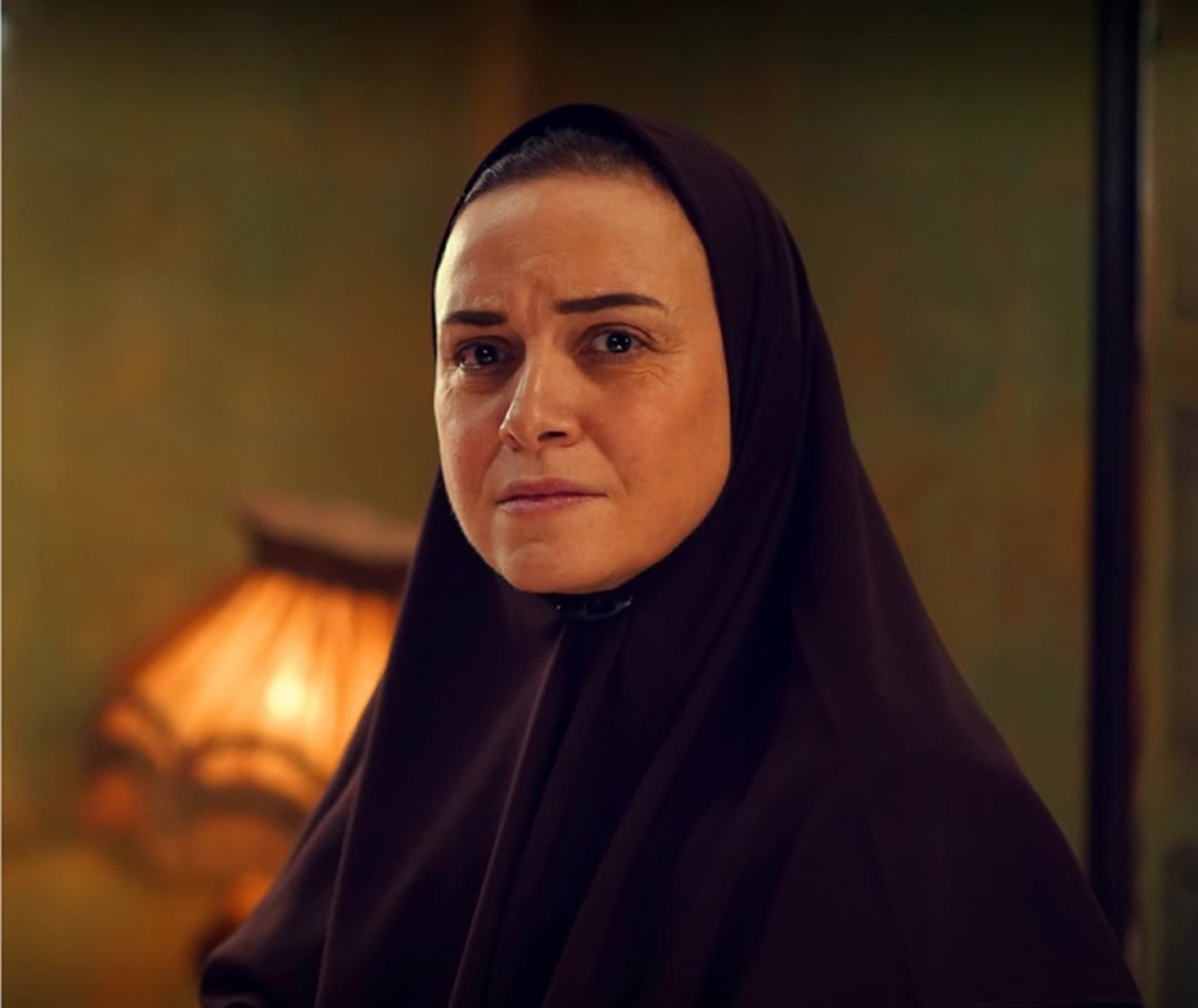
At its core, Hekayet Nerges (Nerges’ Story, 2026) is a disturbing exploration of what happens when a woman is made to feel that she has failed at being a woman.
Nerges’s desperate longing for motherhood eventually leads her into deception and crime, but the real horror begins long before she commits either.
It begins with the expectations placed on her, from the judgment directed at women who cannot have children to the constant scrutiny of their bodies, and the deeply ingrained belief that motherhood is what ultimately gives a woman value, purpose, and legitimacy.
Nerges’s life is horrifying not because she encounters something supernatural, but because she is trapped within expectations that are themselves almost monstrous. She is constantly being measured against an ideal of what a woman should be, and there is little space for her to exist outside of that image.
It asks us to reconsider who the monster actually is. Is it Nerges, whose desperation eventually turns her into the very thing society fears? Perhaps the horror is not simply that Nerges becomes monstrous, but that the expectations imposed upon her were monstrous from the beginning.
Al-Mara’a wa Al-Satour (1996)
Al-Mara’a wa Al-Satour (The Woman and the Cleave, 1996), directed by Saeed Marzouk, is one of the more striking examples of Egyptian cinema’s fascination with the woman who becomes monstrous in response to violence.
Based on an infamous real-life case in Alexandria, the film follows a widow who is exploited and abused by a husband, whose violence and manipulation extend to threatening her daughter. Eventually, she kills him and dismembers his body.
On the surface, it is a gruesome crime thriller, built around murder, blood, and the shocking image of a woman taking a cleaver to a man’s body. Yet beneath its sensationalism is a much more uncomfortable question: what happens when a woman is pushed so far by violence that the only form of agency left to her is violence itself?
Yet, her monstrosity does not appear out of nowhere. It is produced through abuse. She does not begin the story as a monster; she becomes one through a series of humiliations, threats, and acts of male violence that progressively strip away the forms of protection and justice available to her.
The real horror may not be that an abused woman becomes capable of killing, but that a woman has to become monstrous before anyone is forced to take her suffering seriously.
The Shadow of Cairo (2020)
Thol Al Qahira (The Shadow of Cairo, 2020), directed by Tara Shehata, takes the familiar figure of the female monster and gives her a distinctly urban and contemporary form. The film follows a young girl who, after the death of her mother, becomes a vigilante hunting down sexual harassers in Cairo. Rather than presenting monstrosity as something supernatural that suddenly possesses her, the film ties it to trauma, grief, and the everyday violence that women and girls are forced to navigate.
The girl begins from a position of vulnerability, but the experiences surrounding her gradually transform that vulnerability into something more threatening. Sexual harassment, grief, fear, and the failure of the world around her to protect her do not simply traumatize her; they also shape the kind of person she becomes.
The streets of Cairo are particularly important to this transformation. The city is not merely a backdrop for the story but becomes part of its horror. Public space, which should offer freedom and movement, becomes a site of surveillance, threat, and vulnerability for women.
She becomes the thing that her harassers fear.
Mātat Maryam (2024)
Matahet Maryam (Maryam’s Maze, 2004) by Mansoura Ez Eldin takes the idea of the female monster into a much more psychological and surreal territory. The novel follows a young woman moving through a disorienting Cairo where ghosts, doubles, fragmented identities, and distorted memories become almost impossible to separate from everyday life.
The city itself begins to feel haunted, but what haunts Maryam is not only the supernatural. It is also the world she has inherited and the structures that have shaped her understanding of herself. The Gothic quality of the novel is important because it gives form to experiences that are difficult to articulate directly. Maryam’s fractured sense of reality can be read as an externalization of psychological and social pressures that women are often expected to internalize.
Her confusion, isolation, and fragmented identity become manifestations of a deeper unease: what happens to the self when it is constantly being defined, restricted, and observed by the world around it?
The horror is not merely that Maryam is lost. It is that the world has become a place in which losing oneself can feel almost inevitable.



Comments (0)