


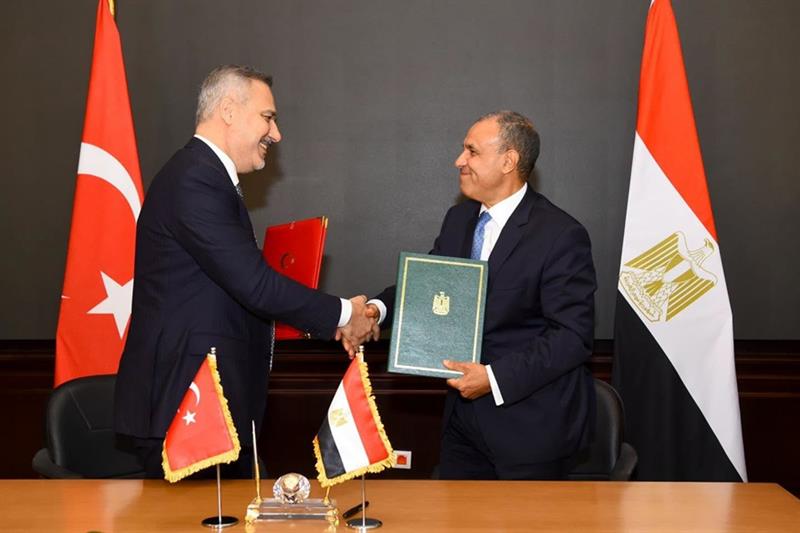
Egypt and Turkey signed several cooperation agreements in Alamein, North Coast on 13 August, covering transportation, infrastructure, logistics, investment and trade, as the two countries seek to deepen bilateral economic ties and increase trade to USD 15 billion (EGP 747 billion).
The agreements were signed during the second meeting of the Egyptian-Turkish Joint Planning Group, co-chaired by Egyptian Foreign Minister Badr Abdelatty and Turkish Foreign Minister Hakan Fidan.
The meeting brought together representatives from the investment, trade, petroleum, and health and population ministries of both countries. Abdelatty and Fidan signed the protocol for the meeting before proceeding with a number of cooperation agreements.
Among the agreements, Egypt formally joined a memorandum of understanding on logistical connectivity involving the transport ministries of several African countries and Türkiye’s Ministry of Transport and Infrastructure.
A separate decision on rules of origin was also signed by Egyptian Minister of Investment and Foreign Trade Mohamed Farid Saleh and Fidan under the joint committee established through the countries’ free trade agreement.
Rules of origin determine the country in which a product is considered to have been produced for trade purposes, helping establish which goods qualify for preferential treatment under trade agreements.
Focus on Trade and Investment
The talks followed the second meeting of the High-Level Strategic Cooperation Council between Egypt and Türkiye, held in Cairo in February and chaired by President Abdel-Fattah El-Sisi and Turkish President Recep Tayyip Erdoğan.
Officials discussed steps to implement the leaders’ agreement to increase bilateral trade to USD 15 billion (EGP 747 billion), alongside efforts to expand investment and strengthen economic cooperation.
The two foreign ministers also reviewed ongoing consultations on reactivating the maritime shipping route between Egypt and Türkiye under the “Ro-Ro” system, which allows trucks and other wheeled cargo to be transported directly by ship, helping speed up the movement of goods between Egyptian and Turkish ports. The route would facilitate the movement of goods, particularly perishable products, while strengthening supply chains and connections between Egyptian and Turkish ports.
Abdelatty also highlighted measures introduced by Egypt to support Turkish investors, including a Fast Track mechanism designed to facilitate access to licenses and approvals.
Egypt is also looking to attract further Turkish investment through a possible fully serviced Turkish industrial zone in the country. Priority sectors identified during the discussions include automotive, aluminum, equipment, chemicals, textiles and ready-made garments.
The Egyptian side also encouraged greater Turkish investment in Egypt’s mining sector, including cooperation in exploration, mineral processing and related industries, as well as exchanges of technical and technological expertise.
Regional Issues
Beyond economic cooperation, Abdelatty and Fidan discussed a number of regional crises, including Gaza, Sudan and Libya.
The two sides stressed the importance of continued coordination to support regional security and stability, including through the regional quartet comprising Egypt, Türkiye, Saudi Arabia and Pakistan.
On Gaza, both sides condemned continued Israeli violations in Gaza and the West Bank and called for an immediate halt to the escalation. They also stressed the need to advance the first and second phases of US President Donald Trump’s peace plan, including Israel’s withdrawal from Gaza, and to ensure humanitarian aid reaches Palestinians without obstruction.
Regarding Sudan, Egypt stressed the need for a ceasefire and a political settlement that preserves the country’s unity, sovereignty and territorial integrity, while emphasizing that any political process should remain Sudanese-led.
On Libya, Abdelatty reaffirmed Egypt’s support for a “Libyan-Libyan” political settlement without external interference and called for the preservation of Libya’s unity and sovereignty, alongside efforts toward presidential and parliamentary elections.
The Alamein talks come amid renewed momentum in Egyptian-Turkish relations following the February meeting of the countries’ High-Level Strategic Cooperation Council and recent discussions between their foreign ministers on expanding bilateral economic and political coordination.




Comments (0)