


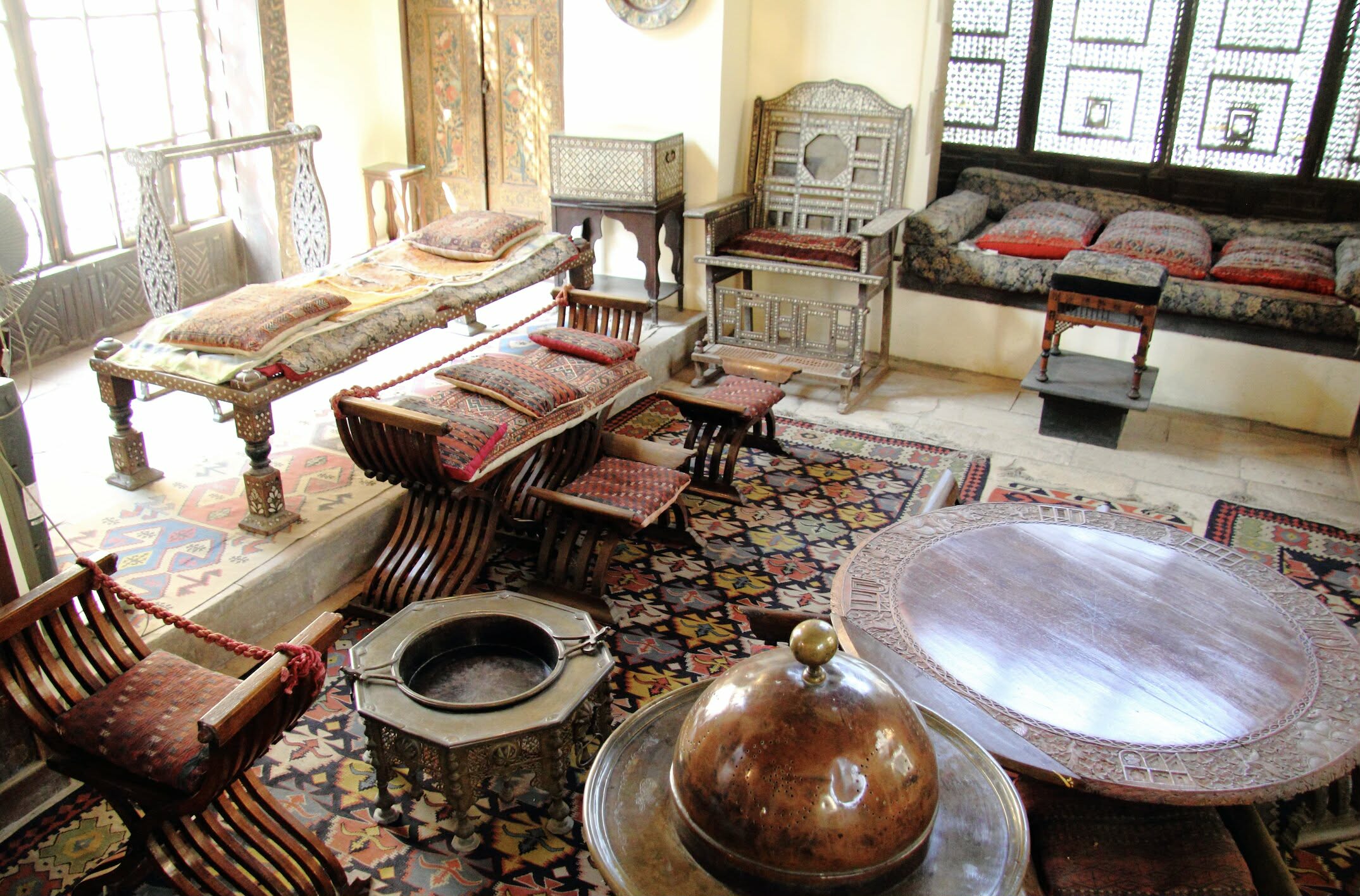
Egypt’s blend of heritage has always captivated me, but the human-made carries a special charm.
Nothing compares to the old Cairene houses, I came to Sayyida Zainab neighborhood to see one of the finest: the Gayer-Anderson Museum. My first glimpse, —its quiet walls beside the immense Ibn Tulun Mosque—was a testament to an elegant past tucked away on Saliba Street, as if reminding me I was in the right place.
The Gayer-Anderson Museum comprises two merged houses, each with its own story. The first, built in 1631 by Hajj Mohammed ibn Jilmam al-Gazzar, carries a legend of the jinn al-Watawit, said to have ordered its construction. Later, a woman from Crete lived there, after whom it became known as Bayt al-Kritliyya. Its final resident, Sheikh Suleiman who lived by the mausoleum of Haroun connected to the house, shared the house’s legends with Gayer-Anderson. The second, older dwelling, built around 1540, belonged to Abdel Qader al-Haddad and later to a woman named Amna. Their names, etched into foundation stelae, silently guard the entrance.
Wandering the rooms, one showcase drew me in: the masks Gayer-Anderson created for each servant. More than mere curiosities, they were teaching tools, sculpted so the staff could study and preserve the houses’ antiquities. Standing before them, I could almost see artisans’ hands, mimicking and safeguarding Egypt’s layered history—the masks a bridge across time between personal dedication and cultural memory.
This display wasn’t just about technique; it encapsulated the museum’s heartbeat, merging personal stories with tangible reminders of Egypt’s diverse eras. The masks, so full of intention and care, became the centerpiece of my fascination—a symbol of how history, craft, and human curiosity intertwine.
As I walked along Saliba Street, I thought of how the neighborhood had changed—many houses were during mosque expansions demolished in the 1920s, but these two survived for the Ottoman artifacts they held. Later they were enclosed by a wall and turned into a pension.
Dr. Wessam Taha recounts how Sir Robert Graves Gayer-Anderson first noticed the Kritliyya House during his service in Egypt, when a woman beckoned from its window. That memory lingered for twenty years until, in 1935, he returned, rented the houses, and filled them with his collection of antiquities and gifts. For nearly a decade he lived here, shaping what would become the museum.
On the eve of World War II, he returned to England, but ensured the houses and collection would be preserved. He donated 19,000 pounds to turn them into a museum that carries his name, inaugurated on July 17, 1945, and left a monthly allowance for its upkeep.
That anniversary is still celebrated, therefore, in 2025 I chose to visit on the same day, eager to follow the echo of his careful steps. As I wandered the corridors. The collection felt intensely alive, each object seemed infused with his curiosity, care, and vision. In that quiet intimacy, his character revealed itself—meticulous, and devoted to safeguarding history for generations.
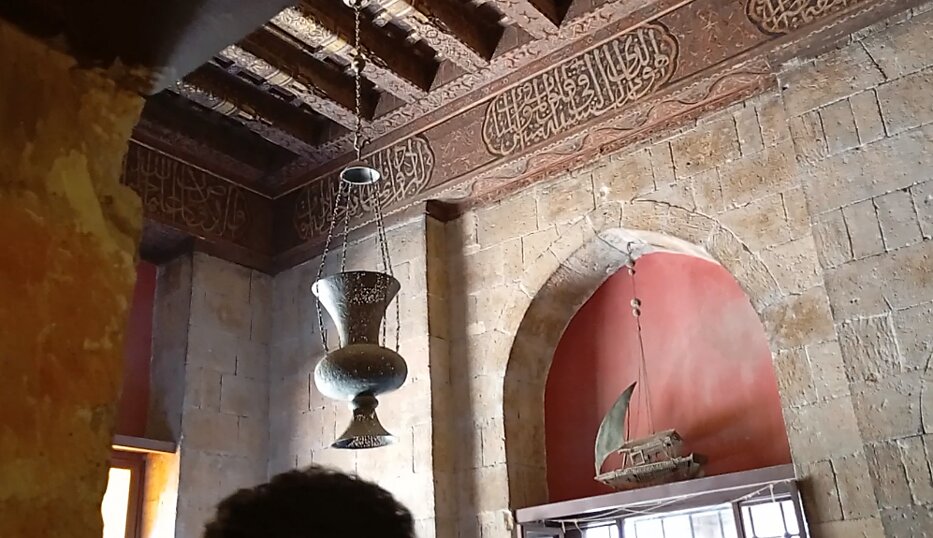
Entering the Kritliya House felt like stepping into a world suspended in time, where every room whispered stories of those who once lived there. My first stop was the Muzamillati Room—once the water attendant/ Saqi al-Sabil. Highlighting the Muzamillati is significant, as the last one in Egypt was captured by the staircase leading to the Summer Men’s Sitting Room (Salamlek) by photographer El-Wardiani whose work ranked in Wiki_Loves_Monuments_2020.
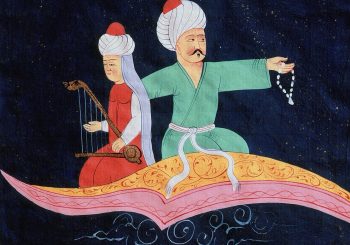
The Sabil next to it immediately hinted that history awaited just around the corner. It houses the timeless tales collected from Sheikh Suleiman, documented in Legends of the House of the Cretan Woman by Sir Anderson, who commissioned Abu Shanab to engrave them onto copper plates, each etched with the house’s legends. A few legends revolved around the Well of Bats, home to the jinn al-Watawit. One tale tells of two lovers, Lotaifa and Amin, from the separate houses, united under a full moon by the jinn. More than a source of water, the well embodies myth, charity, and imagination, still believed to reveal one’s true love on a moonlit night.
Finally, as if the house weren’t magical enough, I learned it had been a filming location, mostly in the Celebrations Hall, which unfolded like a stage, allowed me to imagine female singers performing unseen from the secret room above. From James Bond to Egyptian classics, the hall became both a domestic and cinematic landmark where myths and memories coexist.
In this moment, the past felt closer than ever — a silent dialogue between heritage and depiction.
Stepping back into the street, Cairo’s familiar noise rushed to greet me, yet something lingered. The Gayer-Anderson Museum was not just artifacts behind glass — it was a house that had invited me in, whispered its stories, and left me changed. I thought back to my first glimpse realizing I was leaving not as a tourist, but as a guest welcomed into a home where history and humanity intertwined— a dwelling stitched together, where Mamluk mashrabiyas, Pharaonic relics, and countless other layers breathe under one roof, each chamber carrying a fragment of Egypt’s soul.
This entry is a top ten place winner of Egyptian Streets’ 2025 “Timeless Tales: Cultural Heritage Writing Competition,” in partnership with FairTrade Egypt and Bibliothek Egypt. Entries featured first-person narratives of Egypt’s cultural heritage through Ancient Egypt, Coptic, Islamic, Jewish traditions, and tangible/intangible expressions. Winners were celebrated at Bibliothek Egypt in October 2025, with 13 top stories published on our platform.



Comments (0)