


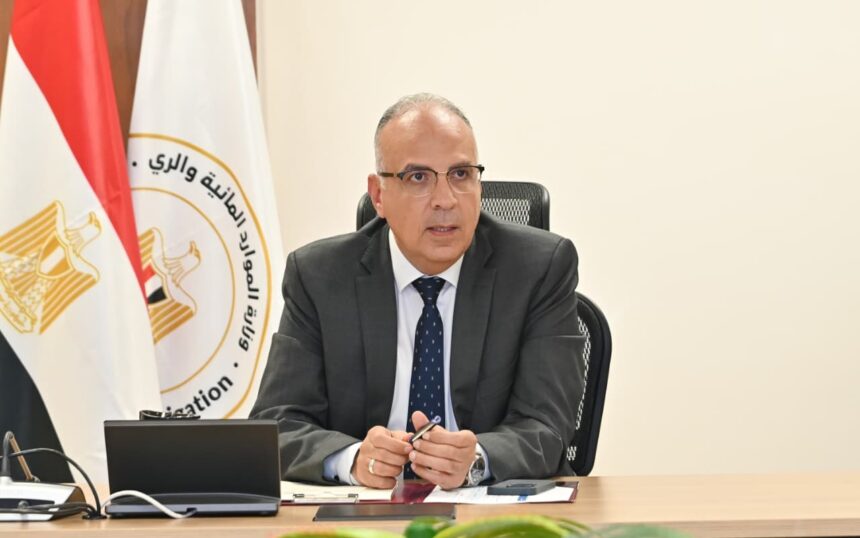
Egypt retains all measures available under international law to protect its Nile water security, Minister of Water Resources and Irrigation Hani Sewilam said on Sunday, 20 September.
Sewilam made the remarks during a media briefing organized by the State Information Service (SIS) in Cairo, attended by more than 80 correspondents representing around 45 regional and international media outlets.
He added Egypt would continue to support development in Nile Basin countries while rejecting what he described as unilateral measures affecting the river. Sewilam was referring in particular to the Grand Ethiopian Renaissance Dam (GERD), which Ethiopia built on the Blue Nile.
Sewilam said the completion of the dam and the passage of time do not mean that Egypt has accepted what it considers to be an imposed situation, adding that Cairo retains its rights under international law.
He further argued that the dam’s operation without coordination could result in sharp changes in downstream water flows, which he said could disrupt water infrastructure in Egypt and Sudan. The Egyptian government has previously raised concerns about sudden changes in Blue Nile discharges and limited access to operational data.
Ethiopia has rejected Egypt’s characterization of the GERD as an unlawful or unilateral project, maintaining that it has the right to use the Nile for development under the principle of equitable and reasonable utilization.
Why the Nile is critical to Egypt
Egypt’s water situation leaves it highly dependent on resources originating outside its borders. According to figures presented by Sewilam, more than 98 percent of Egypt’s renewable water resources come from outside the country, while annual renewable supply stands at around 56.8 billion cubic meters against estimated demand of about 123 billion cubic meters.
Per-capita renewable water availability is around 472 cubic meters a year, below the 500-cubic-meter threshold commonly used to define absolute water scarcity.
Egypt currently reuses around 23.2 billion cubic meters of water annually and is expanding water treatment, desalination, groundwater use, and digital monitoring as part of its broader water-management strategy. Sewilam stressed, however, that these measures cannot replace the Nile as Egypt’s primary source of fresh water.
The GERD was officially inaugurated by Ethiopian Prime Minister Abiy Ahmed on 9 September 2025. Ethiopia has presented the project as a major hydropower development, while Egypt has continued to call for arrangements governing the dam’s operation that it says protect the interests of downstream countries.
Sewilam said Egypt would continue to support cooperation among Nile Basin countries and seek an inclusive framework for managing the shared river, while maintaining what Cairo considers its rights and interests under international law.


Comments (0)