

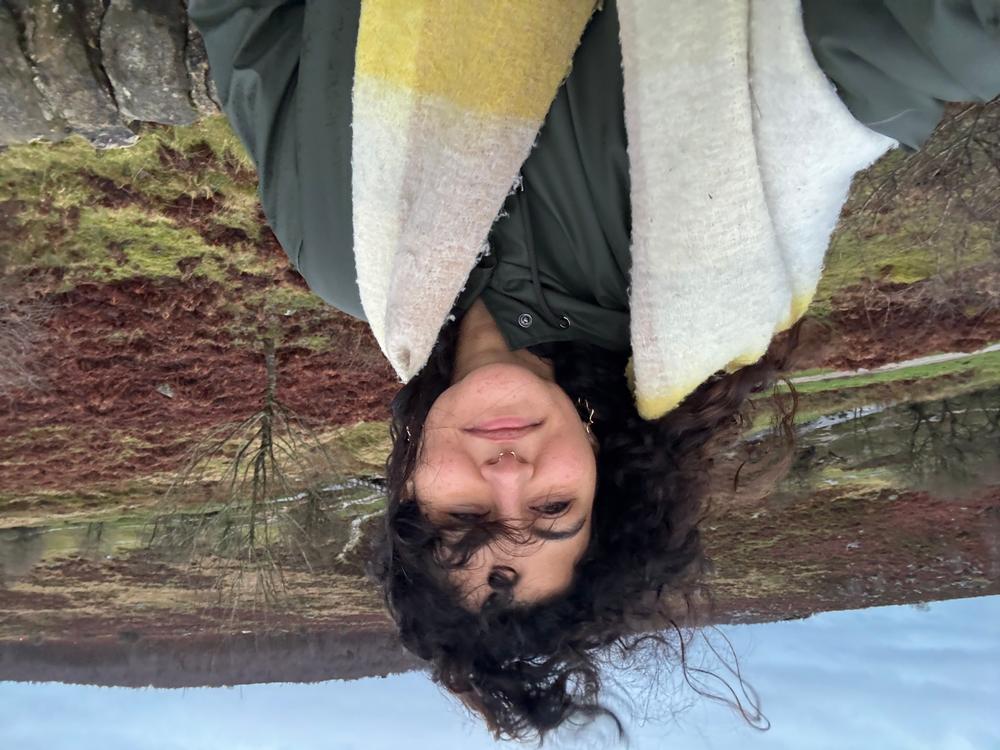
In 2009, Jameel House of Traditional Arts opened its doors in Cairo.
A two-year programme delivered by The King’s Foundation, School of Traditional Arts in London, it teaches “sacred geometry, observational drawing, colour harmony and decorative floral patterns,” alongside specialised training in ceramics, glass, gypsum, metalwork and woodwork: disciplines that, in most of the world, are treated as separate crafts with separate lifetimes of study behind them, and are in need of preserving.
In 2025, it opened its doors to me.
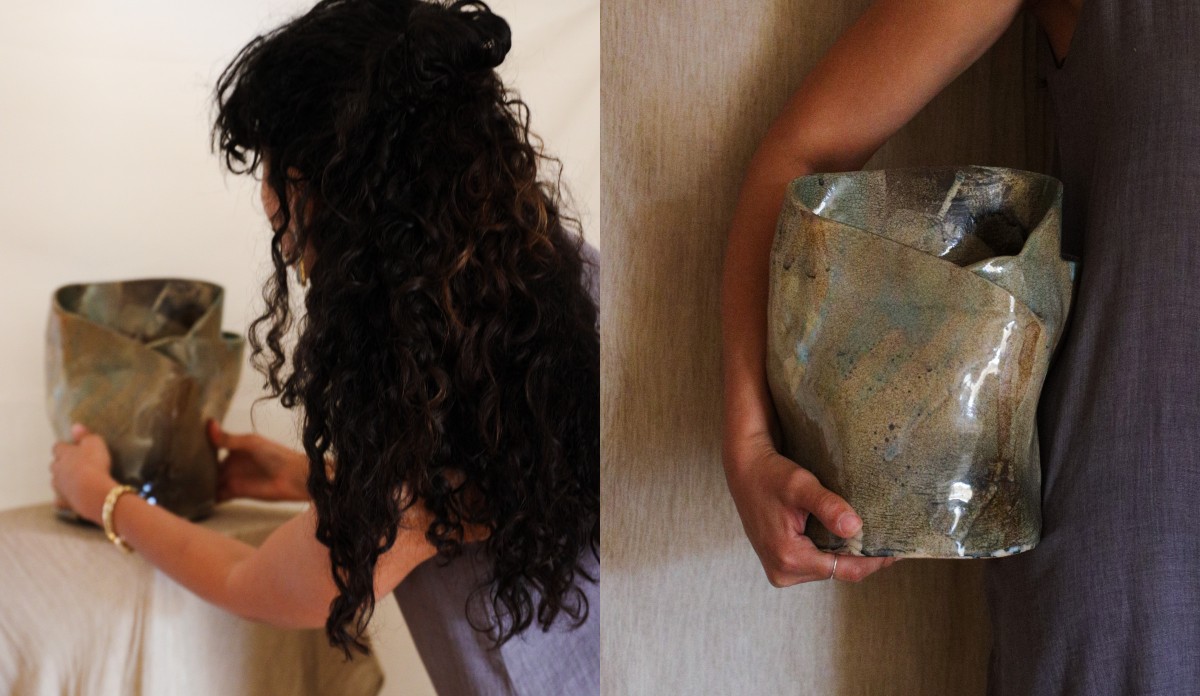
In the final interview of my application process, the admissions panel looked at my contemporary, abstract, perhaps obviously self-taught ceramics and showed me their students’ traditional projects.
“This is what we teach here,” said one of the panellists.
Leaning against the walls were panels of ceramic tiles, either cut perfectly into sacred geometric patterns or painted with elaborate floral families that have been passed down, hand to hand, for centuries.
I smiled.
All I could say was that something would come out of mixing these two worlds together. I did not know what that ‘something’ would be yet, but I wholeheartedly believed that my background in the contemporary should not keep the traditional away. It was the only truth I had. It was also, I later realised, the exact instinct advertising had spent ten years training into me: put two things that don’t belong together in a room and see what happens.
I had just moved back from the United Kingdom and stepped away from a decade after in advertising when I constantly obsessed over the next big idea, the next big win, the next big award. Brief after brief, tight deadlines, late nights, the sweet rush of an ah-ha moment, and the validation of seeing your name on an industry award. I had become addicted to the high of squeezing and pressuring the creative mind, rinsing it of its juice.
I never intended to move to the UK. I had applied for a Master’s, and winning the awards that landed the jobs in London meant a change of plan. Leaving it all behind, years later, after burnout and a disillusionment with what I had made of my life, was the start of another one.
Everything familiar collapsed, and I sat wondering what happens now. I was reluctant to make a plan. In the mysterious close, I realised that most of my plans, until that point, had truly come to me. So I embraced what the kids call ‘micro-retirement’ until a new plan came to me.
Around four months after returning to Cairo, several different people told me to apply to a school I’d never heard of. I thought, what’s there to lose?
I don’t believe that was a coincidence, or that anything ever is.
From conversations with others on the programme, it seems this school has a way of calling for you exactly when you need it. One can apply, but whether you get accepted seems to be specifically linked to where one is in life. Everyone I’ve met here is in a process of becoming.
This is mine.
Encountering the Craft
Up until I started my application, I had been struggling to label myself as an artist, and more particularly a ceramicist. Trying to answer the ever-frequent “What do you do?” was always a dance between fact and potential: “I’m a conceptual creative in advertising… well, technically, not anymore. I’m doing ceramics now.”
‘Little Stories’ is my ceramic practice, or brand in today’s language, but I had found this craft by accident. A beginner’s course a few months after moving from Edinburgh to London, sometime in 2021, continued as cheeky two-hour escapes after work, just to regulate my nervous system.
When I stopped working full-time, I opted instead for full-time studio work.
Preparing a portfolio based on the outcome of those sessions, instead of my shiny advertising book, felt jarring. It is much easier to associate ourselves with what we’re already known for, than with what we’re still becoming.
During our first Islamic Geometry class at Jameel House, we were told that in dissecting the patterns, we would enter the mind of the very first person who thought of them.
“You won’t just understand the pattern,” Mohamed El Deeb, an instructor specialising in Islamic Geometry and Gypsum, explained. “You’ll enter the mind of the very first person who thought it.”
It is easy to draw a pattern: follow the steps, arrive at the shape. The harder ordeal is understanding the philosophy underneath, seeing the map beneath the apparent endlessness, knowing exactly how it begins and ends.
Perhaps what we all seek is a level of understanding underneath whatever we do.
Advertising had taught me to ask: can you come up with a new concept? An edge that convinces differently, that makes a specific brand stand out from the noise.
Traditional art smiles and takes a deep breath. It asks: do you understand where this came from? And the importance of preserving it?
Advertising inevitably rewards the outcome. Traditional art rewards the process. These are two entirely different relationships to thinking that I hadn’t clocked, walking in, were about to challenge me.
In the beginning, it was all utterly uncreative to me. Sitting for hours just to copy a pattern someone else had designed centuries ago felt almost inauthentic to whoever I had been formed to be by a decade of chasing the new. Copying a rosette for the fortieth time offered no relief from boredom, or the sweet clicking when an idea lands.
While I still lived in London, I went to an exhibition of textile designer and poet William Morris at his house in Walthamstow. Having no real knowledge or interest in Islamic Art, it seemed I went out of some form of longing for home or identity.
Standing in his house, I remember thinking about how he had taken an art so intertwined with my identity and let it become a British fusion aesthetic, entirely his own; how you could jump off from tradition rather than simply repeat it.
This was classic advertising: take the reference, twist it, and make it new.
I came to Jameel House assuming I would aspire to modernise similarly, that my calling was to bridge towards a contemporary sensibility. It took the better part of a year to realise I had it backwards.
Tradition wasn’t waiting for me to modernise it.
It was modernising me.
It was slowing my hand and correcting my attention, changing my relationship to how I exist in the world.
The hand changes attention, which should concern all of us, now that the hand generally has a phone in it instead. You lose yourself in one geometric construction; three hours pass and you emerge changed.
The hand humbles you. You cannot demand perfection from it, or correct a mistake without leaving a trace. The focus becomes about improving every time. Slowly, you learn to value whatever level of progress a hand, on any given day, is actually capable of reaching.
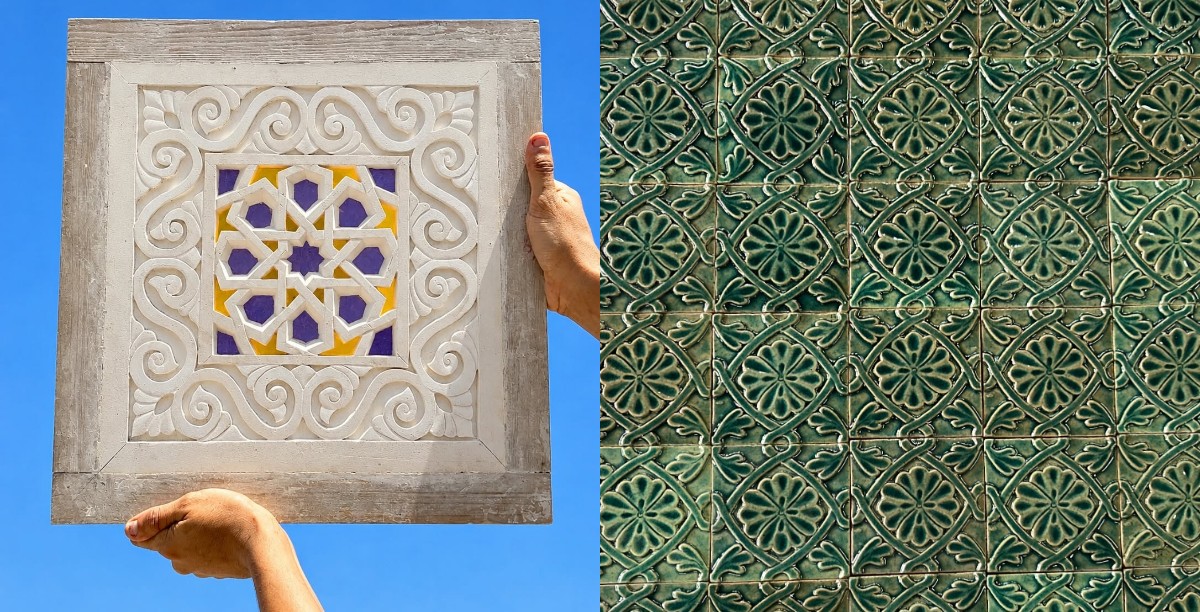
In that patience, we experience what true slowness is about, not the trending aesthetic version of #slowliving. The slowness handed to you by the material itself. You cannot rush gypsum. You cannot hurry clay.
In the making, it is a collaboration between you and the pencil, you and the medium, whether or not you were looking for it.
Somewhere in the middle of that first year, I began to see Cairo differently too.
A motif on a mihrab would stop me because I knew the name of the floral family. I could see the web underneath a pattern on a billboard stand while driving, knew how many points that star pulled from, how the strapwork behind it had been constructed, which family of pattern it belonged to.
It seemed to me like all this art that had been hiding in plain sight.
I had lived in Cairo for around eight years before spending six away, and I had been rushing past all of it. Once I saw it, I couldn’t stop seeing it.
After six years away, I returned to Cairo expecting to feel like a visitor for a while. What I didn’t expect was that a year at Jameel House would hand me a layer of the city I had never had access to in the first place.
It’s a strange kind of homecoming.
In hindsight, my first year at Jameel House transcended symmetry, geometry, and all the projects we made. It became about my entire life: the version of it I lived in London and the version that was apparently waiting for me back in Cairo, in a building in Fustat, teaching me to slow down enough to actually look, inside me and outside.
In the not-knowing, I have come closer to a form of purpose than I did in ten years of chasing certainty and stability.
This purpose is simply the curiosity to keep walking the path of finding out.
I still don’t know how I was accepted into the programme.
But I now know why I stayed.

Comment (1)
What a wonderful article!! Thank you so much for sharing your story!