


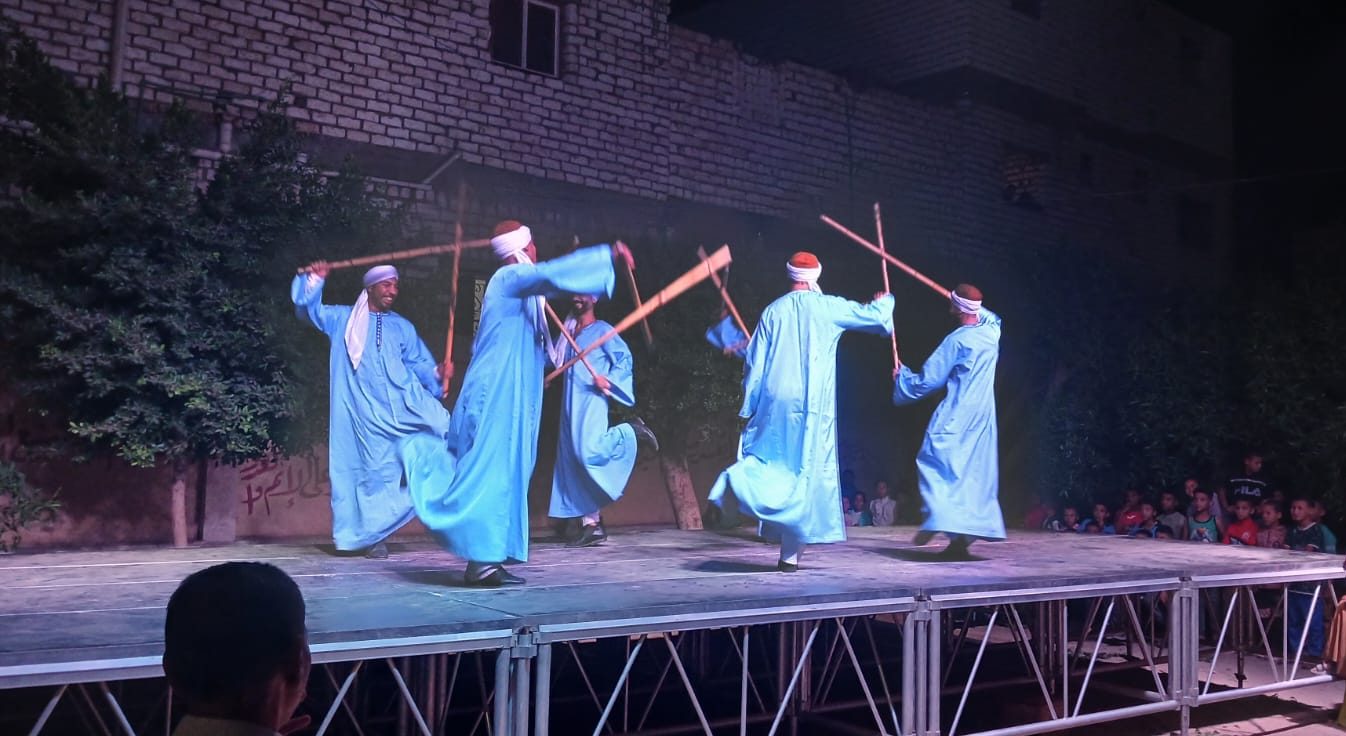
In the village of Baghdad, on the outskirts of Alexandria, a flatbed truck pulled up beside a primary school on 3 August and unfolded into a stage. A puppet show followed, then workshops in beadwork and stencil printing, and a folk-music set that drew children from nearby homes. By evening, a dusty schoolyard had become, briefly, a theater.
The vehicle is Egypt’s mobile theater, a state-run initiative to extend cultural life beyond Cairo into places that have never had a stage, a library or an art class within easy reach.
Organized by the General Authority for Culture Palaces, the body responsible for state cultural centers across Egypt’s governorates under the Ministry of Culture, the mobile theater is a truck fitted with a mechanical, fold-out stage that can be assembled in a village square or schoolyard in short order.
It travels as the centerpiece of larger “cultural caravans,” convoys that also carry puppeteers, folk troupes, craft instructors and public-health specialists to towns far from any permanent culture palace.
The program’s reach has grown considerably. Egypt’s Ministry of Culture now operates six mobile theater units covering Greater Cairo, Upper Egypt, the Nile Delta, the Suez Canal cities and the Sinai Peninsula, part of a wider network of roughly 347 culture palaces and houses nationwide.
Officials describe it as part of a broader decentralization drive, arguing that spreading theater beyond the capital strengthens social cohesion and gives young people in the provinces a space in the country’s artistic life.
Much of the truck’s recent itinerary has been tied to Hayah Karima, meaning “Decent Life,” the presidential initiative to upgrade services in Egypt’s poorest villages. Caravans built around the mobile theater have rolled through Beheira, Matrouh, Alexandria and Fayoum this year, timed to the initiative’s push into underserved rural areas.
In late March, the truck reached villages in Beheira’s Dalanjat district, where organizers said the goal was to bring cultural services to areas in most need. Activities included a talk on the basics of sign language, a talent-discovery segment, and a puppet show.
Days earlier, in a village near the coastal town of Hammam in Matrouh governorate, instructors led children through workshops in painting and cloth-doll making.
The effort has also reached remote borderlands. In April, a caravan traveled to the Siwa oasis, near the Libyan border, in an effort to nurture young talent and spread cultural awareness in frontier communities. The three-day visit combined puppet shows and talent-scouting with craft workshops, including origami, concrete art, crochet and beadwork, before moving to a nearby village to repeat the program.
The truck’s engineering owes much of its efforts to an unlikely partner. Egypt’s Ministry of Military Production helped design and build its retractable stage, according to Ahmed Awad, then head of the Culture Palaces authority, who described the project in 2022 as part of a multi-year plan to eventually reach every village in the country. He said it was also meant to double as a training pipeline, sharpening performances staged through the authority’s broader “mass culture” theater network and giving emerging talent a platform.
For now, the mobile theater’s next stops are being set village by village, following the Hayah Karima map into Delta, its western desert and its southern governorates, in a slow, truck-by-truck campaign to put a stage within reach of villages that have rarely had one.






Comments (0)