


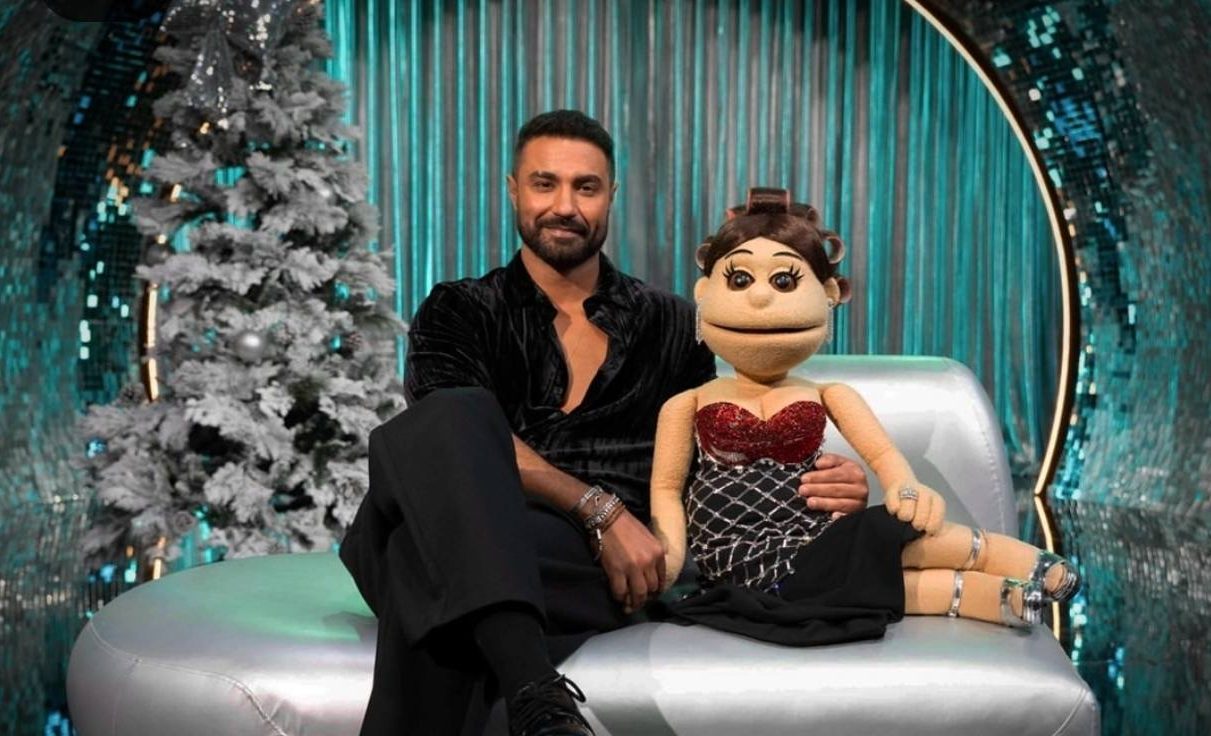
“Priority seating is for older guests and anyone with wide hips.”
Abla Fahita delivered the line into the microphone the way other hosts open a show: a quick signal that the show is about to begin, and a not-so-gentle reminder that she controls the room. It landed as a joke, but it also landed as a message. This would not be a so-polite night of scripted segments.
Her new season, titled Layla Fontastic Ma’ Abla Fahita (A Fantastic Night with Abla Fahita, 2025), did not feel like a nostalgia exercise when I attended a mid-December taping ahead of its Saturday, 20 December broadcast.
I first watched Fahita in her early online era, and I followed her later television runs, including the last episode featuring actor Karim Fahmy. This time, what stood out was how deliberately the material reflected 2025 — fast-moving, internet-aware, and tuned to the social realities people recognise immediately, sometimes with the kind of laugh that arrives half a second late because it is not only funny, but also accurate.
A new stage, a different kind of energy
The show is no longer taped at Cinema Radio, but at the Sayed Darwish Theatre in Haram, and the shift matters. A smaller theatre makes reactions contagious, silences noticeable, and audience interaction unavoidable.
It also removes some of the distance that television creates. In the current theatre, you are part of a crowd that can be heard and felt, and that changes how a performer plays the room.
Fahita leaned into that closeness of the live show. She did not simply throw punchlines and move on. The effect was that the taping felt less like watching a show being recorded and more like being inside a live performance that happened to have cameras pointed at it.
The entry rules helped create that atmosphere, as it was invitation-only, with a QR code checked at the door. Phones were collected and stored in lockers, and entry was restricted to adults. Those boundaries did not make the night feel rigid. They made it feel contained, and in that containment, the humour felt freer.
With fewer distractions and fewer limits on what the room could handle, Fahita pushed harder than what typically survives the edit.
Five hours for one hour of television
On screen, the episode later moved at a tight pace. In the theatre, the recording was a marathon — around five hours, with multiple breaks and a food truck stationed outside the theater during intermission.
That gap between what the audience experienced and what viewers later saw explained a lot about why Fahita felt sharper live. The televised hour is a carefully shaped product. The live taping is the raw material, and it includes the waiting, the resets, the repeated takes, and the improvisation that happens when a room full of people reacts unpredictably.
It also makes you appreciate how much of Fahita’s strength is not only what she says, but how she handles what happens around what she says. In a long taping, the room’s energy rises and dips. Attention drifts. People get restless. The performer has to re-grip the crowd, again and again. Fahita did that by returning to audience interaction, by treating the crowd like a character in the show, and by using improvisation as her main tool rather than a bonus feature.
An attendee I spoke to during a break described the difference simply: “It is more adult than what you see on television. It feels closer to the older days, but sharper.”
A 2025 reset, not a replay
There was nothing overtly political in the material I watched. Instead, the show moved across what has been shaping everyday life in 2025; from internet culture, celebrity life, sports chatter, to relationship dynamics people joke about because they are too familiar.
Fahita’s jokes landed because they sounded current. They reflected the kind of social reality people live inside: the pressure to look unbothered, the constant performance for other people, the fast language of online life, and the strange intimacy of knowing too much about strangers and too little about yourself.
That was the clearest link to Fahita’s early online era; the instinct to mirror the moment with uncomfortable accuracy. Back then, the humour often felt like it was moving at the same speed as the audience. Here, it felt like she was slowing down at the right moments to make people notice what they had been rushing past.
The growth of the show is also why the adult tone matters; it was direct. The room was treated like a room of adults with adult lives and adult contradictions, and the jokes were built to hit that reality rather than soften it.
Karim Fahmy, and the guest who stole the show
The live taping I attended featured Karim Fahmy, but the night’s unexpected scene-stealer was not a celebrity. Fahmy brought his mother, his wife, and his dog, Minnie with the latter quickly becoming the centre of the room’s attention. A dog on stage changes the temperature immediately; it breaks the polished rhythm of a typical guest segment and pulls the audience into the unscripted.
Fahita understood that, and she leaned into the chaos. Instead of forcing the segment back into a neat interview shape, she used the unpredictability as fuel, steering the conversation away from rehearsed answers and into live, reactive humour. In a show built on timing, Minnie’s interruptions were a gift.
By the end of the taping, I found myself with an unexpected thought: the televised version is almost the secondary experience. The night’s best element was the live exchange; the give and take between a performer who thrives on audience energy and a crowd that arrived ready to be part of the joke.
Early on, I wrote a note to myself: go with it. By the time the recording found its rhythm, the audience had found their rhythm too.
The opinions and ideas expressed in this article are the author’s and do not necessarily reflect the views of Egyptian Streets’ editorial team.
To submit an opinion article, please email [email protected].






Comments (0)