
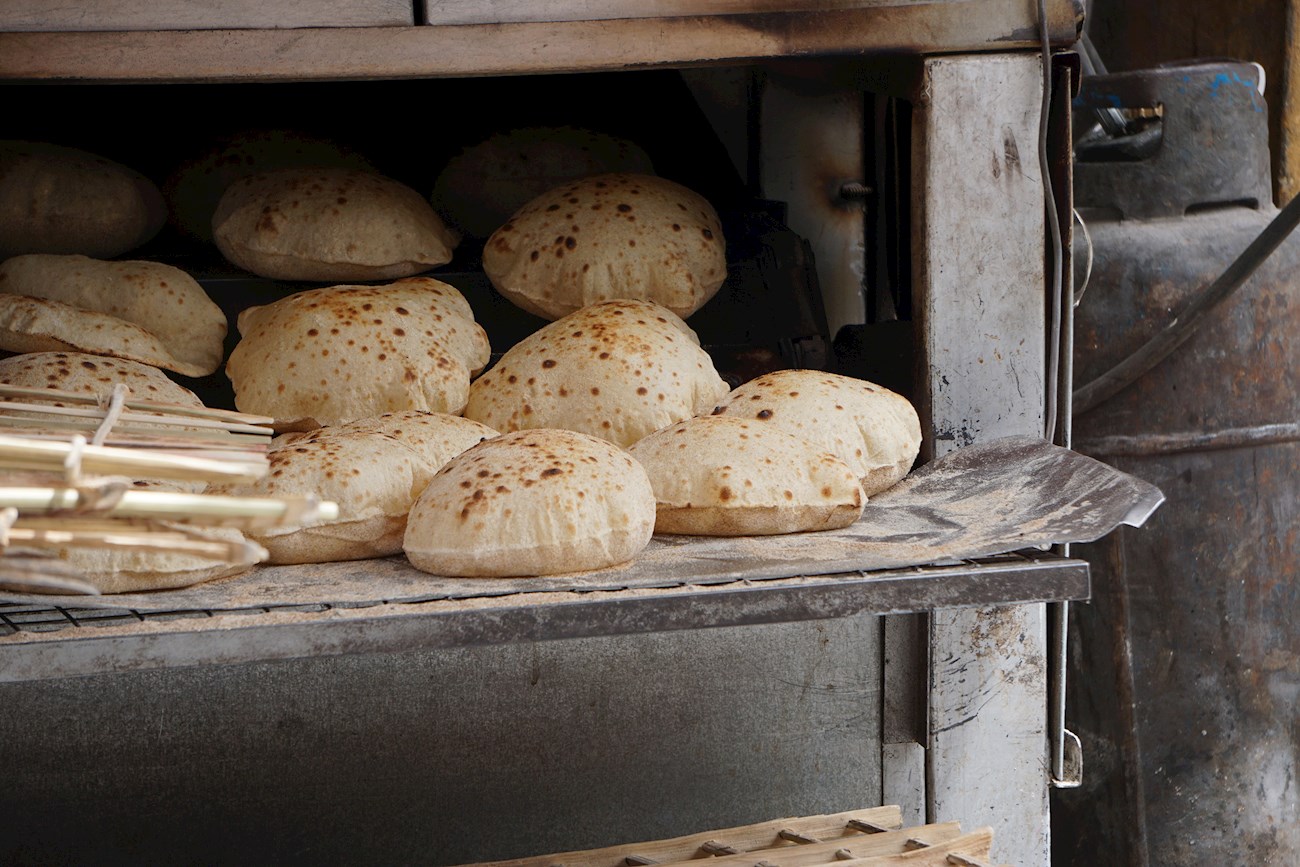
When Egypt moved to cap the price of unsubsidized bread just last week, it was not just to prevent price manipulation following a recent surge in fuel costs. Rather, it was also a response to a deeper, decades-old equation that links food, politics, and national stability.
The current price cap follows a sharp increase in fuel prices, itself linked to wider geopolitical tensions affecting energy markets. As transport and production costs rise, bread, highly sensitive to both fuel and wheat prices, becomes one of the first goods to reflect inflationary pressure.
After Egypt increased fuel prices by 10 percent to 17 percent amidst soaring inflation on 10 March, the government set clear maximum prices for “free-market” (unsubsidized) bread to stop bakeries from raising costs too fast after fuel prices jumped.
An 80-gram baladi loaf cannot exceed EGP 2 (USD 0.04), a 60-gram one is capped at EGP 1.5 (USD 0.03), and smaller sizes follow the same rule.
At a moment of rising fuel costs and regional tension, bread has once again become a frontline policy issue.
It reflects a long-standing political economy in which bread sits at the center of what scholars often describe as a “moral economy” of subsistence, which is a system where the state is expected to guarantee affordable access to basic food.
The “moral economy” of bread
Bread in Egypt is not merely a commodity; it carries the weight of its history and civilization, holding within it the imprint of Egypt’s identity and the long, unbroken story of its survival.
The Arabic word most commonly used for bread, ʿaish’, also means “life,” reflecting its central role in everyday existence. It is consumed across all social classes, anchoring meals and household budgets alike. For millions, it is the most reliable and affordable source of calories.
The cultural and material centrality has led scholars to understand Egypt’s bread system through the concept of the “moral economy,” a framework that describes the unspoken social contracts governing access to essential goods.
In this context, subsidized bread is a deeply rooted societal expectation with historical origins, integrated into the relationship between the state and its citizens. Since the mid-twentieth century, successive governments have positioned affordable bread as a cornerstone of social stability, particularly amid rapid urbanization, income inequality, and periodic economic strain.
Over time, this provision has crystallized into a widely shared understanding that access to cheap bread is a basic right of citizenship. When this expectation is threatened, it is not perceived as a technical adjustment to subsidies, but as a breach of trust.
Attempts to dismantle or scale back this system have repeatedly encountered resistance. The most famous example came under Anwar Sadat in 1977, when subsidy cuts triggered the 1977 Egyptian bread riots. Within days, widespread protests forced the government to reverse its decision.
The introduction of digital ration cards has improved targeting and reduced waste, while modest price increases, such as the 2024 adjustment to subsidized bread, have signaled a willingness to recalibrate the system.
Why the current pressure is different
What makes the current moment particularly fraught is not a single crisis, but the convergence of multiple external shocks that are compounding one another.
Egypt’s bread system, already structurally dependent on imports, has become increasingly vulnerable to disruptions originating far beyond its borders.
As the world’s largest importer of wheat, Egypt relies heavily on global markets to sustain its domestic food system. The outbreak of the Russia–Ukraine War was especially consequential, as both Russia and Ukraine had long been among Egypt’s primary wheat suppliers.
The war disrupted supply chains, constrained exports, and sent global wheat prices soaring. For Egypt, this translated directly into a sharply higher import bill, placing immediate strain on state finances and subsidy programs.
Yet the pressure did not end there. More recent regional instability, ranging from recent tensions affecting key maritime corridors to fluctuations in global energy markets, has introduced a second layer of stress.
Keeping bread subsidized under pressure is essentially a matter of shifting the burden away from consumers and onto public finances, state institutions, and, at times, other parts of the economy. At the most direct level, the government absorbs rising costs through the budget.
The key question is: where does the funding come from? In short, it is drawn from the state budget. Egypt allocates billions every year to food subsidies, with bread alone accounting for a substantial portion, costing the government billions of dollars annually.
To afford this, the government may reallocate spending from other sectors, reduce the number of people eligible over time, or slightly increase prices, like the 2024 price hike.



Comments (0)