


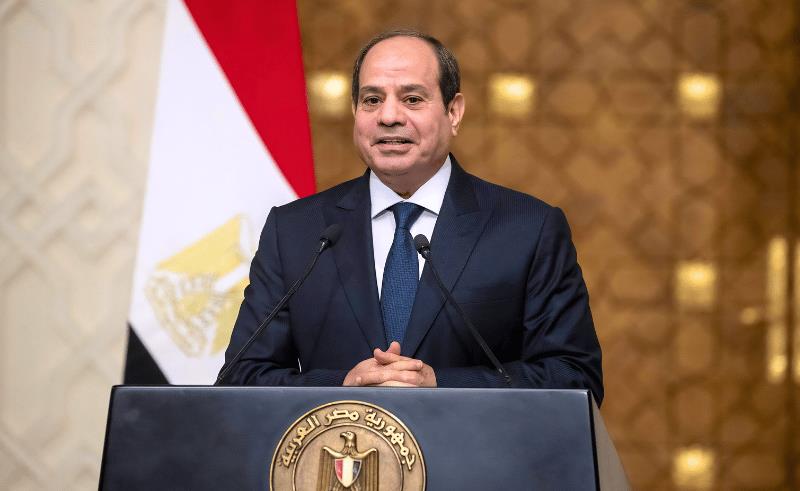
Egypt’s President Abdel Fattah Al-Sisi has issued a presidential decree authorizing the Defence Minister and the Minister of Military Production to exercise certain powers assigned to the President under Egypt’s conscription and general mobilization law.
The decree, bearing number 395 of 2026, stipulates that the Defence Minister and the Military Production Minister are delegated the specific presidential authorities set out in Articles 9, 12, and 24 of Law No. 87 of 1960 on general mobilization.
The delegation is set to run for one year, starting from 1 November 2026.
In a phone call to the TV program Ala Mas’ouliyet (Under my Responsibility), which aired on Sada El Balad, Lieutenant General Mohamed El-Ghabary, former director of the National Defence College, explained that the move is a legal and administrative procedure that is routinely repeated when a new Defence Minister assumes office.
He said the delegation is not a new measure tied to an exceptional or emergency situation, but rather a step based on the legal framework, with the President delegating certain responsibilities to the Defence Minister in accordance with the relevant texts.
El-Ghabary added that the delegation does not mean Egypt is announcing a change in its general mobilization status.
He further clarified what general mobilization entails, noting that the structure of national forces in peacetime relies on active-duty forces and reserve forces. Mobilization, he said, is the mechanism used to complete the required strength of the Armed Forces to the intended level.
According to El-Ghabary, each country’s peacetime force level is different, and mobilization is used to bring the forces up to the needed strength.
Discussing how mobilization relates to peacetime, El-Ghabary said it is tied to continuous training and to the need for units to complete their force levels during military projects and exercises.


Comments (0)