
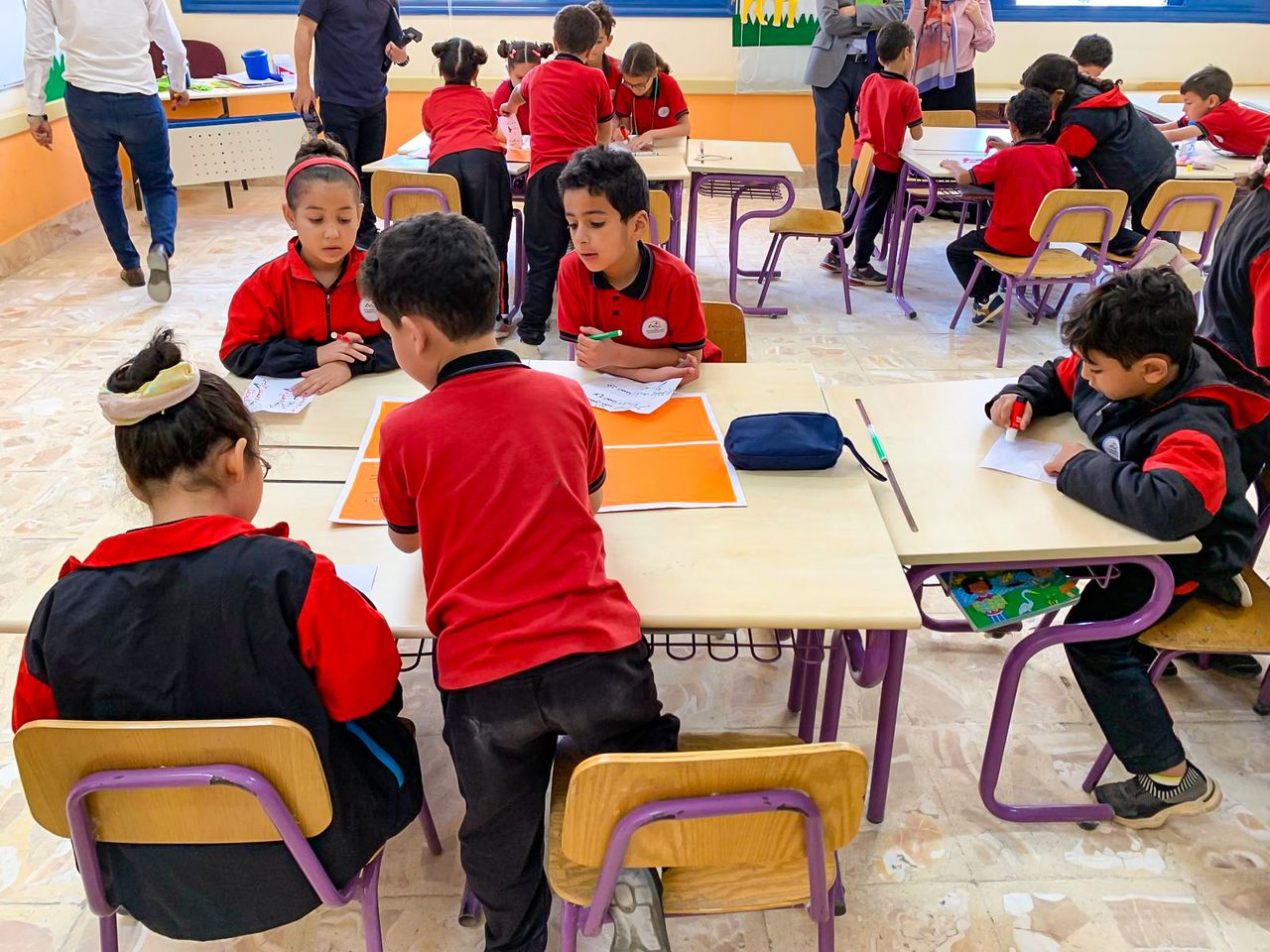
In a country where public school classrooms are often overcrowded and dominated by rote memorization, Egypt has been experimenting with a new model of education, inspired by a country far beyond the North African region. Over the past decade, under a bilateral pact with Japan, the Egyptian government has launched a network of “Egyptian-Japanese schools” aimed at fostering academic prowess and emotional resilience, teamwork, and daily discipline — hallmarks of Tokyo’s renowned education system.
As of early 2025, these institutions number 55 across the country, enrolling some 16,000 students, mostly from middle-class families seeking an affordable upgrade from overcrowded public options.
The initiative traces its roots to a 2016 state visit by President Abdel Fattah Al-Sisi to Japan, where he and former Prime Minister Shinzo Abe unveiled the Egypt-Japan Education Partnership. This collaboration sought to infuse Egypt’s beleaguered school system, criticized for its emphasis on test-cramming over critical thinking, with elements of Japan’s “whole child” philosophy.
Folded into the Education Ministry’s sweeping “Education 2.0” reform, launched in 2018 and slated for full rollout by 2030, the program aligns with the nation’s Egypt Vision 2030 blueprint for socioeconomic renewal.
By blending Japanese methods with the Egyptian national curriculum, these schools offer instruction in English, all while capping classes at 35 to 40 students.
At the heart of this model lies “Tokkatsu,” shorthand for “tokubetsu katsudo,” which means special activities, which prioritize interpersonal skills, emotional maturity, and collaborative habits alongside core subjects. Students engage in daily rituals like classroom cleanups and group chores to teach hygiene, responsibility, and peer cooperation — practices drawn from a system that boasts a 99 percent literacy rate for those 15 years old and older, and ranks eighth globally in the public education system, per a 2021 survey by U.S. News & World Report.
Egypt, by contrast, placed 39th in the same ranking, highlighting the urgency of reform. Though Japanese is absent from the syllabus, the approach, backed by the Japanese International Cooperation Agency (JICA), cultivates “socially adjusted” learners through these immersive exercises, free from the national curriculum’s heavier reliance on drills.
Aimed at middle-income families, the schools offer an education considered better than public options, yet more affordable than most elite private schools.
The annual tuition averaged EGP 18,650 (USD 393.3) for the school year 2025-2026, not including the school uniform or textbooks. The fees may be paid in three installments: the first within a week of the child’s acceptance, the second in November, and the final in January.
Meanwhile, private schools’ tuition fees in 2025, whether Arabic or English-track, range from EGP 5,000 (USD 105.4) to EGP 35,000 (USD 738), while international schools can cost up to EGP 450,000 (USD 9,490) per year.
JICA’s role goes beyond pedagogy. Since 2018, the agency has provided roughly EGP 26.1 billion (USD 550.4 million) in grants and loans, including EGP 7.5 million (USD 158,168) in 2019, to build and equip these schools. Thousands of Egyptian educators have traveled to Japan for hands-on training on tokkatsu.
Looking ahead, the plan is ambitious: the country aims to establish 100 Japanese schools, upgrading select public schools along the way, with a long-term goal of 500 nationwide to ease overcrowding in underserved governorates.


Comments (0)