
It only takes one call for prayer, or al-athaan in Arabic, to make one pause, even for a millisecond. And in that small millisecond, no matter how small or how minor it is in the large sea of hours in their day, one remembers to pray, remembers to recite a simple verse, and sometimes, even remembers a small glimpse of their connection with God.
At times, the athaan is rarely heard. At other times, particularly during the hours of dawn when most people are still asleep, it is easier to pay more attention to the sound and the melody, and the emotion that the reciter puts into such a simple call for prayer.
You feel the emotion, the emphasis of certain words or phrases to glorify God, and how, from its beginning to its end, the emotions of the words flow together like a wave, taking you from one moment of alertness to another moment of feeling humility and grace. From glorifying Allah, to then feeling reflective over the greatness of God.
We live in such a fast-paced world that even pausing to hear the emotion behind the reciter, or the call to prayer itself, has become rare. Our nervous systems have grown accustomed to a constant state of restlessness, as most of the time we feel as though we are always chasing time just to get everything done.
But, in the athaan and Quranic recitations, time is neither chased nor controlled, and it often feels as though time does not exist at all. For a brief moment while listening to a Quran reciter, time becomes a stranger, because the reciter is not trying to rush through the recitation or keep up with time; the reciter is completely immersed in the words of the Quran, swimming in its vastness and depth.
As Ramadan quickly approaches in mid-February, there is no better time than now to reflect more slowly and intentionally on the beauty of recitation, and why it has always played such a huge role in the lives of many Muslims.
An Ocean of Words
Nearly every young Muslim carries a vague memory of their parents, particularly their mother, placing her gentle, warm hands on their forehead as they drifted to sleep, while softly reciting the Quran.
As a child, you did not need to listen closely or understand every single word; simply hearing the voice and listening to the words flow over one another was enough to make you fall asleep almost instantly.
There is a brief pause, then a long stretch of a verse, followed by another pause, and then another long repetition. Much like the waves of the ocean that follow their own rhythm, there is a verse in the Quran that itself metaphorically compares the ink used to write its verses to the ocean, as it says, “Say, [O Prophet,] ‘If the ocean were ink for ([writing] the Words of my Lord, it would certainly run out before the Words of my Lord were finished, even if We refilled it with its equal.’” (18:109)
I always read this verse and wondered why the ocean, in particular, was used to quantify the words of the Quran. What makes the ocean so different and so symbolic in this specific context? Itt turns out that, as researchers of Quranic recitation note, the Quran was never meant to be understood or read merely as written text, as many Western scholars tend to place heavier emphasis on analyzing the meaning of the written verse itself.
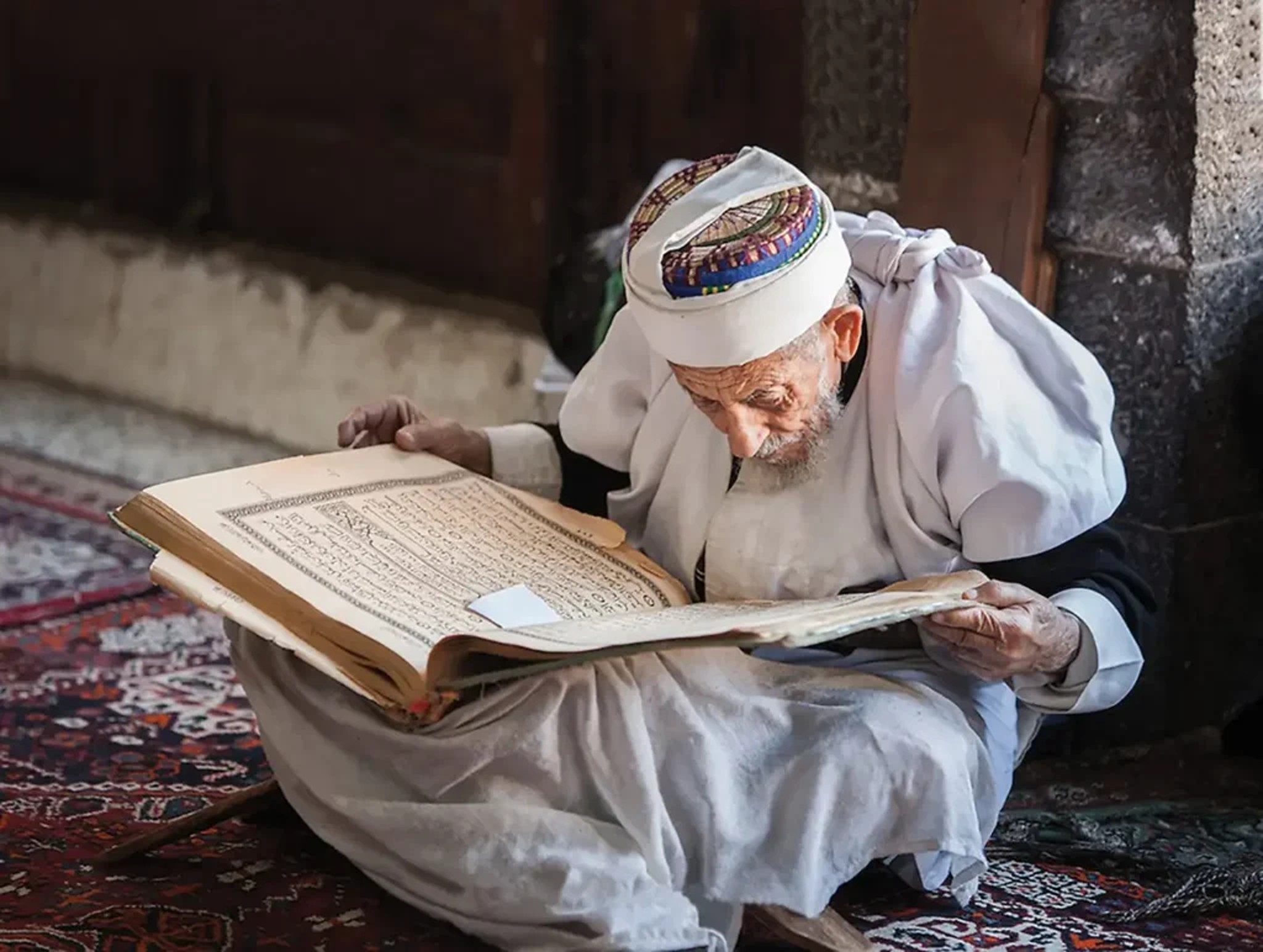
In actuality, from its very beginnings, the Quran was meant to be recited and listened to with all of our senses, not just with our eyes that read, because it is through recitation that one begins to uncover the many different meanings within a single verse, even in the way a single pause, or a single repetition, can shift or emphasize an entirely new meaning.
Much like how the ocean can never truly be understood through our eyes alone, one has to dive into it completely and feel the depth of its many waves and layers, which could never be felt or seen from the surface.
When Prophet Muhammad first received the revelation of the Quran, his inability to read or write meant that recitation became one of the most powerful and widely used ways to spread its message.
The Quran was often mastered through careful memorization and devoted practice in oral performance, and in this way, it also carried a message of inclusion and accessibility, allowing people from different backgrounds, including those who could not read or write, to listen to the Quran and still feel its depth without ever having to pick up the book itself.
It is why there has always been a rich history of blind reciters of the Quran, and why many of them became the most well-known, because they recited the Quran with a depth of sensitivity that only someone who sees with the heart, and not the eye, can truly reach.
Historically, many renowned reciters were blind, as visual impairment often led to a heightened focus on listening, memorization, and recitation, particularly in the early 20th century, when blindness did not hinder their connection to the Quran, but in many ways deepened their devotion to it.
Egyptian reciter Sheikh Muhammad Rifat, for instance, lost his eyesight at the age of two due to an infection. Despite this, he memorized the entire Quran by age ten and became one of the most influential reciters in modern Islamic history. Known for his powerful voice and precise Tajweed, the Islamic art of beautifying one’s recitation of the Holy Quran, he was the first reciter to recite on Egyptian Cairo Radio in 1934.
Another prominent blind reciter is the pioneering female reciter Sheikha Munira Abdou. Rising to prominence in the 1920s and 1930s, she made history in 1934 at the age of 32 by becoming the first woman to recite on Egyptian national radio. As both blind and a woman, she was permitted to recite at women’s funerals, a space that ultimately helped establish and legitimize the profession of female sheikhas in Egypt.
Today, a new Quranic recitation competition program is airing on CBC channel, an Egyptian satellite TV network, nurturing a new generation of reciters tasked with protecting the legacy of Egypt’s great voices and reviving the Egyptian school of Quranic sciences. The program also highlights many blind reciters, a reminder of how religion, at its core, is meant to be accessible to all, including those who cannot read or write.
From the call to prayer of the athaan, to our mother’s nighttime whispers of recitation, to our own verses repeated in the heart when we are anxious, depressed, or even happy, the beauty of reciting the Quran lies in how the words, like the ocean, become embodied within the body and memory.
Much like the ocean that surrounds you and pulls you into its deepest depths, the reciter carries the words within themselves and lives alongside them. No matter the day or the time, the Quran becomes ingrained in one’s life and in its smallest moments, a constant remembering of God’s presence, even through the simplest verse.
The opinions and ideas expressed in this article are the author’s and do not necessarily reflect the views of Egyptian Streets’ team.





Comments (0)