


Just days before Morocco’s World Cup 2026 clash with France, many media outlets focused on one of the tournament’s biggest talking points: French-born midfielder Ayoub Bouaddi’s decision to turn down France and represent Morocco, the country of his family’s roots, instead.
Whenever Morocco takes the field, there is always one statistic that is almost always brought up by every commentator. Nineteen of the squad’s 26 players were born outside Morocco, meaning roughly 73 percent of the team comes from the Moroccan diaspora, and only seven players were born in Morocco itself.
The question that follows is almost always, “Why did they choose to represent Morocco instead of the European countries where they were born?”
Yet instead of asking what motivated their choice, perhaps the more important question is, “What does this tell us about the role of the diaspora in giving back to their countries of origin?”
When Dutch football legend Marco van Basten labelled Hakim Ziyech “stupid” in 2016 for choosing to represent Morocco over the Netherlands, few could have predicted how symbolic those words would become.
A decade later, Morocco eliminated the Netherlands in the Round of 32 at the 2026 World Cup, in a full-circle moment that underscored the power of the diaspora. It proved that where someone grows up does not determine where they can make an impact.
And perhaps even more importantly, it challenged the long-held belief that members of the diaspora are defined solely by the countries they were born in and the identities they inherited there. It pushed back against the idea that modern identity must be singular, fixed, and confined to one passport or one nation.
Growing up abroad does not mean someone cannot also choose, willingly and meaningfully, to contribute to the country they feel connected to. Morocco is not simply “importing” players from overseas; these players are making a conscious decision to represent Morocco and give back to the country that forms part of their identity.
In doing so, they are creating their own model of belonging and representation, one that challenges the idea that identity must be confined to one place. Even if this understanding is not yet fully recognized by those who view identity as something permanent and unchanging, the Moroccan model demonstrates how national belonging can evolve across borders.
At the same time, these players represent the success of Morocco’s broader investment in developing its football ecosystem, from domestic infrastructure to professional structures such as the Mohammed VI Football Academy and the wider federation system.
Watching the victory feels even more emotional because it no longer represents a win on the pitch alone. It becomes a victory for the Moroccan families who made many sacrifices to create better futures for their children, and whose efforts have, in many ways, come full circle as those children give back to the country of their heritage.
It feels like a victory for the years of struggle, the tears shed, and the sacrifices made beyond the football pitch by Moroccans who continue to strive to build a future while carrying the painful weight of their history.
The Moroccan players were not thinking only of themselves. They were thinking of their parents, the sacrifices their families made, and the generations that came before them, whose lives and stories together shaped the nation they now represent.
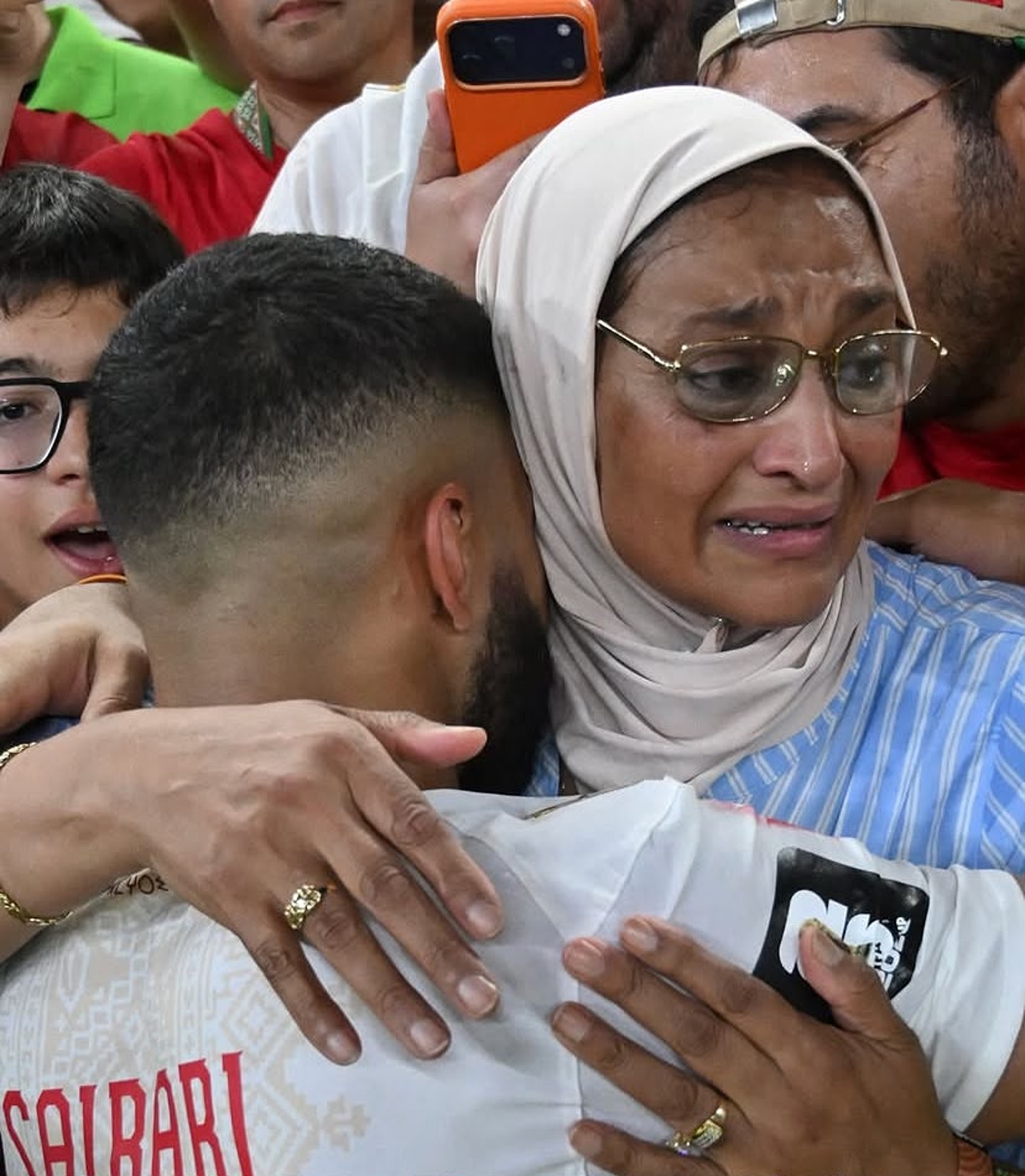
Perhaps no moment captured this more beautifully than the image of Morocco’s hero, Ismael Saibari, embracing his tearful mother after the final whistle of Morocco’s victory over the Netherlands. The embrace quickly spread around the world because it came to symbolize something much larger than football.
It showed that every achievement is built upon the sacrifices of those who came before us, and that for many in the Moroccan diaspora, representing their country also means honoring their parents, their families, and the generations whose dreams made their own possible.
As Morocco captain Achraf Hakimi has often described it, representing Morocco was “the choice of the heart.” It is a sentiment that has been echoed by many members of the Moroccan diaspora, who see their decision not as a rejection of another country, but as an affirmation of their identity and roots.
They do not play with their feet alone. They play with their hearts.
The opinions and ideas expressed in this article are the author’s. To submit an opinion article, please email [email protected].



Comments (0)