


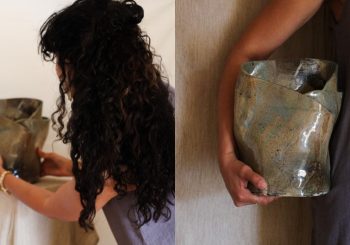
Pit-firing leaves smoke traces on ceramic pieces, giving them a look of antiquity, a texture, and causing variations in colors— elements that Salha Al-Masry loves to incorporate in her work.
Al-Masry has been an art critic and visual artist for almost two decades. She graduated from the Faculty of Art Education in 2004 and went on to earn both a Master’s and a PhD in Philosophy of Art. From 2007 until around 2022, she wrote critiques for magazines such as Al-Thaqafa Al-Jadida (New Culture), Al-Khayal (Imagination), Adab wa Naqd (Literature and Criticism), and Al-Bayt (Home), analyzing the Egyptian visual art scene and reflecting on its evolving forms.
Years of studying ancient forms and exploring historical scripts shaped her work up until her visual criticism intersected with hands-on creation.
“I started with criticism and writing,” Al-Masry told Egyptian Streets. “I wanted to understand and read the visual arts scene. But eventually, I realized I needed to work directly with the materials, to create, experiment, and produce pieces that could communicate beyond words.”
Her journey into ceramics began as an experiment in reinterpreting the pottery of ancient Egyptian history. Heavily influenced by inscriptions and writings, she applies hieroglyphic writings on the surfaces of her pieces to highlight that modern and ancient Egyptians share roots.
“Ancient scripts are a bridge between civilizations. No matter our differences, in shape, religion, or culture, these scripts remind us of our shared origins,” she explained.
Al-Masry’s influences further extend beyond ancient Egypt to the everyday life of the pottery village, where she observed and learned from local artisans.
Her focus completely changed during the isolating days of COVID-19. She visited the Fustat Pottery Village in Old Cairo daily, photographing workshops, narrow alleys, and old buildings.
“I was passionate about photography,” she said, “but eventually I wanted to create myself. The craftsmen were patient, and I learned to link traditional techniques to my vision, applying old writings and pit firing to produce pieces that felt alive with history.”
She practiced wheel-throwing, hand-building, shaping, and firing under the guidance of village craftsmen. Pit-firing became her favorite technique, dating back to the Predynastic Period, 4400 BC.
Ancient Egyptians would place pottery in pits, cover it with organic materials, and fire it, which leaves distinctive smoke marks on their pottery. Initially functional, these effects evolved into aesthetic choices in later Egyptian eras, which is a transformation that fascinated Al-Masry.
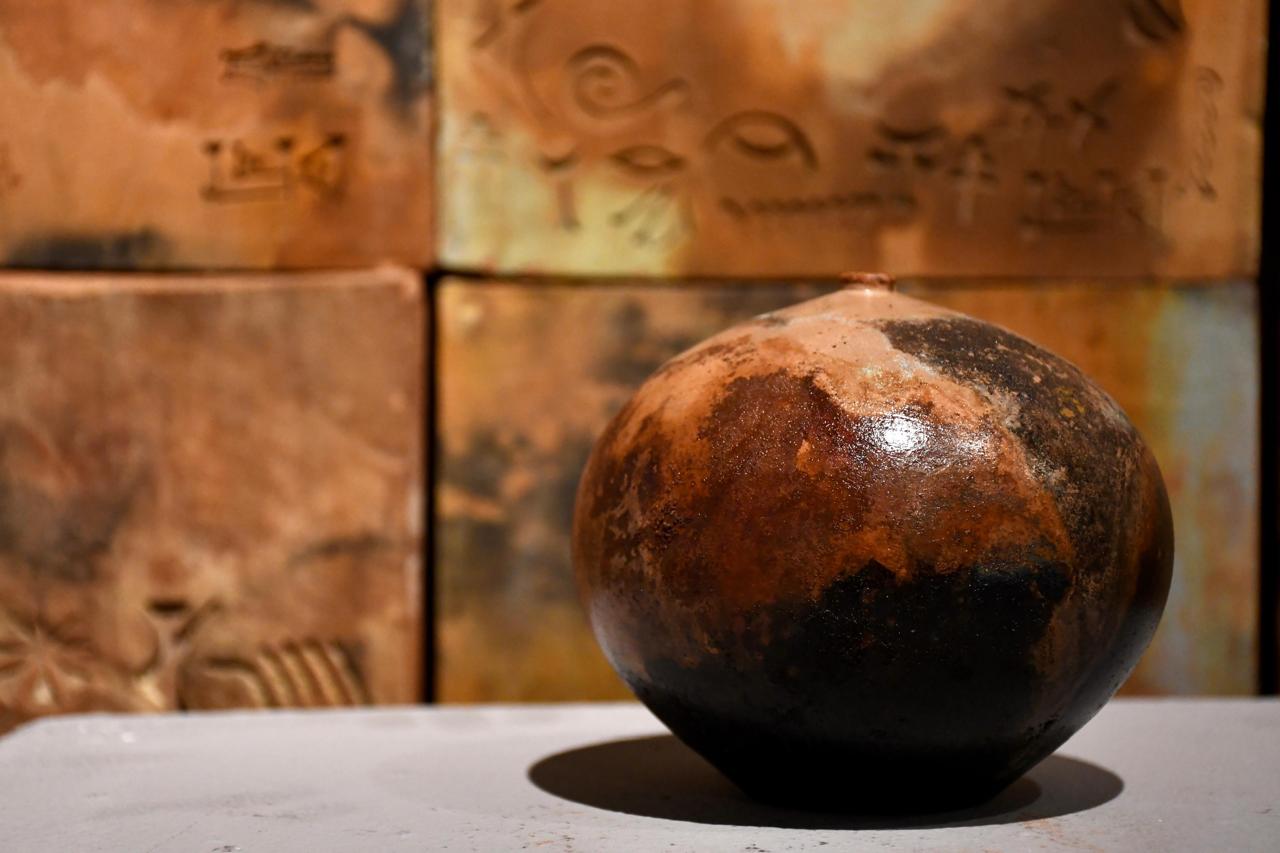
“What amazes me is how the marks left by fire and smoke, originally practical, became a form of artistic expression,” she said, noting that she wanted to bring that idea into her work and to create pieces that show history while telling a new story.
“The pieces look as if they had come out of a tomb or a museum,” she marveled.
Her first ever exhibition was in 2024, held at Salah Taher Hall in Cairo Opera House. It introduced the public to her approach, combining ancient forms with contemporary presentation, and received a positive response.
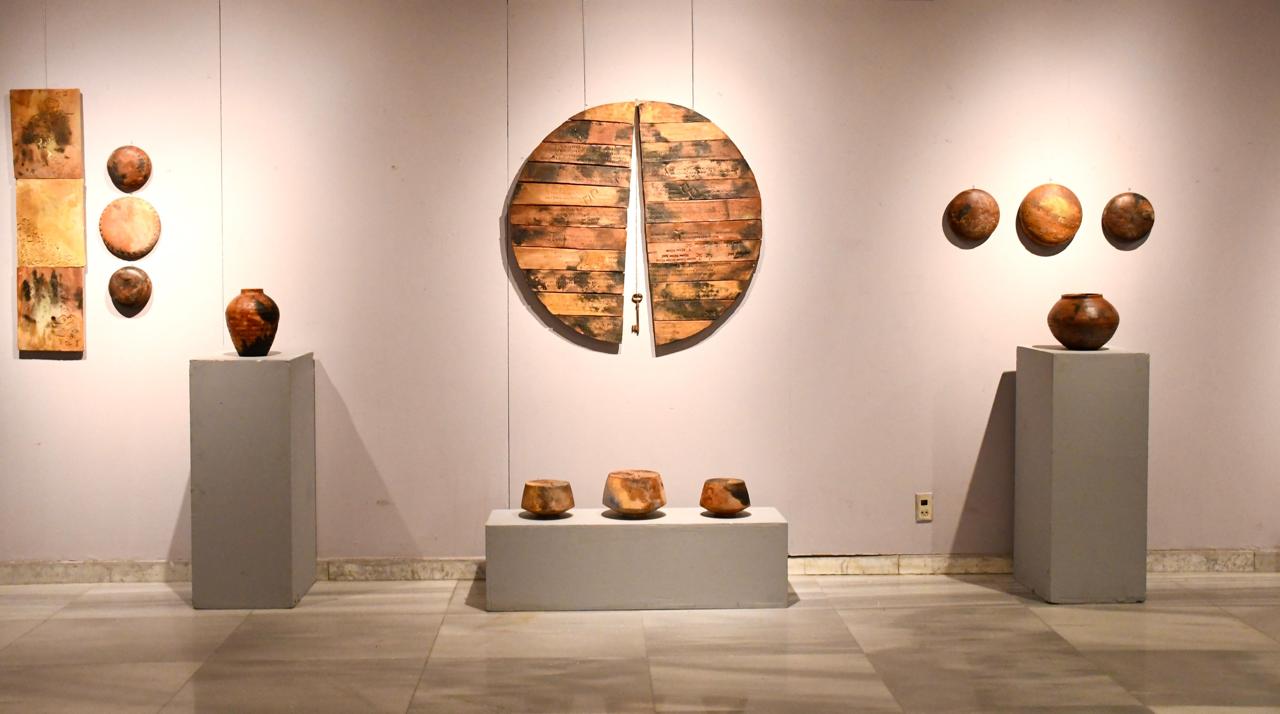
“The audience realized that this kind of intricate work is not limited to museums or traditional museum displays. It can be owned, and it can also be viewed in contemporary, non-traditional exhibition spaces,” Al-Masry told Egyptian Streets.
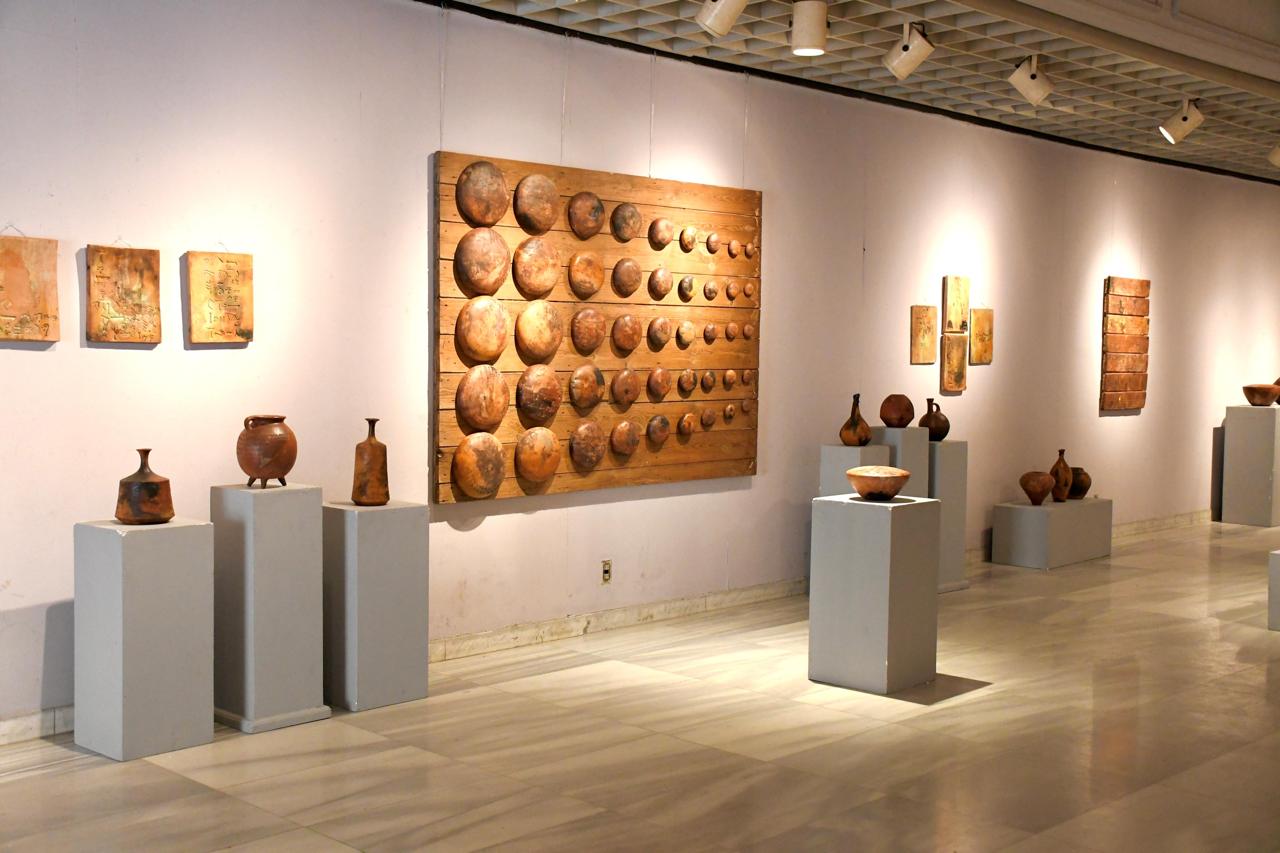
Al-Masry held her second exhibition in the same venue in 2025, displaying artwork that focused on installation and spatial storytelling.
She used ceramic forms as they exist in ancient Egyptian history and reinterpreted or reshaped them within a specific space to create a new concept and communicate new narratives. Her reinterpretation of amphora, canopic jars, and stelai garnered admiration from visitors.
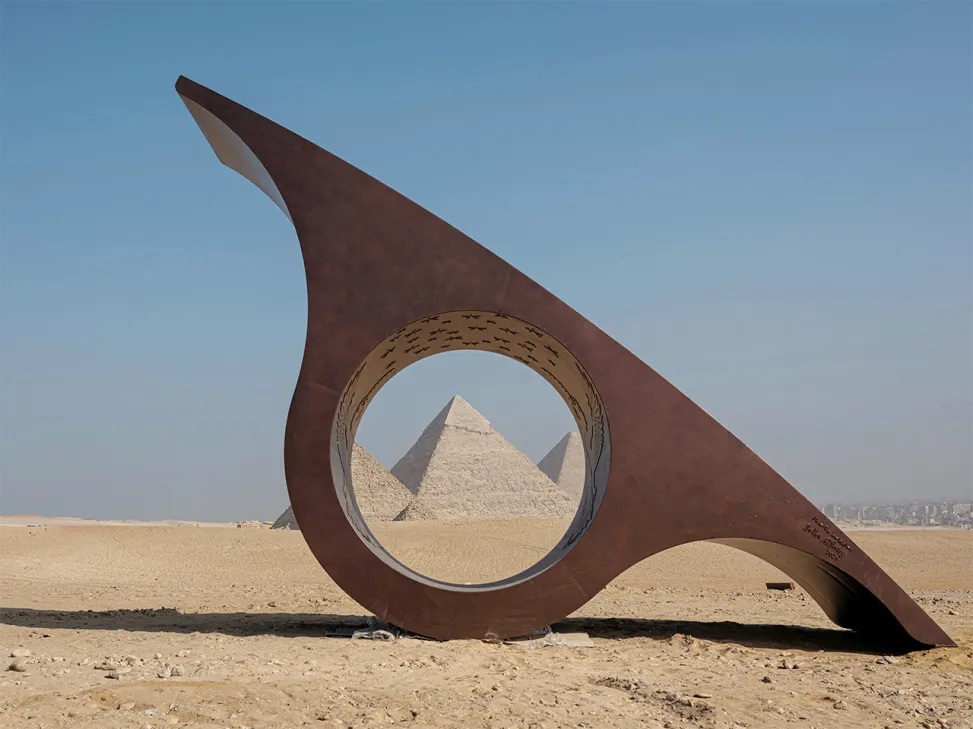
One of her standout works, “Ma’at,” was created for the fifth “Forever Is Now” exhibition, held from 11 November to 6 December.
She represented Egypt alongside nine artists of varying nationalities, including Italy, Portugal, Russia, Brazil, Turkey, Lebanon, France, South Korea, and the United States of America.
Ma’at, a large seal ring, is named afterthe goddess of ancient Egypt, and conveys concepts of truth, justice, balance, and honesty. It draws inspiration from Egyptian funerary traditions and incorporates inscriptions from the ancient Egyptian funerary text, the ‘Book of the Dead.’
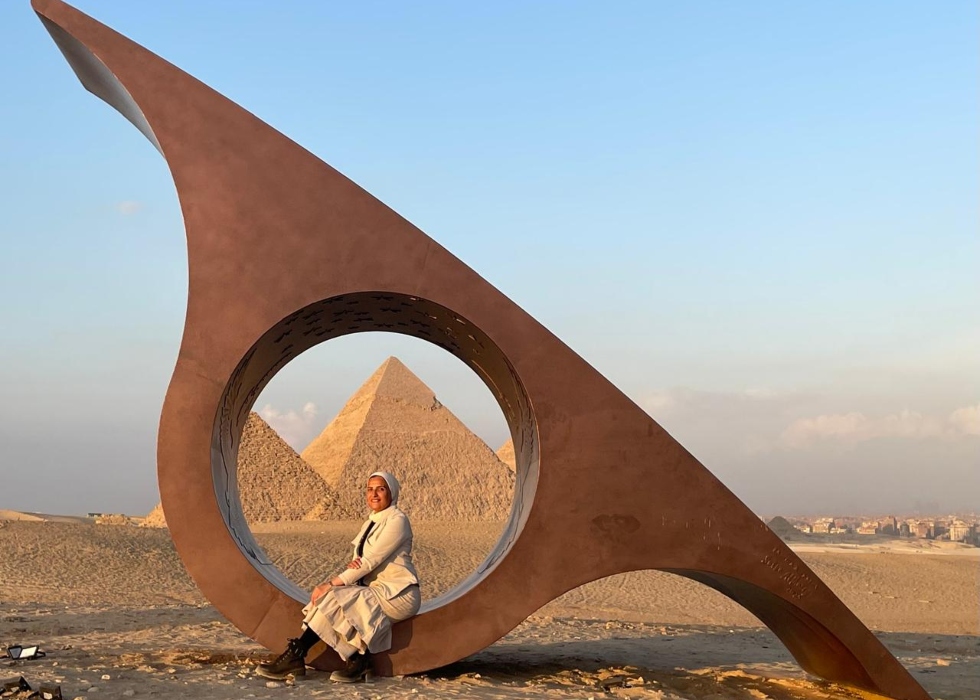
Building on these traditions, the piece’s circular form reflects the ancient Egyptians’ belief in life after death and resurrection.
It is meant to symbolize the scale with which Ma’at weighs the deceased’s heart against a feather to determine their fate in the afterlife, representing the boundary between life and eternity. The seal ring also features inscriptions on its inner surface, and its upper part suggests the shape of a bird’s head, reminiscent of the solar deity Horus in ancient Egyptian art.
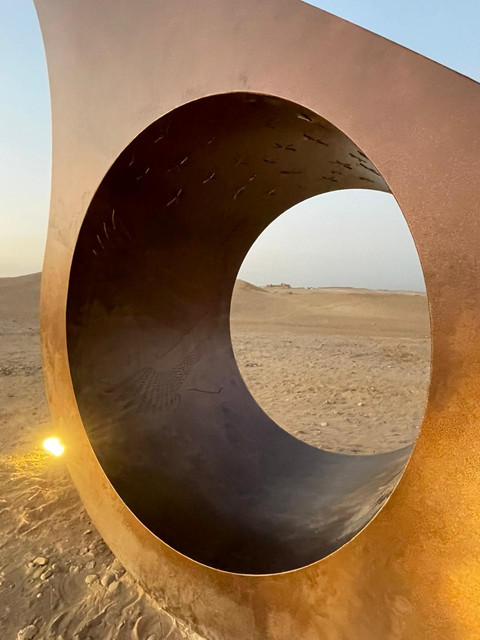
“The ceremonial ring is a symbol of authority and a gateway to another world,” she said, noting that it invites reflection on concepts and human values, creating space for dialogue — a goal she tries to achieve in her work and a metric with which she measures success as an artist.
Visitors to ‘Forever is Now’ received the piece as intended by Salha.
Its connection to ancient Egyptian history reached audiences without words, without philosophy, and without explanation, according to Al-Masry.
“When a piece resonates without explanation, that is success,” Al-Masry said, explaining that the reward of creating art is for viewers from different backgrounds to intuitively engage with her work, understand its symbolism, and connect to its history and aesthetics.
Currently, Al-Masry is preparing for her next exhibition, which will continue to explore her three guiding axes: ancient forms, inscriptions, and pit firing.
She hopes to showcase her new work at the Egyptian Museum in Cairo, continuing her mission to reinterpret the past while creating accessible, engaging art for contemporary audiences.



Comments (0)