


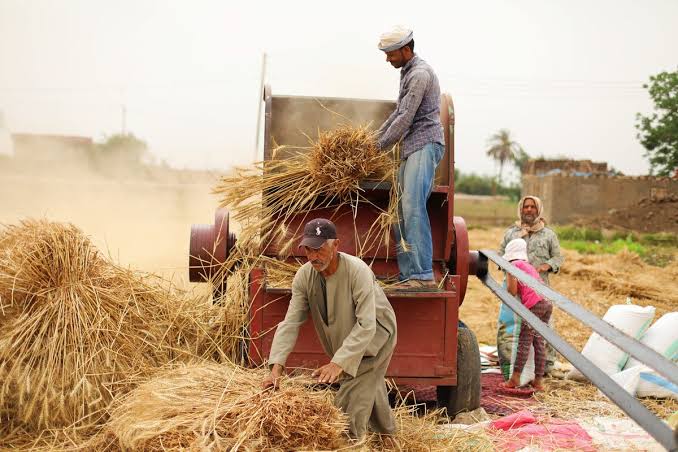
Egypt is expected to remain the Arab world’s largest wheat producer in 2026, with production projected to reach 10.2 million tons, according to estimates by the UN Food and Agriculture Organization (FAO) published by the Cabinet’s Media Center on Sunday, 23 August.
The FAO estimates place Egypt ahead of Morocco and Iraq, which are each projected to produce five million tons, followed by Algeria at 3.5 million tons, Tunisia at 1.4 million tons, and Saudi Arabia at 1.1 million tons.
Egypt’s wheat production is expected to increase by around seven percent in 2026 compared to its average production, largely driven by the expansion of cultivated areas.
Domestic wheat production is also projected to exceed 10 million tons this year, marking a 6.5 percent increase from 9.4 million tons in 2025. Meanwhile, wheat imports are expected to fall to 12.5 million tons from approximately 13.2 million tons last year.
The area cultivated with wheat reached a record 3.76 million feddans this season, an increase of around 600,000 feddans compared to the previous season.
The figures come as Egypt concluded its 2026 wheat procurement season, with around five million tons supplied to the government, the highest quantity recorded under the state procurement system.
The government set the procurement price at EGP 2,500 (USD 49) per ardab, equivalent to around 150 kilograms of wheat, this season to encourage farmers to supply their crops locally.
Egypt has also expanded the development and cultivation of high-yielding, climate-resilient wheat varieties, including Misr 3 and Misr 4, Giza 171, Sakha 95 and 96, Sids 14 and 15, Beni Suef 5 and 7, and Sohag 5 and 6.
Wheat remains one of Egypt’s most important strategic crops and is a key component of the subsidized baladi bread system. The increase in local production is part of ongoing efforts to reduce reliance on imports and strengthen the country’s food security.






Comments (0)