


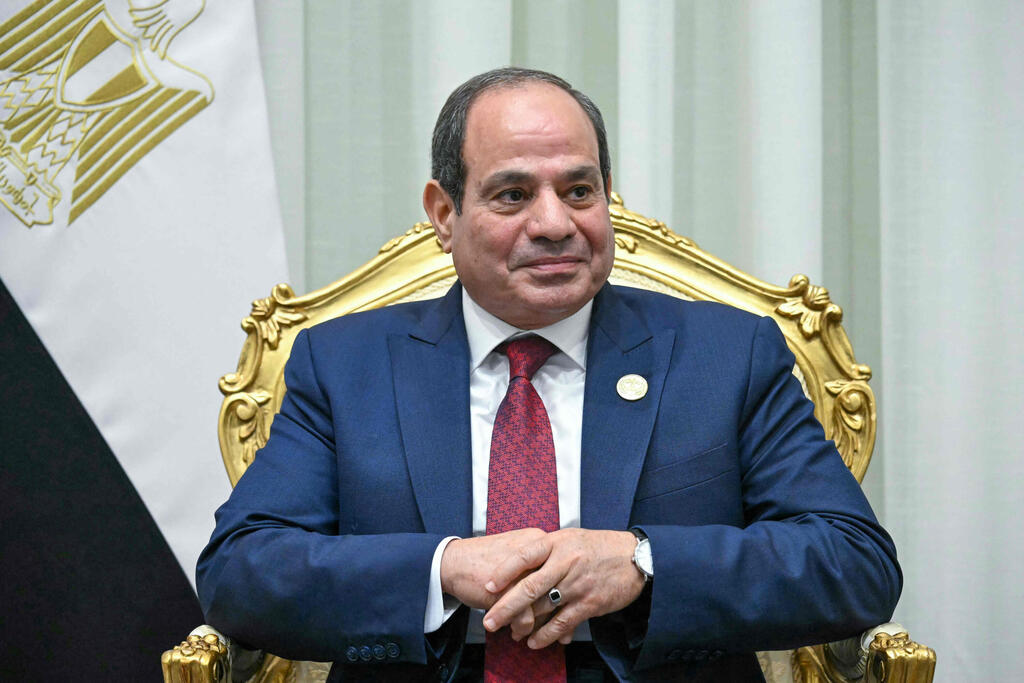
Egyptian President Abdel Fattah El-Sisi announced while speaking in Egypt’s New Administrative Capital on Saturday 17 October his presidential term will end in 2030 and that he intends to leave the Egyptian Constitution untouched, signaling the end of his presidency.
The Egyptian President added that a process would be launched to prepare the country for a new leader to be selected.
El-Sisi also announced a proposal to prepare potential presidential candidates through the Egyptian Military Academy, while reaffirming that his current term will end in 2030 and that the Constitution will remain unchanged.
Speaking at the graduation ceremony of the academy’s first cohort and new batches from military colleges in Egypt’s New Administrative Capital, El-Sisi described the end of his presidency as a settled matter.
“Leaving the Constitution untouched is the right course. In 2030, my term leading the country will end, if I am still alive. This matter is completely settled and will not be discussed further,” he said.
Proposed Programme
El-Sisi outlined a proposed programme lasting up to 30 months and comprising more than 7,500 hours of training and education, aimed at preparing potential presidential candidates and other qualified personnel for leadership positions across state institutions.
The programme would target applicants aged between 40 and 50 who hold doctorate degrees from reputable Egyptian or foreign universities. Candidates would be required to pass admission tests, while a committee would establish the programme’s selection criteria.
El-Sisi suggested that the programme could accommodate between 200 and 1,000 participants, with the aim of equipping them with an understanding of the Egyptian state, its resources, and the responsibilities involved in governing it.
He added that individuals who had served in government for six years or more would be exempt from the programme, arguing that their experience had already prepared them for senior responsibilities.
The Armed Forces would cover the programme’s costs, regardless of the amount, he said.
El-Sisi called for selection to be based on merit and ability rather than favouritism, adding that the initiative would give Egyptians a pool of qualified candidates to choose from.
Legislation to Govern the Programme
The president said the Speaker of the House of Representatives, alongside the ministers of higher education and justice and a group of thinkers and politicians, should work on drafting legislation to regulate the proposed programme and establish the conditions for selecting candidates.
He said the initiative was intended to prepare people capable of assuming responsibility for the presidency, ministries, parliament, governorates, and other vital institutions.
“We cannot bring someone in to experiment and learn on the job, even in ministries,” he said.
El-Sisi also rejected suggestions that the proposal was intended to prepare a member of his family or a relative to lead the country, saying the Military Academy would help prepare a generation capable of taking on leadership responsibilities.
He said he was announcing the proposal more than 40 months before the end of his term to prevent speculation and political disputes surrounding the country’s future leadership.
Role of Armed Forces
During his speech, El-Sisi also referred to the constitutional provisions defining the Armed Forces’ responsibilities, including protecting Egypt’s territory, security, and Constitution, as well as democracy, the civilian character of the state, and individual rights and freedoms.
He said the provisions were intended to protect state institutions from attempts to undermine them and stressed that the Armed Forces were an integral part of Egyptian society.
The president also highlighted the importance of preparing qualified personnel to preserve the stability of state institutions, describing the development of future leaders as a shared national responsibility.
El-Sisi first became president in June 2014 after winning the 2014 presidential election, following his role in the military’s removal of former president Mohamed Morsi in 2013. He was re-elected in 2018 and secured a third term in December 2023, winning 89.6 percent of the vote.
Constitutional amendments approved in a 2019 referendum extended presidential terms from four to six years and allowed El-Sisi to run for a third term, enabling him to remain in office until 2030. The amendments were approved by 88.83 percent of participating voters, with turnout reaching 44.3 percent, according to Reuters.
El-Sisi took the constitutional oath for his third term on 2 April 2024 at the House of Representatives in the New Administrative Capital.

Comments (0)