


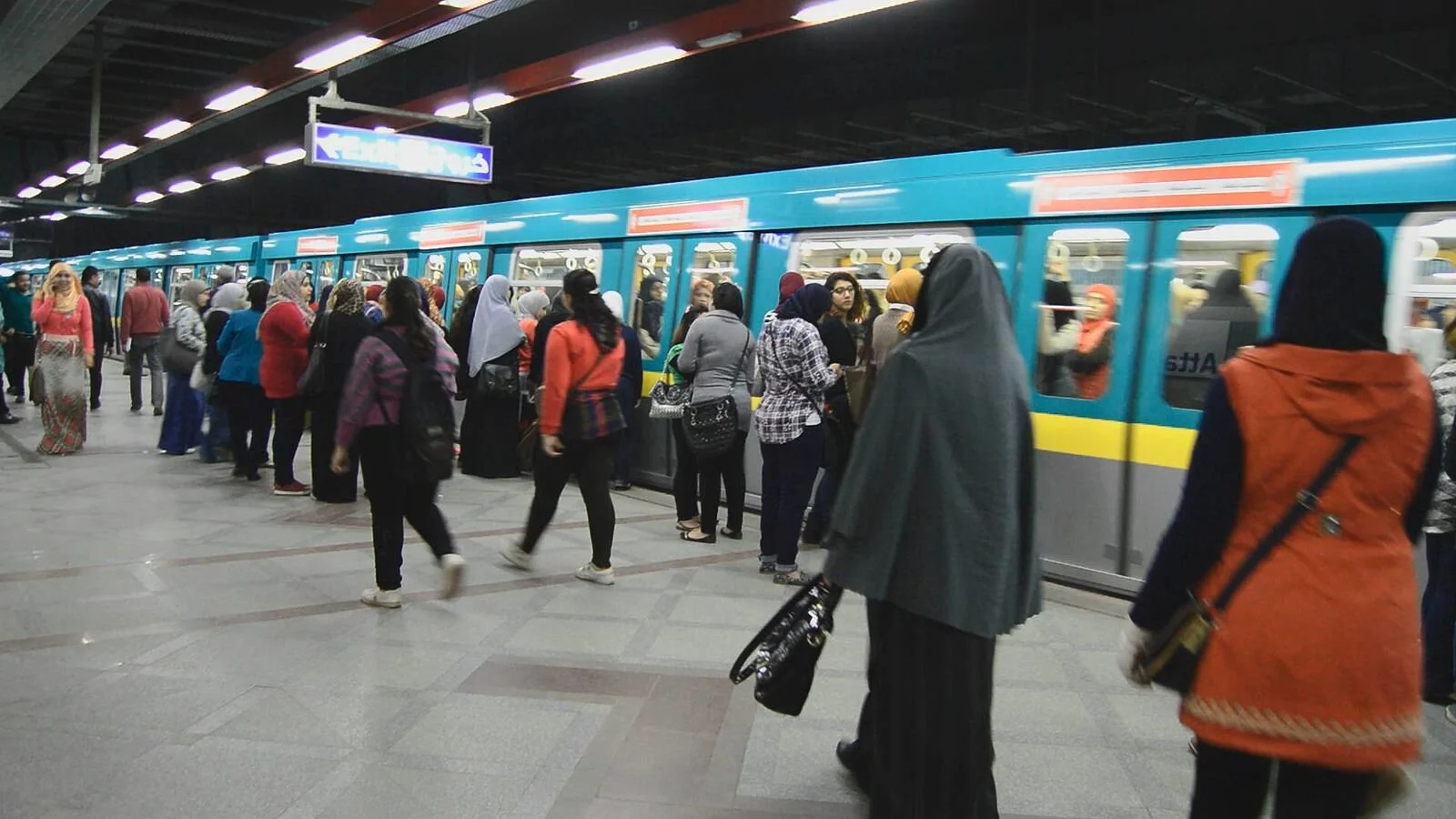
A month ago, a video circulated showing an elderly man confronting a young woman on a Cairo metro carriage over the way she was sitting. Raising his voice, he told her that crossing her legs in front of male passengers was inappropriate.
The incident drew mixed reactions online. While many described the confrontation as harassment, others defended the man’s actions, framing the woman’s behavior as inappropriate or “disrespectful.”
The incident highlighted how deeply social expectations and traditional norms shape how women are judged in public spaces, often carrying more weight than legal protections when it comes to how women dress, move, and present themselves.
The Gap Between Social Authority and Legal Authority
What stands out in the metro incident is not just the aggression, but the certainty with which the man assumes authority. He speaks as if enforcing a rule, yet no such rule exists. Cairo Metro regulations focus on safety, ticketing, and public order. They do not regulate posture, clothing, or how passengers sit.
By contrast, Egyptian law explicitly criminalises harassment. Amendments to the Penal Code introduced in 2014 penalise verbal harassment and offensive gestures that violate a person’s dignity in public spaces. The law protects individuals from being verbally attacked or shamed, not from how others choose to sit.
In other words, the behavior on display in the video aligns far more closely with what the law prohibits than with what it permits.
The confrontation reveals a familiar dynamic: social norms stepping in where legal authority does not exist. Men act as enforcers not because the law empowers them, but because custom encourages them to.
Public Space as Conditional Space
Legally, women occupy public space as citizens. Socially, their presence is often treated as conditional.
From public transport to streets and sidewalks, women are expected to manage their posture, tone, and clothing to appear “respectable.” Public space becomes something to be navigated carefully rather than freely occupied.
Violence and harassment in public spaces restrict women’s freedom to move, work, and access services. A 2025 study by the Economic Research Forum in Egypt found that fear of harassment shapes how women travel and limits their participation in public life, including education and employment.
The metro incident illustrates this clearly. The woman’s posture was not treated as neutral, but as something requiring correction. Her body became open to public commentary, her comfort reframed as disrespectful.
Why Visibility Changes the Conversation
Encounters like this are not new. What has changed is their visibility.
Smartphones have turned everyday interactions into public records, exposing informal power dynamics that previously unfolded without scrutiny. A 2024 study published by the American University in Cairo found that viral videos and social media campaigns often transform private experiences of harassment into collective discussions about rights and social norms.
If public space is legally shared, but socially conditional, then each viral moment becomes evidence of that contradiction. The question raised is not simply whether one man was wrong, but why so many people still feel entitled to regulate women’s presence in spaces that are meant to belong to everyone.
Until the difference between women’s legal rights and how society actually treats them is addressed, incidents like this will keep happening, not as exceptions, but as a reminder that public life is still unequal.
The opinions and ideas expressed in this article are the author’s and do not necessarily reflect the views of Egyptian Streets’ editorial team.
To submit an opinion article, please email [email protected].





Comment (1)
Until the difference between women’s legal rights and how society actually treats them is addressed, incidents like this will keep happening, not as exceptions, but as a reminder that public life is still unequal. that’s a very strong article I really enjoyed reading it