


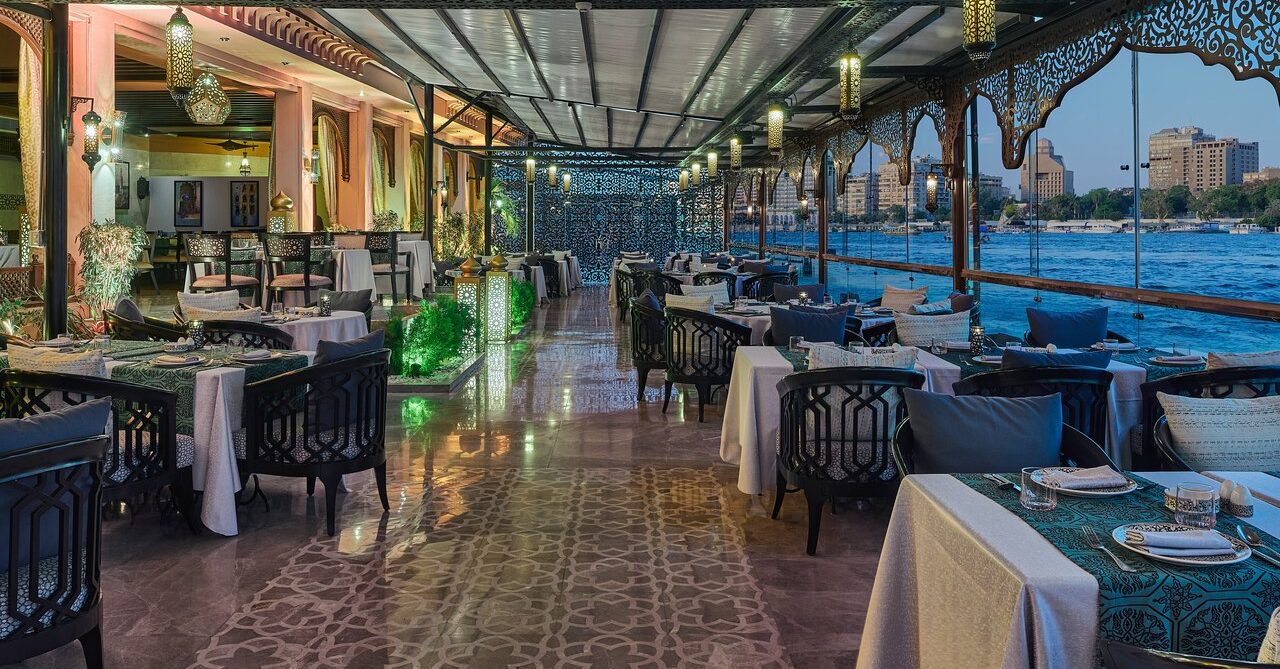
On Cairo streets, many restaurants open with optimism and close with startling speed. New signs go up overnight, and months later, the lights go off, replaced by another concept, another promise. In Egypt, the restaurant scene is diverse, crowded, and risky.
Globally, restaurants are fragile enterprises.
Roughly 17 percent of restaurants close worldwide within their first year, and about 80 percent shutter within five. In Egypt, the churn is harsher. Industry estimates suggest that as many as 60 percent of restaurants fail in their first year, and similar to worldwide statistics, nearly 80 percent close within five years. The turnover rate points to fierce competition, thin margins, and a market that welcomes newcomers and weeds out the unprepared.
“People think having a restaurant is easy,” Amr Mostafa, hospitality consultant and founder of Amr Mostafa Hospitality Management Solutions, told Egyptian Streets. “They are not.”
Mostafa has 24 years of experience across hotels, fast food, casual dining, and mass catering.
His career reads like a tour of the global food industry. He began in international hotels, worked his way through KFC and Burger King in the Gulf and Egypt, helped launch the French café chain Brioche Dorée locally, and later oversaw large-scale catering in hospitals and transportation. Along the way, he earned two Master’s degrees and a doctorate in business administration. Today, he directs food projects in Saudi Arabia and trains aspiring restaurateurs across the region.
“People often come to me saying they have EGP 2 million (USD 42,745) and want to open a restaurant,” he said. “I tell them frankly that, without proper planning, it may be wiser to preserve their capital rather than invest it in a high-risk venture.”
The most common reason why restaurants fail is almost always location.
He reported, “Sixty percent of a restaurant’s success depends on where it is open. Twenty percent depends on operation, and the remaining 20 percent depends on marketing.”
Owners confuse convenience with strategy, opening a restaurant in their apartment building, on a side street, or in an area saturated with competitors, according to the expert. Others overpay for prestige addresses.
“With a monthly rent of EGP 500,000 (USD 10,686), the restaurant must be making at least five million in sales,” he said, explaining that rent should cost from 10 to 18 percent of revenue. “Anything higher sets the business up for failure.”
Such miscalculations often stem from a bigger issue, which is starting a restaurant business without conducting thorough feasibility studies or serious financial and market analysis, Mostafa shared.
Research must precede any financial commitment, according to Mostafa, beginning with clear, fundamental questions and answers, such as where the restaurant will be located, what it will offer, and the pricing required to generate a profit.
“The restaurant owner must decide on the location, define the concept, determine what the staff will wear, how the food will be packaged, how it will be plated, who their target customers are, and how to reach them, whether through social media, flyers, or television ads,” Mostafa said.
Without a proper feasibility study, restaurants risk misjudging customer demand, setting the wrong prices, or relying on marketing to cover poor quality.
“The customer understands quality, and can not be fooled forever,” he said.
Management failures compound the problem.
Restaurant profit margins are thin, typically between 5 and 15 percent, and require constant oversight. Owning a restaurant and managing it are different, said Mostafa.
“If you are not closely overseeing your finances, the business will quickly collapse.”
Common mistakes also include chasing trends. Some owners try to attract customers by offering services such as hookah, video games, or other services that are unrelated to their restaurant’s concept and brand identity, which can severely hurt their brand.
Others disappear after opening day, assuming the operation will run itself.
“If you’re not free to manage it,” he said, “why did you open a restaurant?”
However, a restaurant’s failure is not necessarily fully the owner’s responsibility and fault. External factors and shifting conditions also play a role and can derail well-run operations. Political upheaval, economic volatility, and changing consumer tastes have wiped out even strong brands.
Mo’men, for example, once one of Egypt’s most successful fast-food chains, collapsed amid political turmoil, Mostafa recalled. Amid the Rab’a massacre, Mohamed Momen, co-owner of the chain, was linked to Egypt’s Muslim Brotherhood government after its ousting in 2013, which initiated the chain’s downfall.
Sometimes, a pricey international brand can struggle to attract enough customers to make a profit, as the Egyptian pound faces depreciation, necessities become more out of reach, and Egyptians’ salaries remain unchanged.
Yet success stories exist. Local brands such as Desoky and Soda, or Stereo, thrived by understanding their market, pricing realistically, and adapting quickly, according to Mostafa.
In the hospitality industry, Mostafa uses his expertise to prevent failure rather than diagnose it.
When it comes to dining in Egypt, ambition is abundant, but preparation remains scarce.
Mostafa said, “Business is not a gamble; it’s a science that should be taught, studied, and practiced.”





Comments (0)