


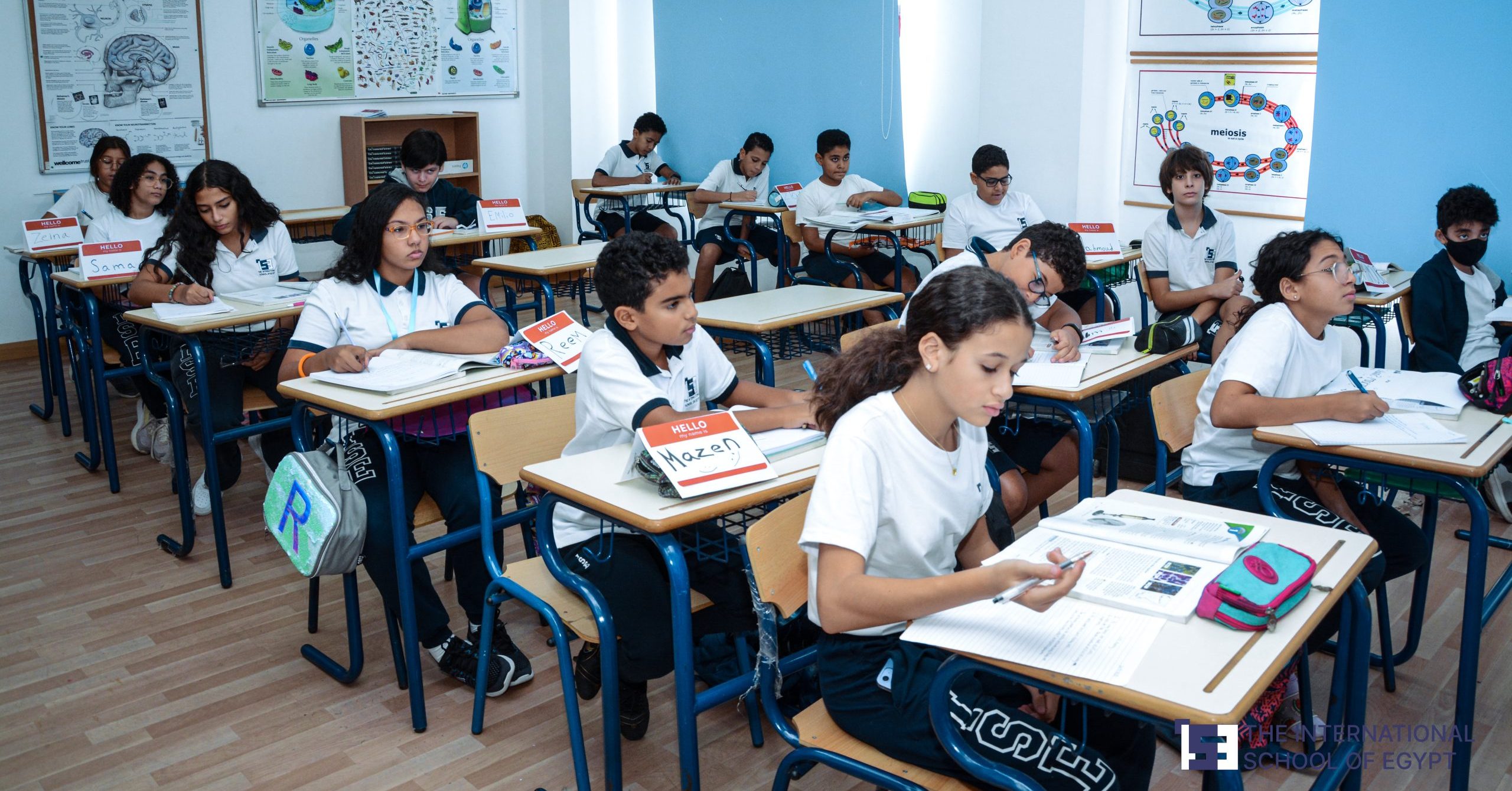
On playgrounds and in living rooms across Egypt, children narrate their worlds in colloquial Egyptian Arabic, bargaining over snacks, playing games together, and asking endless questions. When they enter the classroom, they code-switch, reading and writing in Modern Standard Arabic (MSA), the formal language of textbooks, news broadcasts, and newspapers, as opposed to studying in colloquial Egyptian.
The coexistence of two language varieties, known as diglossia, creates a structural gap between spoken and written forms of the language, which in turn affects how young learners acquire foundational reading and language skills. The Arabic language is not exempt from the effects of diglossia, as the gap between MSA and spoken languages also plays a role in literacy acquisition, according to a 2024 study published in Frontiers in Education.
While many students learn MSA, also known as fusha in Arabic, from a young age as they begin reading and writing, often around four years old, those who do get exposed to MSA from a young age could struggle to learn. However, depending on how the linguistic gap is addressed pedagogically, their knowledge of colloquial Egyptian can serve as a bridge.
According to the United Nations Educational, Scientific, and Cultural Organization (UNESCO), children learn best when their first language is valued and used in the classroom, which strengthens literacy and inclusion, and connects school learning to what they already know.
Meanwhile, understanding the effects of the diglossia gap could help educators better support literacy instruction without dismissing the role of children’s first spoken language.
The diglossic gap affects learners’ phonological awareness, which is the ability to recognize and manipulate sounds within words. It also hinders decoding, the ability to match written letters to spoken sounds, as well as lexical access, the ability to quickly retrieve and understand the meaning of words in MSA.
Morphological awareness, understanding word patterns, is also affected by the diglossia gap, making it harder for students to connect what they say to what they read and write without targeted instructional support, a 2023 study published in the International Journal for Research in Education reveals.
One of the ways teachers can acknowledge diglossia and take into account the linguistic realities of students’ everyday speech includes introducing simplified or transitional forms of standard Arabic in early grades. Exposing children to MSA in engaging ways, not just through formal grammar lessons, can also help them grow more familiar and comfortable with it.
By bridging colloquial Egyptian and MSA through contextually grounded literacy activities, children can excel in reading acquisition, according to research in the British Journal of Education.
While Arabic diglossia is unique in its form and scope, the underlying principle that children learn best when new literacy skills build on prior language competence is widely supported in language education literature.
MSA and colloquial Egyptian are not competing linguistic systems, but equally important variations of the rich Arabic language. When teachers acknowledge the duality of Arabic, students can use the language they already know to build confidence in reading and writing in fusha.


Comments (0)