


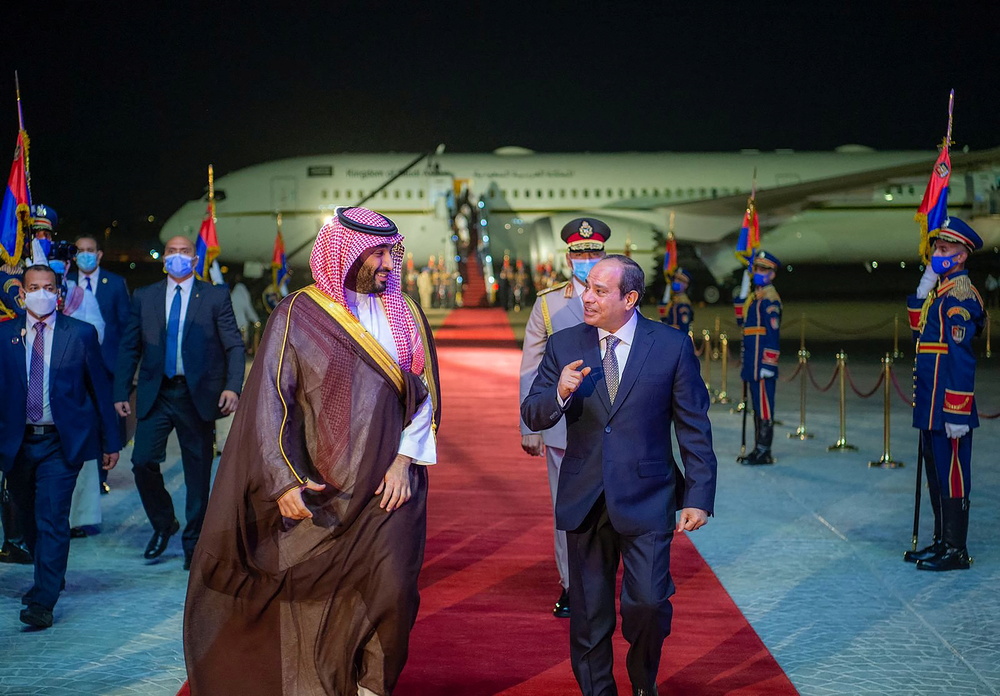
For decades, the idea of a bridge connecting Egypt and Saudi Arabia has lingered somewhere between ambition and fantasy. First proposed in the late 1980s, revived in 2016 during King Salman’s visit to Cairo, and then seemingly shelved by years of diplomatic silence, the King Salman Causeway has spent more time on drawing boards than it has in headlines.
That may be about to change. The US-Israeli war on Iran, now in its fourth week, has laid bare a vulnerability that Gulf planners long feared but rarely planned for in earnest: the near-total closure of the Strait of Hormuz, the simultaneous disruption of Red Sea shipping, and the cascading economic damage that follows when the world’s most critical maritime corridors shut down at once.
For Egypt, the toll is already severe. President Abdel Fattah El-Sisi has warned that cumulative Suez Canal revenue losses now exceed $USD 10 billion since the onset of regional instability, with canal traffic dropping by roughly half since the war began. Foreign portfolio investors have pulled some $USD 6 billion from the Egyptian market, the pound has depreciated further, and the country is scrambling to secure LNG cargoes after Israel suspended gas supplies and Qatari shipments were disrupted.
For Saudi Arabia, the picture is no less stark. The kingdom has been forced to reroute crude exports through the East-West pipeline to its Red Sea port of Yanbu, a system that can handle roughly 5 to 7 million barrels per day but cannot replace the volumes that normally flow through the Gulf terminals of Ras Tanura and Juaymah. The workaround is a pressure valve, not a solution.
Against this backdrop, the proposed 32-kilometre causeway linking Saudi Arabia’s Ras Hamid to Sharm El-Sheikh across the Strait of Tiran looks less like a prestige infrastructure project and more like a strategic imperative. And the timing of its most recent momentum, it turns out, could hardly have been better.
From Concept to Near-Construction
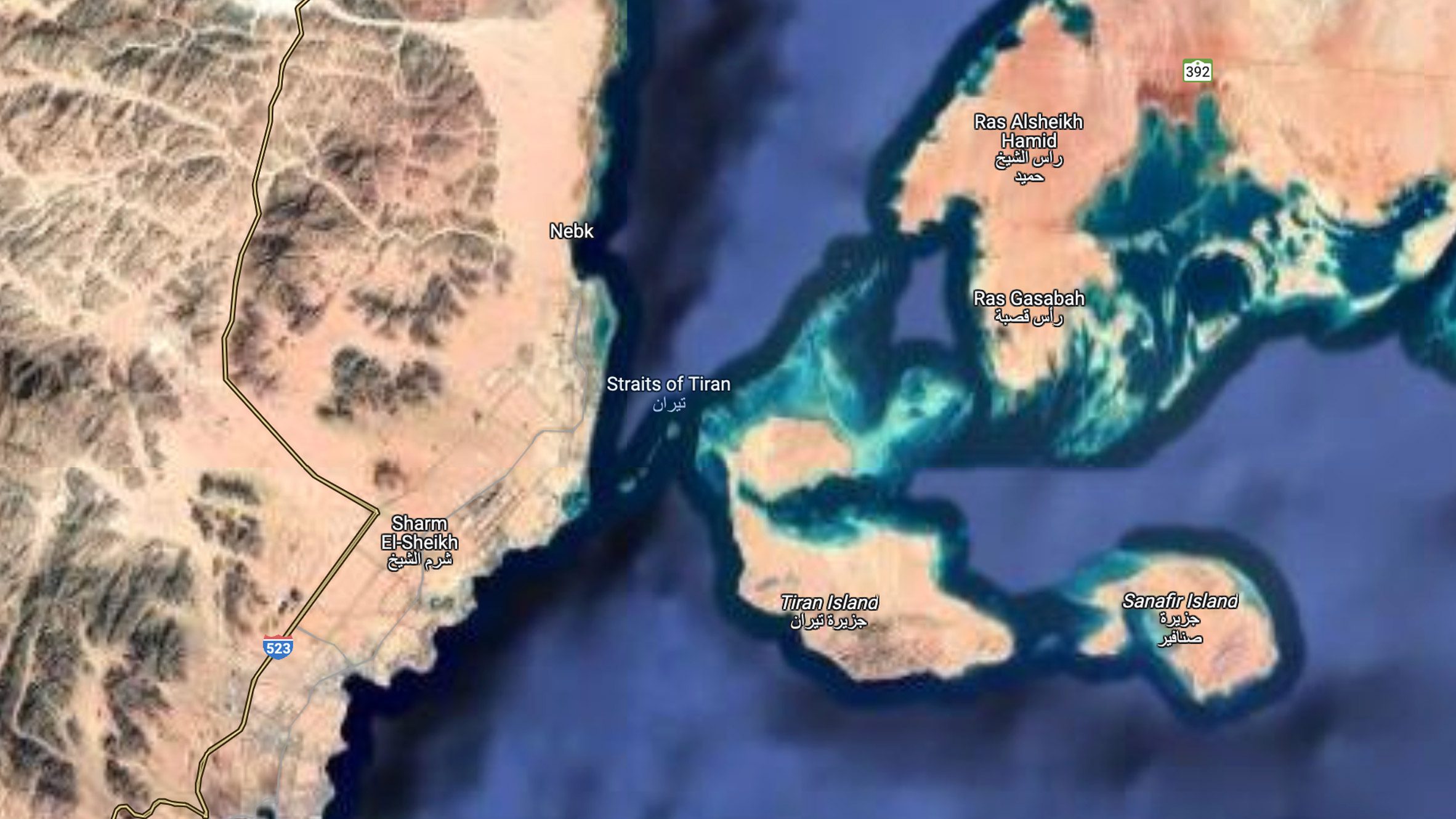
In June 2025, Egyptian Transport Minister Kamel Al-Wazir confirmed that all planning for the Red Sea bridge was complete and that construction could begin “at any time,” pending final approval. The project, reportedly fully financed by Saudi Arabia at an estimated cost of $USD 4 billion, is designed to support both road and rail traffic and would connect with Saudi Arabia’s expanding national rail network and Egypt’s developing infrastructure in the Sinai Peninsula.
The diplomatic groundwork had quietly been laid years earlier. Egypt’s transfer of the strategic Tiran and Sanafir islands to Saudi Arabia in 2017 removed the most significant political obstacle. The Camp David Accords’ guarantee of Israeli freedom of navigation through the Strait of Tiran remains a sensitive dimension, but the operational planning appears to have advanced regardless.
The bridge’s Saudi endpoint sits near NEOM, the $USD 500 billion megacity project in the kingdom’s northwest. On the Egyptian side, it feeds into Sharm El-Sheikh, a tourism hub, and aligns with Cairo’s long-standing ambition to populate and develop the Sinai. Officials have estimated the bridge could serve over one million travellers annually, including Muslim pilgrims heading to the holy cities via a direct overland route from North Africa.
Before the Iran war, these were already compelling arguments. After it, they look essential.
The Chokepoint Crisis
The war that began on 28 February 2026, when the US and Israel launched coordinated airstrikes on Iran under Operation Epic Fury, triggered a maritime crisis without modern precedent. Iran’s Islamic Revolutionary Guard Corps declared the Strait of Hormuz closed. Major container shipping companies, including Maersk, CMA CGM, Hapag-Lloyd, and MSC, suspended all transits. Tanker traffic through the strait dropped to near zero. Protection and indemnity insurance was cancelled from 5 March.
The crisis did not stop at Hormuz. Yemen’s Houthis announced the resumption of attacks on Red Sea shipping the same day, reversing the fragile gains made since the October 2025 ceasefire. For the first time in modern history, both of the Middle East’s major maritime corridors were simultaneously threatened. The Suez Canal, which had only recently begun recovering from the Red Sea disruption of 2023 and 2024, saw traffic fall again as carriers rerouted to the Cape of Good Hope.
Oil prices surged past $USD 120 per barrel at their peak. The International Energy Agency described the situation as the greatest global energy security challenge in history. Over 3,000 vessels were stranded in the Middle East, and Gulf port networks experienced cascading operational stress.
For Egypt, the implications were immediate and multifaceted. Rising oil prices inflated the import bill. The suspension of Israeli gas supplies and the disruption of Qatari LNG shipments created an energy gap the government is still racing to fill. Tourism, already fragile, faces renewed uncertainty. And the Suez Canal, which had been projected to recover to nearly $USD 10 billion in revenue in 2026 following the Gaza ceasefire, is once again haemorrhaging income.
The lesson could not be clearer: Egypt’s economy, and the region’s trade infrastructure, remain dangerously dependent on narrow maritime passages that can be shut down by a single conflict.
The Overland Logic
This is precisely the vulnerability a bridge would begin to address. The King Salman Causeway would create the first meaningful, direct overland trade and transit corridor between Africa and the Arabian Peninsula, bypassing the maritime chokepoints that have proven so fragile.
The strategic logic extends beyond bilateral trade between Egypt and Saudi Arabia, though that alone would be significant. Saudi Arabia is already one of Egypt’s largest foreign investors, with over $USD 8 billion pledged across tourism, agriculture, and technology. The bridge would shorten travel time between the two countries to roughly 30 minutes by car, compared to current sea and air routes. Early estimates have suggested the causeway could quadruple Saudi tourist visits to Egypt, from approximately 300,000 annually to over 1.2 million.
But the broader opportunity lies in what the bridge could unlock as a node in a wider logistics network. Saudi Arabia has been investing in multiple connectivity corridors: east toward India, west toward Africa, and north through Iraq and Syria toward Turkey. The Moses Bridge, as it has been informally named, would give the kingdom a direct route to Europe through Egypt’s Mediterranean gateway, offering what the Atlantic Council has described as a “depoliticised alternative” to the India-Middle East-Europe Economic Corridor (IMEC), which depends on the Israeli port of Haifa and has been compromised by the very geopolitical dynamics now destabilising the region.
For Egypt, the bridge offers something perhaps even more valuable than toll revenue or tourist arrivals. It offers the possibility of repositioning the country as a land bridge between the Gulf, Africa, and Europe, reducing its structural dependence on the Suez Canal by developing complementary overland trade routes. Cairo has already begun investing in east-west rail lines, port upgrades on the Mediterranean, and logistics zones in the Sinai. The causeway would anchor that infrastructure strategy in a physical connection to the Gulf’s largest economy.
The Yanbu Precedent
The Iran war has already provided a small-scale preview of this dynamic. As the Strait of Hormuz closed, Saudi Arabia pivoted its oil exports to the Red Sea port of Yanbu via the East-West pipeline. Pakistan formally requested that Riyadh reroute oil supplies through Yanbu, and Saudi Aramco asked Asian buyers to prepare for April cargoes from the Red Sea coast. The SUMED pipeline, which runs from the Gulf of Suez across Egypt to the Mediterranean, was identified as a potential route for increased flows.
Saudi Arabia also launched a new Logistics Corridors Initiative aimed at facilitating cargo movement between its ports and those across the GCC. Freight forwarders began steering cargo through Red Sea gateways including Jeddah, King Abdullah, and Yanbu, before moving goods overland into Gulf destinations.
The pattern is clear. When maritime routes fail, overland alternatives become urgent. But the current alternatives, cobbled together under crisis conditions with limited road capacity, insufficient trucking, and emergency surcharges of $USD 1,800 to $USD 3,000 per container, are stopgaps. A permanent, high-capacity overland link between Egypt and Saudi Arabia would transform that emergency improvisation into durable infrastructure.
What Still Stands in the Way
None of this is without complexity. The environmental stakes are serious. The Strait of Tiran is home to vibrant coral reefs, endangered dugong populations, and significant marine biodiversity. Conservation groups have conditionally approved the bridge only if rigorous environmental impact assessments are completed and their recommendations implemented.
The geopolitical sensitivities remain real, though diminished. Article V of the Camp David Accords guarantees freedom of navigation through the Strait of Tiran, and Israel’s only Red Sea port, Eilat, lies at the northern end of the Gulf of Aqaba. The bridge’s construction and operation would need to be designed to preserve those navigation rights. However, with Saudi Arabia making clear that normalisation with Israel remains off the table absent Palestinian statehood, the project’s framing as an alternative to Israel-dependent corridors carries its own diplomatic weight.
The cost, at $USD 4 billion, is substantial but manageable by Gulf standards, and Saudi Arabia has reportedly committed to financing the project entirely. The question is less about money than about political will and timing.
A Moment of Clarity
Wars have a way of clarifying strategic priorities. The 1980s Tanker War prompted Saudi Arabia to build the East-West pipeline that is now proving its worth four decades later. The Houthi disruption of Red Sea shipping in 2023 and 2024 forced a global reckoning with chokepoint vulnerability. And the 2026 Iran war, with its simultaneous closure of Hormuz and renewed disruption of the Red Sea, has exposed the full extent of the region’s dependence on narrow waterways that adversaries can weaponise at relatively low cost.
For Egypt and Saudi Arabia, the question is no longer whether a bridge between the two countries makes strategic sense. The Iran war has answered that question definitively. The question is how quickly they can move from plans to concrete.
With construction reportedly ready to begin at any time, and with the economic and strategic costs of inaction now painfully visible, the King Salman Causeway may finally be an idea whose time has come. Not because the geopolitics have shifted in its favour, though they have. And not because the economics are newly compelling, though they are. But because the war has demonstrated, in the most visceral terms possible, that the infrastructure connecting Africa and the Arabian Peninsula cannot remain hostage to a single strait and the threat of its closure.
Egypt has lost billions. Saudi Arabia has been forced to scramble. The global economy has been convulsed. A 32-kilometre bridge across the Red Sea will not solve all of these problems. But it would ensure that the next time a chokepoint closes, there is at least one alternative route that does not depend on the sea.






Comments (0)