

Since the end of the 20th century, private tutoring has transitioned from a supplemental aid to a primary engine of academic achievement for many families in Egypt.
Although public education in Egypt is officially free, the experiences of many students and parents tell a different story: educational progress, especially in high-stakes years, like Thanaweya Amma, secondary education certificate or SAT’s, depends on paid classes outside the school’s classroom.
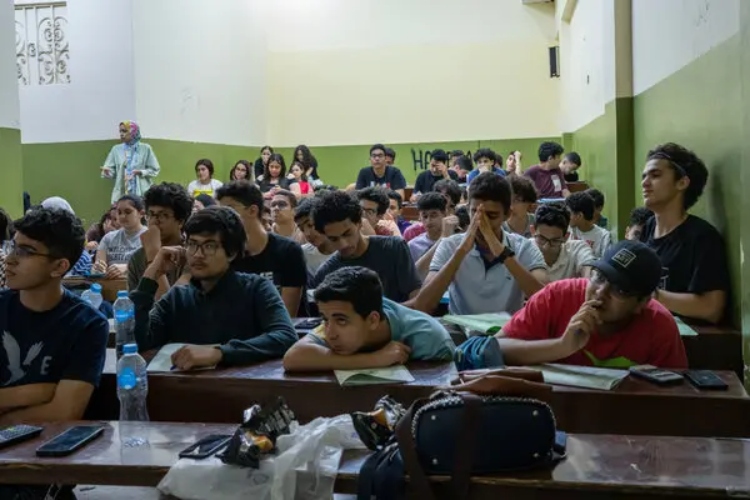
One challenge is the quality of teaching in many public schools’ classrooms. Overcrowded classrooms can limit teachers’ ability to provide individual attention. In this environment, private tutoring becomes the space where students receive clarification, targeted practice, and repetition, elements that are otherwise difficult to deliver within the constraints of school schedules.
Over time, this pattern has produced what Professor Mohamed Alaa Abdel-Moneim, of the Faculty of Economics and Political Science at Cairo University, describes in 2021 as a “parallel” or “shadow” education system, running alongside formal schooling and, in many cases, putting greater influence over students’ outcomes.
In today’s Egypt, the typical academic journey, particularly Thanaweya Amma, frequently revolves around private lessons. Students may attend group sessions at tutoring centers, receive individual teaching at home, or rely on online sessions.
Ahmed Reda, 20, a Thanaweya Amma student last year, told Egyptian Streets that he used to attend a private tutoring center in Sheraton, Heliopolis, for Chemistry classes and other subjects to help him achieve a high percentage and secure admission to his dream university.
Sessions in 2025 cost around EGP 150 (USD 2.80) to EGP 200 (USD 3.73), depending on the teacher’s reputation and the size of the class.
Reda did not attend simply as a matter of preference or occasional reinforcement. Rather, Reda depended on that center to study for all his Thanaweya Amma exams. He would not even go to school most of the time and focus on studying at this center.
Estimates of how widespread private tutoring is among secondary school students in Egypt suggest that about 42 percent to 60 percent of students take part.
A World Bank project document estimated that around 75 percent of students in the final year of secondary education were receiving private tutoring.
Most importantly, private tutoring is not limited to struggling learners. High-achieving students use tutoring to gain an edge, while average students and even younger learners seek extra support to keep up with the curriculum.
Zeinab Ramadan, 40, mother of Thanaweya Amma student Rodayna Ahmed, says she depends heavily on private tutors who visit their home to provide extra sessions.
She adds that the tutoring focuses mainly on English and Science, helping Rodayna improve her grades even though she is not struggling at school.
Why has tutoring dependence deepened?
Economic realities also play a major role. For many teachers, salaries are insufficient relative to living costs, leading tutoring to function as supplemental income, and in some cases as a primary livelihood. Popularity of private tutoring then creates a structural dependency in which students increasingly need tutoring to succeed, while teachers increasingly rely on tutoring as a reliable income stream.
Demand then remains persistent because many parents see tutoring as the most reliable source for exam preparation and improvement. Additionally, because teachers rely on tutoring for their income, they are incentivized to expand the private market. This cycle forces families to participate so their kids do not fall behind academically.
Meanwhile, cultural expectations reinforce the trend: education is widely regarded as the primary route to upward stability, and families place significant pressure on students, particularly during exam years, to achieve strong results.
Accordingly, in many households, private tutoring is viewed less as an optional supplement and more as a necessary investment, especially for families who can afford it.
Private Tutoring in the Modern Day
In 2026, private tutoring in Egypt has developed into a large informal market with prices varying by subject and level.
While group tutoring remains the most affordable option, sessions now typically start from around EGP 200 (USD 3.67) and can reach EGP 300 (USD 5.51) or more according to Thanaweya Amma students accounts, particularly for high-demand subjects and well-known teachers, reflecting a noticeable increase from earlier years.
As for one‑on‑one tutoring, it typically charges higher fees due to personalized attention, with individual tutors in Egypt charging around EGP 100 to 500 (USD 1.86 to 9.32) per session, depending on experience, subject, and level. Meanwhile, online tutoring platforms show average package prices ranging from about EGP 540 (USD 10.07) to EGP 1,400 (USD 26.10) per month for structured online support.
For households with multiple children, monthly spending on private lessons can easily reach several thousand Egyptian pounds, increasing even more for students preparing for Thanaweya Amma, who take 5–7 core, exam-focused subjects requiring intensive tutoring.
From an economic perspective, parents pay twice for education, first through the schools their children attend (particularly if they are enrolled in private education), and again through private tutoring.
Price increases are driven by multiple forces, including inflation and currency depreciation, the high demand for experienced tutors, and the commercialization of education, where teaching increasingly operates as a market service rather than a public good.
Consequences of Private Tutoring
Abdel-Moneim’s research on private tutoring in Egypt shows that spending on tutoring has become a “substantial and rising share of household budgets,” disproportionately benefitting students from wealthier families and further disadvantagering poorer students who cannot afford extra lessons.
This cycle contributes to widening inequality and undermines equity in education, as wealthier students gain access to more and higher-quality tutoring while low-income students are left behind, creating a significant financial burden on families and raising questions about how educational resources are distributed and whether public schooling is fulfilling its intended value.
Beyond academic consequences, the tutoring schedule can affect student well-being.
Many students endure long days that combine school with multiple tutoring sessions, leading to fatigue, stress, and burnout. For those who also participate in sports, their days can be even longer, requiring them to perform in the classroom, during private tutoring, and finally on the field or court, placing significant physical and mental demands on them.
Moreover, learning itself may also become transactional and focused on scoring rather than understanding, which can reduce a student’s creativity and curiosity. The focus on just scoring is more familiar with students who attend private international schools and take the SATs or ACTs as their standardized college tests.
Based on my personal experience, teachers tend to focus on ways students can get higher scores rather than trying to help the students understand mathematical equations or strengthen their English levels. The problem then becomes very evident as lots of students do not fully understand the curriculum they have been studying for years, and focus on achieving the highest scores.
Private tutoring is likely to remain a defining feature of Egyptian education, as long as demand remains strong, driven by ongoing competition and the belief that tutoring is the quickest way to exam success. Prices may also continue to rise as inflation and cost pressures persist, and the integration of online and traditional tutoring will likely shape how tutoring services evolve.



Comments (0)