


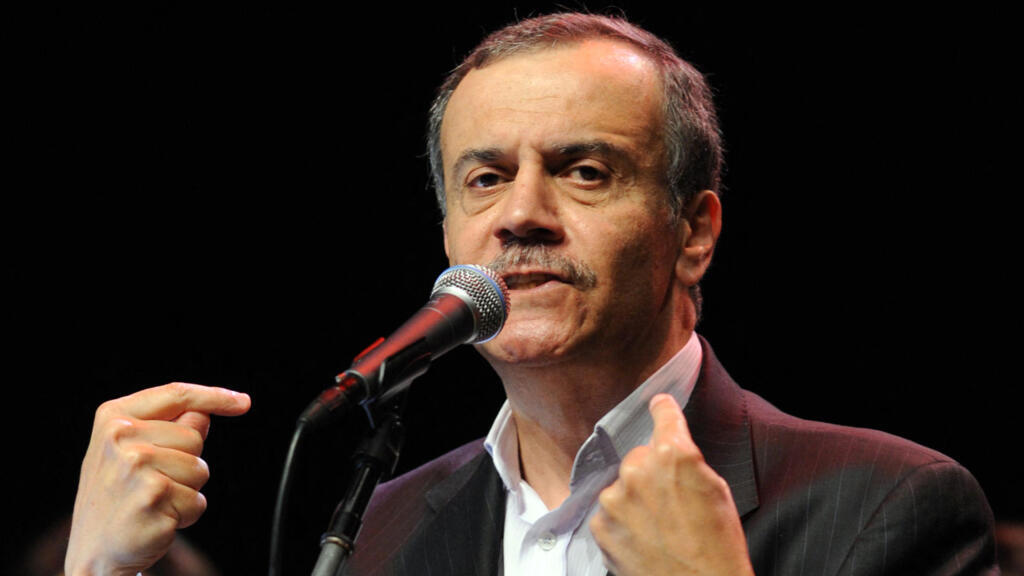
In the summer of 1975, a 19-year-old with no formal musical training sat down with a decade-old poem and, amid the beginning of a civil war, composed a melody he assumed few would hear. Fifty years later, Ounadikom (I Call on You, 1976) is still being sung in the streets.
Born on 9 July, 1955, in Beirut, Kaabour studied theatre at the Lebanese University before beginning to perform in small cultural gatherings. He came of age during the Lebanese Civil War, a period that would shape both his artistic voice and his political outlook.
A Song Born in Crisis
In 1975, with the outbreak of the Lebanese Civil War, Kaabour turned to the 1966 poem by the Palestinian poet Tawfiq Ziad, Ounadikom, setting it to music and performing it as both his first composition and his first vocal test. While he had no formal musical training, the song was born out of a desire to offer moral support to those fighting across various fronts. Shared between his voice and a chorus, his youthful delivery gave the song a raw authenticity.
The song spread in ways he could not have anticipated, becoming a defining expression of Palestinian tragedy, wound, and enduring resilience. During the Israeli invasion of Lebanon in 1982, it became one of the most widely sung anthems of solidarity with the Palestinian people.
“The song became more famous than I did,” he once said on a podcast. “Ounadikom did not succeed only because it dealt with a national cause or because it was written by Tawfiq Ziad. It succeeded because it had aesthetic value.”
The song continues to be sung at protests and solidarity demonstrations across the Arab world and beyond, resurfacing with particular force whenever the Palestinian cause reclaims the world’s attention.
A Collective Voice
For many across the Arab world, and especially in Palestine, Kaabour was revered for his melodies, a voice with warmth and a slight roughness, and the interplay of solo and chorus. His music had a communal quality, as if he were singing not for an audience but alongside one.
Throughout his career, Kaabour maintained a studied distance from the commercial music industry. He insisted on treating art as a form of testimony rather than a product. His position aligned him with a tradition of committed Arabic song embodied by artists like Marcel Khalifé, with whom he collaborated.
He was also deeply active in children’s theatre, working with groups including Farek al-Sanabel, the Sanabel team, a children’s artistic troupe that aids Palestinian families, and the Lebanese Puppet Theatre, where he wrote and composed for more than 20 productions.
From the Stage to the Screen
Kaabour’s artistic range extended well beyond music.
He began his acting career in Lebanese theatre during the 1980s, and later moved into film. He appeared in a biographical film about the Palestinian cartoonist Naji El-Ali, titled Naji El-Ali (1991), alongside the late Egyptian actor Nour El-Sherif.
His most prominent international role came years later. Kaabour made his international debut as Wadie Haddad in the TV miniseries ‘Carlos’, which premiered at the 2010 Cannes Film Festival.
Kaabour is survived by his wife, the artist Iman Bikdash, and their son Marwan. He died at Al-Makassed Hospital in Beirut on 26 March 2026, following a long illness, at the age of 70.
To this day, his songs continue to circulate, to be sung, to be rediscovered by younger generations who may not know his face but recognize his voice.





Comments (0)