


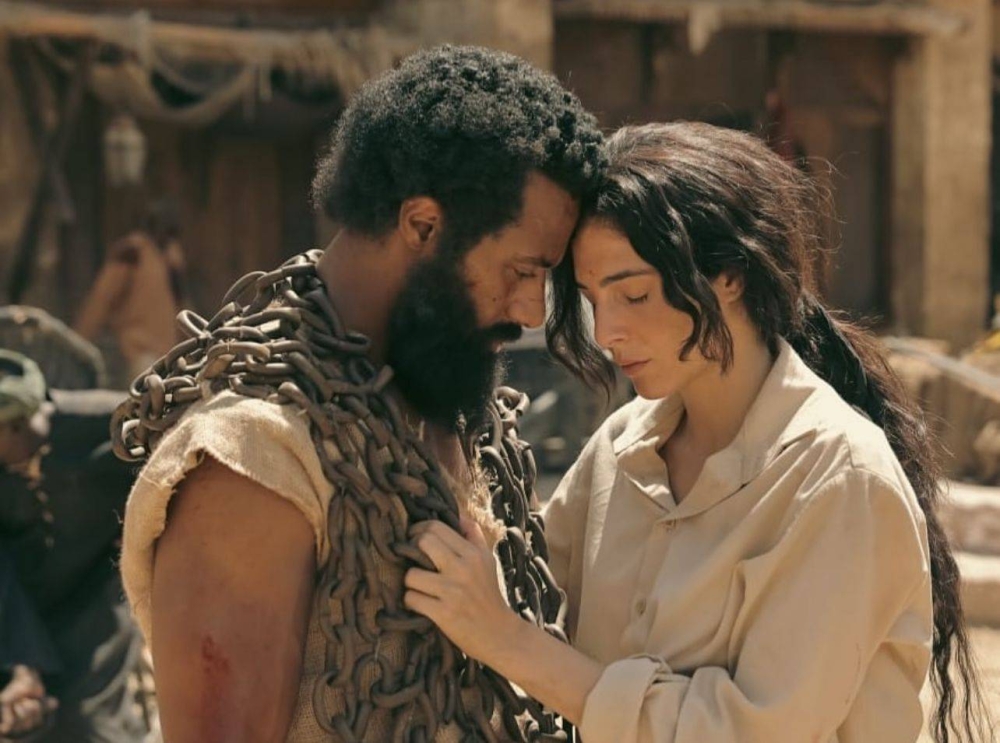
At first glance, Asad might seem like a historical action film set in nineteenth-century Egypt. But, as the film unfolds, it becomes something more immediate: a fictional story rooted in a historical backdrop, using that world to explore ideas of dignity, rebellion, and freedom within a system built on ownership and class hierarchy.
Directed by Khairy Beshara and Mohamed Diab, the film follows Asad, an enslaved man played by Mohamed Ramadan whose life changes after he falls in love with Laila, a free woman portrayed by Razane Jammal.
Their relationship is forbidden because Asad is legally considered property and it would bring shame to the family if a free person married a slave. When the two secretly marry and Laila becomes pregnant, a chain of events is set in motion that transforms a personal love story into a broader struggle for freedom.
The film is set during a period when slavery was still deeply embedded in Egyptian society. Throughout much of the nineteenth century, enslaved people were bought and sold across Egypt and the wider region, working in households, agriculture, and other sectors of society. While slavery is often overlooked in discussions of Egyptian history, Asad places it at the center of its narrative, forcing viewers to confront both its brutality and its lasting human consequences.
What makes the movie striking is its commitment to realism. The film’s world feels fully inhabited, from its costumes and production design to its landscapes and scenes. There are moments where it becomes easy to forget that this is a modern production. Every detail appears carefully considered, creating an immersive experience that transports viewers into another era.
The cinematography is among the film’s greatest strengths. Throughout the story, intimate moments are often contrasted with vast landscapes, creating a constant reminder of the scale of the world surrounding the characters.
One of the film’s most striking early scenes captures this approach perfectly. Asad and Laila sit together by the water, sharing a quiet moment, when the body of an enslaved man appears floating nearby. The camera then gradually pulls back, widening the frame until more bodies become visible across the water.
The camera then gradually pulls back, widening the frame until more bodies become visible across the water. The scene starts with Asad and Laila, but by the time the frame fully opens up, the viewer’s attention shifts to the bodies scattered across the water. It is a powerful introduction to the world of the film and one of its strongest visual moments.
This attention to visual storytelling continues throughout the film. Wide desert landscapes, sprawling battle sequences, and carefully composed shots give the story a sense of scale without losing sight of the people at its center.
The performances strengthen this realism. Mohamed Ramadan delivers a compelling performance, portraying Asad with a combination of resilience and vulnerability.
The supporting characters deepen the film’s portrayal of slavery as a social reality embedded within everyday life rather than a separate institution.
Yakan, portrayed by Egyptian actor Aly Kassem, is introduced as a powerful aristocrat deeply entrenched in the slave trade and is defined by contradiction. As a man who chooses to conceal his identity by appearing lighter-skinned, he moves through a hierarchy that rewards proximity to whiteness while working within the slave trade itself, an irony that sits at the center of his character.
The film also reveals a more intimate contradiction in his life: his own mother is enslaved within his household, showing how slavery extends into the immediate family.
A similar dynamic appears in Awad, Laila’s half-brother, who is also enslaved within his own family. Together, these characters reflect a world where lineage does not guarantee freedom, and where kinship and ownership exist side by side within the same household.
The violence in Asad is direct and often difficult to watch, but it is not framed for spectacle. Instead, it underscores the harsh realities of the world the film depicts.
After Laila’s family discovers the truth about her relationship, Asad is taken and punished. The scene begins in close range while Asad was suffering, before the camera slowly pulls away, revealing workers spread across the desert around him. What starts as an individual moment of suffering expands into a wider landscape of collective suffering.
Note: If you wish to avoid spoilers, stop reading here. The following section discusses key plot points and the film’s ending.
The film’s final act delivers some of its most powerful moments. After discovering that his son has been purchased by the Khedive’s son, Asad orchestrates an exchange. What follows is a confrontation in the desert that unfolds on a grand scale, as the Khedive’s army surrounds a smaller group of enslaved people who stand with Asad.
The endless desert horizon, the rows of soldiers behind the Khedive, and the small group gathered around Asad create an immediate sense of imbalance. Yet despite being outnumbered, the enslaved people refuse to surrender.
After the exchange, the Khedive orders them to return to their owners. Asad refuses and leaves the decision to them. They choose freedom collectively, despite knowing the consequences.
What follows is one of the film’s most heartbreaking sequences. Unarmed and outnumbered, the group advances as gunfire erupts. They continue moving even as people fall, turning the scene into an act of collective resistance.
The moment reaches its peak when even the Khedive’s own slave can no longer continue giving orders. His hesitation becomes an act of resistance, until the Khedive kills him and turns the weapon on Asad. Asad dies surrounded by Laila and their son.
The film ends on a note that is both tragic and hopeful. Freedom is achieved, but at a cost. What remains is the image of people moving forward together into an uncertain future.
The opinions and ideas expressed in this article are the author’s and do not necessarily reflect the views of Egyptian Streets’ editorial team.
To submit an opinion article, please email [email protected].





Comments (0)