


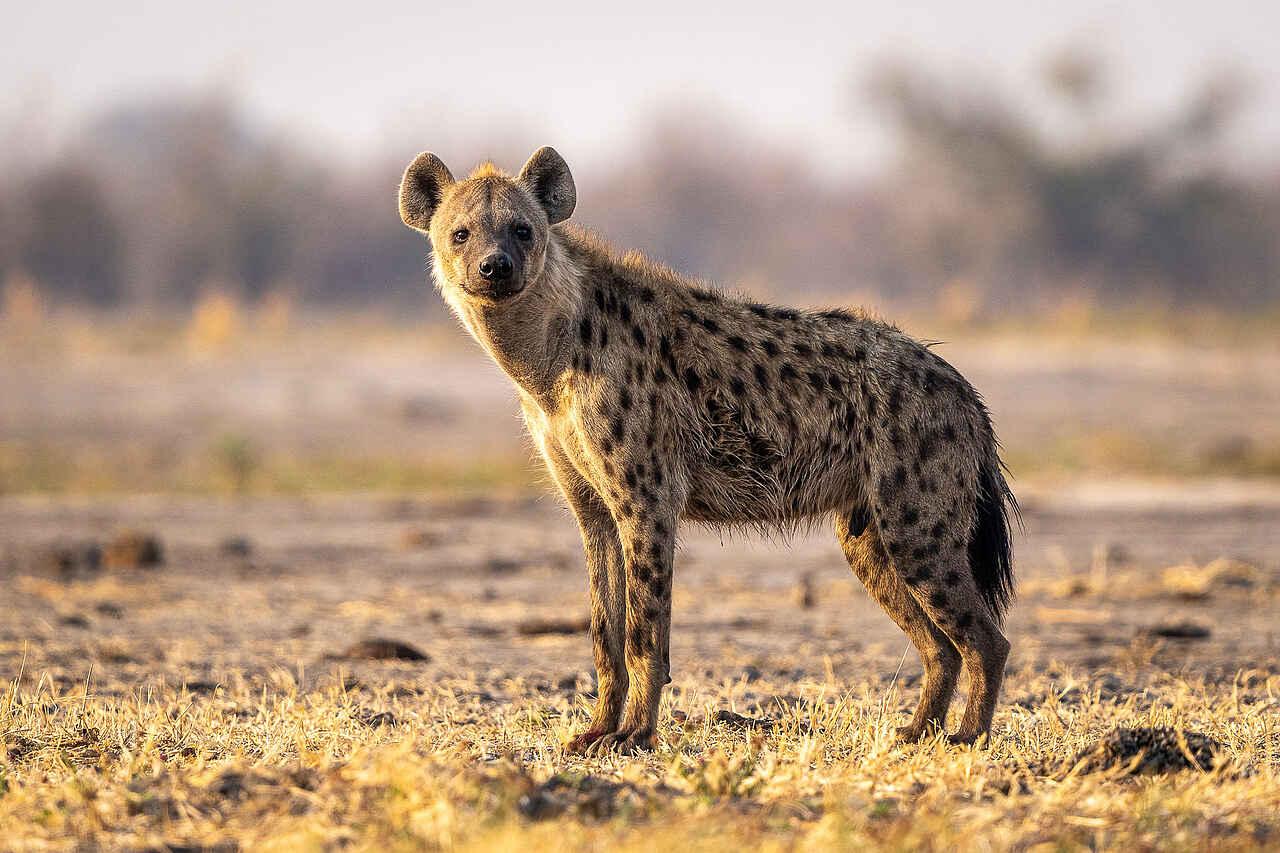
On a wind-scoured morning, in the village of Abu Ramad, the gateway to Jabal Elba (Elba Mountain) in the Halaib area of Egypt’s Red Sea Governorate, a pair of mutilated sheep signaled the return of a visitor from the past—the spotted hyena.
Once hunted and fattened by ancient Egyptians as a feast delicacy, the spotted hyena (Crocuta crocuta) had vanished from the region for over five millennia. In 2024, it has traversed deserts and borders into a land that no longer remembers how to live alongside it. According to Aldoushy Mahdy, Associate Professor of Aquatic Ecology & Marine Biology, Al-Azhar University (Assiut), there have been no more sightings since then.
“Local shepherds came upon two sheep that had been killed and partially eaten, which was a rare occurrence in our region,” Faisal Ohag, an English teacher living in Halaib, said.
The huge, violent bite marks on the prey and the footprint of the predator, much larger than that of a dog, raised alarms about the predator. The shepherds rallied the locals, following the footprints by car, motorcycle, and camel to a cave in Jabal Elba, where, to their surprise, they discovered it was a spotted hyena.
Officials from the Ministry of Environment confirmed that the spotted hyena had not been observed by personnel at the Elba Protected Area. Instead, the locals cornered it and attacked it, according to Ohag.
“They used swords, sticks, and rocks to kill it,” he said, noting that he arrived after it had already been killed.
While the spotted hyena may be an unfamiliar threat to today’s villagers, it was once far more integrated into Egyptian life.
“You can see hyenas in ancient Egyptian art in the Old, Middle, and New Kingdoms,” Salima Ikram, Egyptology professor at the American University in Cairo, said. “In the tombs of Saqqara, they are shown not only being captured, but also force-fed in preparation to be eaten.”
She added that while ancient Egyptians feared hyenas, they regarded their meat as a luxury, an ‘exotic kind of food.’ Beyond consumption, hyenas played a role in Egyptian material culture, being utilized in medicine and rituals, and were deeply integrated into society.
The spotted hyena is the largest of three hyena species, alongside the brown hyena and the more common striped hyena in Egypt, often depicted in ancient Egyptian art. It roams much of sub-Saharan Africa, including Chad, the Central African Republic, South Sudan, Ethiopia, Kenya, Tanzania, Botswana, Angola, Namibia, and parts of South Africa.
Its reappearance in Egypt, after a 5,000-year absence, stirred both scientific intrigue and deep concern, particularly among the residents of Abu Ramad, who now face a predator long absent from collective memory.
According to a study by Abdullah Nagy, a professor of ecology and zoology at Al-Azhar University, the surprising return of the hyena could be linked to “shifting ecological conditions” in the Elba Protected Area.
“Though part of the desert belt, the Elba Protected Area briefly transforms into a natural, vivid green carpet after heavy autumn rains,” Nagy told Egyptian Streets. He explained that his team analyzed 20 years of satellite data, revealing a slight rise in vegetation between the hyena’s range in Sudan and its recent sightings in Egypt.
Mirroring Nagy’s findings is Mahdy. According to Mahdy, increased rainfall in recent years has helped Jabal Elba flourish, making it more hospitable to wildlife and plant life.
“Distinctive flora has resurged, such as the rare Dragon’s Blood tree (Dracaena cinnabari), a striking species typically found clinging to the rugged slopes of Yemen’s Socotra Island,” he shared, noting how unique and unlikely such an occurrence is.
Nagy shared Mahdy’s astonishment, noting that the coastline’s moisture makes it a more passable route than the harsh desert. However, the hyena traveled nearly 300 kilometers of desert from Sudan.
“This is rare under normal conditions,” Nagy emphasized, agreeing that the increase in plant cover may have created a “corridor” along the Red Sea Coast.
He also suggested that war in neighbouring countries could disrupt habitats, forcing animals to flee in search of safety, pointing out that hyenas, typically social in high-risk areas, may travel alone when resources are scarce.
Similarly, Mahdy finds that ongoing conflicts in Ethiopia and Sudan could have made habitats there unsafe, forcing animals to migrate in search of more stable environments.
“We believe we’ll start seeing many new species in the area,” Mahdy told Egyptian Streets.
Nagy countered Mahdy’s observation, stressing that it remains uncertain whether such incidents will increase, citing limited regional data from the Halaib Triangle, a border area difficult to study due to political and boundary issues, alongside the growing challenge of human-wildlife conflict. As of early 2025, no further sightings had been reported.
Sharing a similar fate to the spotted hyena is an African leopard that reached Egypt for the first time in 65 years more than a decade ago, in 2014. After attacking livestock in Wadi Shalal within the Elba Protected Area, the locals killed it.
“It’s hard for people here to coexist with a wild animal, because their main livelihood is raising sheep and livestock,” Ohag said, noting that if a predator kills two sheep a day, people could lose all their animals in a month, so when threatened, their response is swift and unforgiving.
“The locals refer to their livestock as their money,” Nagy supported Ohag’s opinion. “It is challenging for wildlife to expand its range and live in Jabal Elba.”
Wild animals were once the natural inhabitants of the land. As human populations grew and expanded into these areas, competition for resources intensified, leading to human-wildlife conflict (HWC), which often leads to property damage, disruption of livelihoods, and occasionally, loss of life.
To mitigate the human-wildlife conflict and foster coexistence, wildlife conservation organizations are working to raise awareness among the locals about the importance of preserving these animals, according to Nagy.
“Another way to address the conflict would be to address the economic impact of such losses and provide financial compensation to those who lose livestock, or to reduce human-wildlife interaction by securing villages,” he said, adding that using satellites to track wildlife and send alerts to conservation authorities when such an animal is near a settlement could enable rapid intervention.
Mahdy built on Nagy’s insights, calling for proactive, community-driven solutions rooted in deeper local engagement.
“The key is to raise environmental awareness within the community,” he said. “Instead of conservationists leading awareness sessions about wildlife, we could collaborate with respected elders, figures revered for their wisdom, to spread the message.”
Emphasizing the importance of local outreach at the grassroots level led by community leaders, he stressed the need for preemptive action rather than reacting after the damage is done.
“Awareness should lead, not follow,” Mahdy said.






Comments (0)