


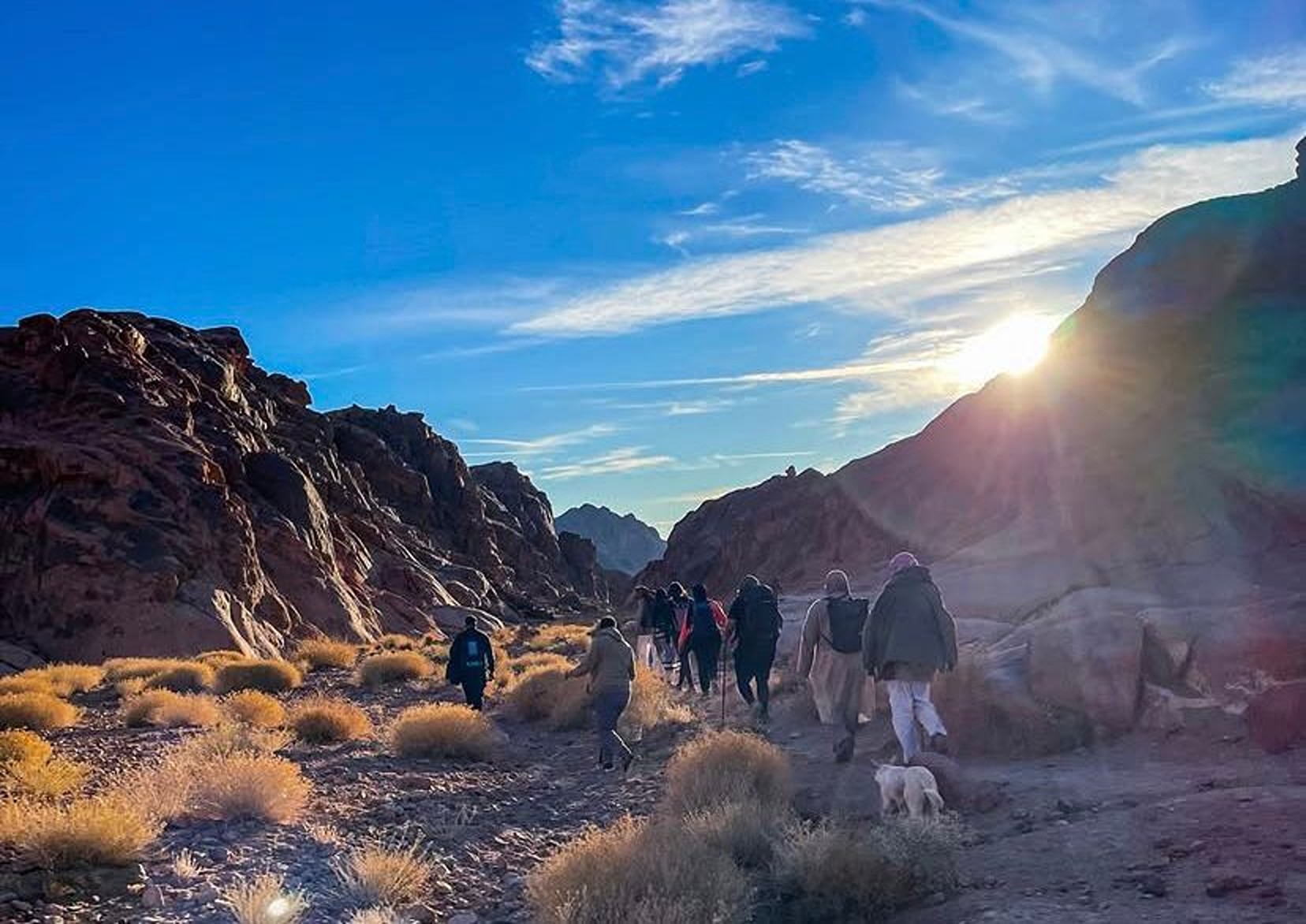
It takes time for the desert to open itself to you and to acknowledge your presence; time to reveal what it keeps hidden, and what slips past the ordinary eye.
Slowly, moment by moment, you begin to understand just how much the desert can say and show you, even when it appears to be at its most silent and most empty.
If there’s anywhere on Earth where the desert can speak volumes, even in its stillness and purity, and even when it has no need to impress, it’s Saint Catherine in Sinai. In its simplicity, where all there is is the earth beneath you and the sky above, it dares you to understand it.
Can you still your mind and become as silent as the desert? Can you find true peace when all you have is the vastness of nothingness?
In its emptiness, the desert asks us to look into that emptiness without demanding anything else. It seems to hold our hand and ask gently: Can you accept this emptiness as it is, without wanting more? Can you discover beauty even in the nothingness? And even when there is nothing but the sounds and shapes of nature to catch your attention?
While staying at Fox Camp in St. Catherine, you are surrounded by a lush garden filled with pomegranate, fig, apricot, plum, and olive trees, along with fragrant herbs. From the window, the mountain views are crisp and clear, and the wider Sinai region reveals a landscape rich with beautiful oases, winding canyons, and dramatic peaks to explore with local Bedouin guides, including Mount Sinai itself.
And while it may not promise luxury, it offers something far more meaningful: a deeply unique and distinctive experience, imbued with the spirit of the monks, spiritual seekers, pilgrims, and healers who come to this desert landscape to gaze out over the vastness and remember their own place in the universe.
Around the world today, the most important factor shaping how people choose to travel is the way a place can heal, not necessarily by entertaining or providing grand memories, but by helping someone find peace and restoration within their spirit.
This trend, often called “wellness tourism,” has expanded far beyond exclusive spa retreats into a broader movement of travel that nurtures psychological healing. It is precisely more about how people are shifting their desire to see the world, not for more experiences, but for more clarity and understanding of themselves and the world around them.
And while places like Bali in Indonesia have earned their reputation as some of the most healing destinations in the world through their ancient water cleansing ceremonies, there is another place that deserves the same reverence: the mountains of St. Catherine.
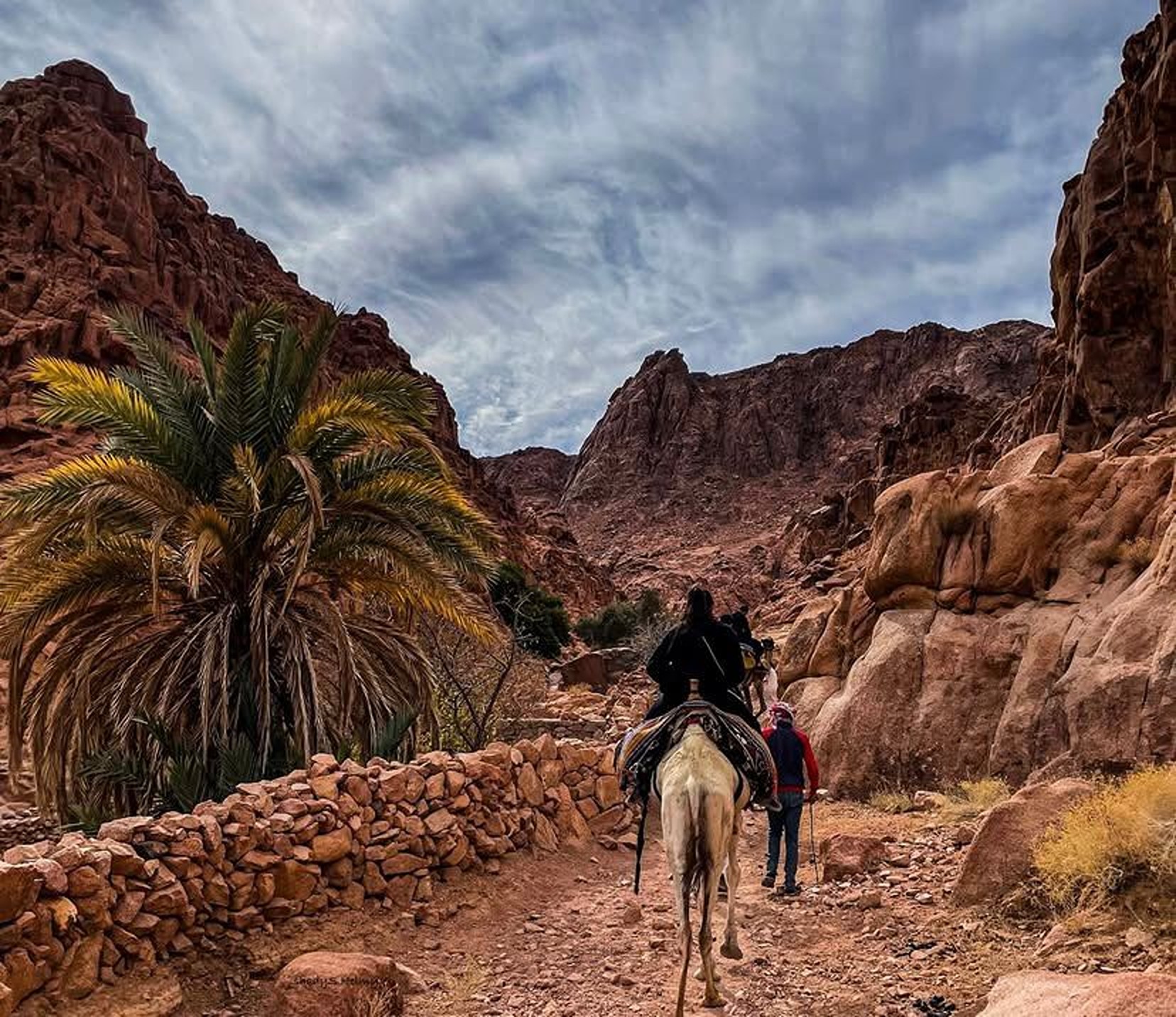
Water’s healing energy, as experienced in Bali, is instantly felt. Yet the desert heals too, but in ways that are quieter, deeper, and less easily named.
Scientific research has shown that simply immersing oneself in a desert environment can be healing in itself, without the need for rituals, effort, or ceremony.
Scientists have explored the therapeutic and restorative qualities of desert landscapes, pointing to their silence, solitude, vast openness, and minimal sensory stimulation. These benefits are often explained through Attention Restoration Theory (ART) and Stress Reduction Theory (SRT), both of which suggest that certain natural environments can calm the mind and restore mental balance.
What ART proposes, specifically, is that exposure to nature can help improve our focus and ability to concentrate. Similarly, the SRT examines the link between environmental exposure and mental stress, concluding that overstimulating urban streetscapes, such as those dominated by noise and skyscrapers, can heighten stress, while calmer, less stimulating environments help reduce it.
This idea connects to the work of Canadian researcher Holli-Anne Passmore, chair of the psychology department at Concordia University of Edmonton, who has been studying and testing ways to access the psychological benefits of nature. Her research led her to develop a simple method called the “Noticing Nature Intervention.”
The experiment showed just how much clarity and healing nature can provide humans with, even without the human having to do anything. The intervention asked participants to notice one element of nature each day for 14 consecutive days and to write down the emotions they experienced.
When the experiment was completed, those who finished the 14-day intervention were 68 percent more likely to report above-average levels of satisfaction with life and 77 percent more likely to report above-average levels of elevation.
Simply and intentionally observing nature, even something as small as noticing the textures of a piece of rock, is enough to make one feel more healed and hopeful, as Passmore’s method proved.
It is not in what we see, but in how we intentionally observe it and interact with it.
The beauty of the desert landscape in Sinai is that it tells us that nature, on its own, can be enough. It is enough to simply sit on the ground, feel its presence, and look toward the horizon. Within that moment of pure serenity and clarity, there is no need to own anything from the world, not even material possessions. The only need that remains is to own your heart and mind in that very moment.
In that moment, the desert’s emptiness and silence stand in stark contrast to humanity’s constant hunger for more; more needs, more power. Emptiness meets greed, silence meets noise, and stillness meets restlessness.
It is in our nature to rule and conquer, to fill every void with kingdoms, towns, and communities. But it is not in our nature to live with emptiness. The desert in Sinai teaches us how to face emptiness and silence not with fear, but with confidence. It teaches us to face the uncertainty of having nothing with peace and clarity.
There is nothing to run after, no wealth to seek, no ambitions to map out, but only the mystery of nature and the way it seems to hold both what has been and what is yet to come within everything it creates.
And when we choose to look toward the desert more often than toward our own kingdoms and cities, when we step beyond our walls, we begin to surrender to the discomfort of having no plans, no ownership, and no desire, and in doing so, we find peace.
Any viewpoints expressed in this article are exclusively those of the author. To submit an opinion article, please email [email protected].





Comments (0)