


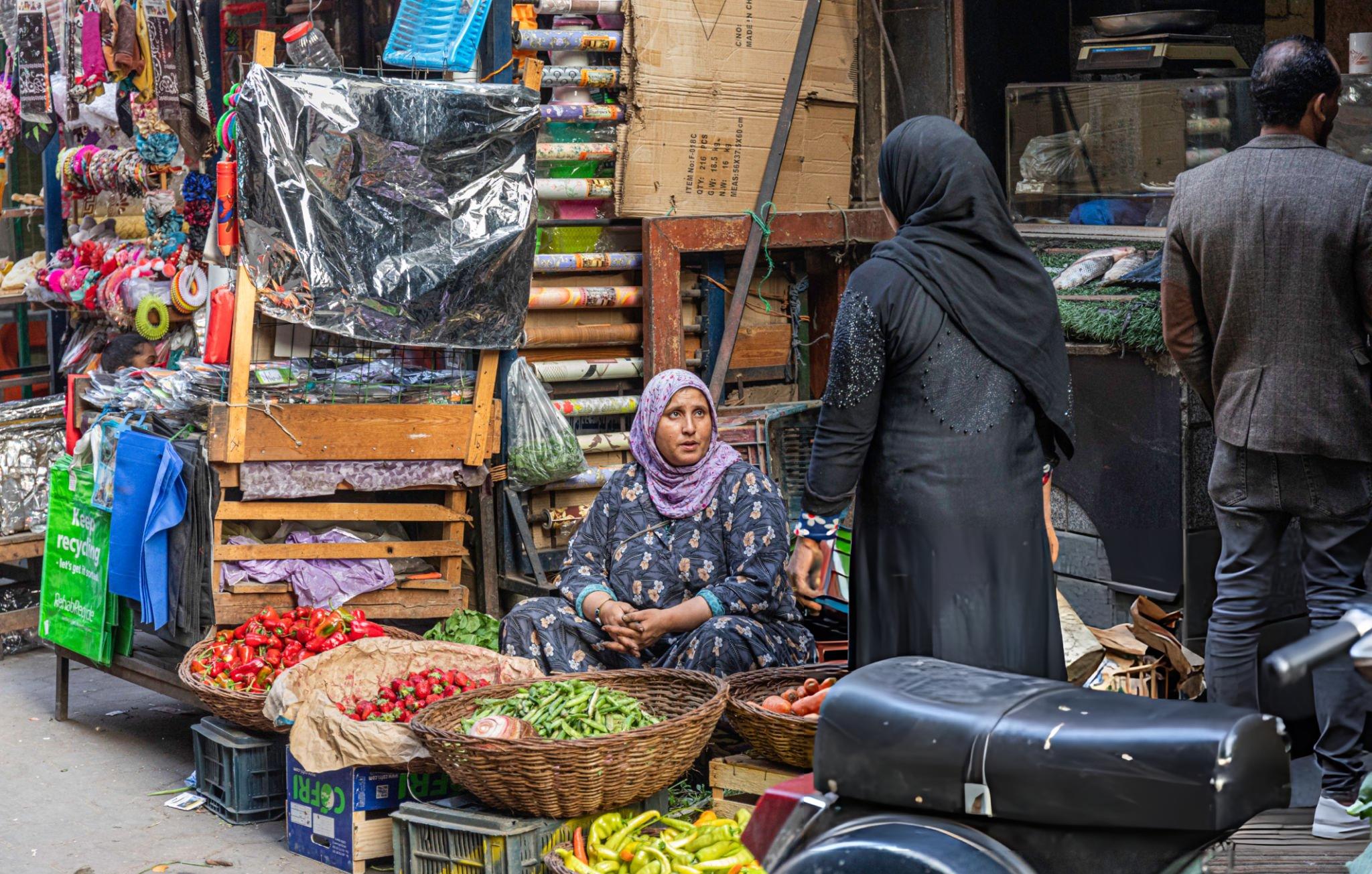
On a busy morning in Faisal Street in Cairo, the scent of fresh bread drifts through the narrow street of Adly Habib as Sabah Mahmoud, 59, arranges her bags of loaves on a worn wooden tray. She greets every customer with a smile, a familiar gesture to her recurrent and loyal base.
Across town in Attaba, Amira Abdeltawab, 38, spreads her fruits and vegetables across a mat near the metro station, her hands moving quickly to put the ripest tomatoes for the day’s customers on display. Both women, decades apart in age and coming from villages far from the bustle of Cairo, start their day in the early morning, staking out spaces that have become their own little corners of the city.
Street vending is a vital part of urban life worldwide, from mobile carts in Bangkok to stationary stalls in Mexico City. In Egypt, however, it remains legally precarious and socially stigmatized, often depicted as a nuisance to traffic, urban order, and tourism.
Yet, women like Sabah and Amira represent place-makers, as their stalls create a sense of community, local identity, and a form of survival that keeps families fed and children in school.
“My husband’s income isn’t steady,” Amira told Egyptian Streets. “To afford school for the children and cover basic needs, I had to work.”
Amira, originally from a village in Beni Suef, lives with her husband, Ayman, a daily construction laborer, and their three children in a small apartment in Attaba. Selling fruits and vegetables has been her livelihood for nine years.
“With just a primary education, selling produce in the streets was the only option I had,” she said. She buys tomatoes, lemons, potatoes, and onions from a distributor who works with a small farm, sometimes taking the produce on credit and paying the supplier only after sales.
“Fresh produce can go bad quickly, so there isn’t much room for risk. I try to sell everything the same day.”
Amira’s experience is far from unique.
Across Egypt, street vending accounts for more than half of total employment in many countries, according to a 2022 study by Banha University. Globally, at least 48 percent of trade in developing cities passes through informal channels, the United Nations Development Program (UNDP) estimates.
In Egypt, the informal economy accounts for roughly 50 percent of gross domestic product (GDP), according to the Ministry of Planning.
While women’s workforce participation remains low at 16.9 percent, compared to 70.3 percent for men, street vending is an engine of survival, community, and resilience for female street vendors like Amira.
The fresh produce vendor has been mostly working in the same location, at the Attaba metro station. Sometimes, government authorities ask her and her neighbouring vendors to move, so she packs her products and moves to another location.
Some days she makes a decent profit, other days, she barely covers the living costs, and rising prices mean she must buy less, as customers purchase smaller quantities of produce
“The hardest part is that the market isn’t like it used to be,” Amira said. “Add staying under the sun during the hot summer—it’s a tiresome job.”
Much like most female street vendors in Cairo, who are often stationary, Amira begins working as early as 8 a.m. and stretches until sunset, sometimes longer, staying in one place. Male vendors, by contrast, are more likely to move along intersections or roam streets offering their merchandise.
Across the city, in Faisal, Giza, Sabah works every day in the same spot, starting at 9 a.m. and often remaining for 12 hours.
She sells bread near her home, where she lives with her youngest son, who is in college, her 28-year-old daughter, her son-in-law, and two grandchildren. A widow for 18 years, she inherited her bread-selling spot from her late husband, who once provided for the family.
“I sit by the local coffee shop where everyone knows me,” she says. “Most of my customers are regulars. Some of them came to buy bread when they were ten years old, and now they bring their own children.”
Bread selling is her family’s main source of income. Her eldest son, who is married and works as a toktok driver, occasionally helps financially, and other times, he relies on her support. While competition occasionally shows up in the street where she works, new vendors tend to move on, leaving Sabah’s loyalty-based clientele intact.
Earnings fluctuate slightly but remain relatively stable. “Everyone needs bread,” she said.
For Sabah, the challenges of street vending began from the very start. Safety was once a constant worry. “In the beginning, I felt unsafe, especially as a woman alone,” she recalled, though now, everyone in the neighborhood knows and respects her.
“I am an elderly woman now,” she laughed.
Informal employment sustains poor people in cities around the world, while authorities view street vending as a problem, the cause of congestion, an untidy urban environment, not as a solution to deeper economic challenges, according to the United Nations-Habitat. However, Cairo’s informal labor and markets are a home for those determined to live a decent life.
“As long as my children and grandchildren need me, I have to endure,” Sabah told Egyptian Streets, noting that a sense of responsibility drives her daily. “I work hard to give us all a decent life. We don’t ask for pity, but I do ask for a fair chance for my children.”
She hopes her youngest son finds a stable office job, her daughter’s husband settles into steady employment, and her grandchildren enjoy opportunities she never had.
Similarly, Amira wants her children to continue their education and not end up in the same situation as her.
“Seeing my children grow more educated and wiser than I ever was makes all the effort worthwhile,” she said. “We live honestly and earn our money fairly. God willing, Allah will reward me, and my children will thrive.”
For women like Amira and Sabah, the streets are both workplace and stage. Earning daily wages to feed, educate, and protect the next generation, they embody the reality of Egypt’s informal economy, where earnings are uncertain, hours are long, and hope can be found in the small acts of selling produce and bread, day after day.




Comments (0)