


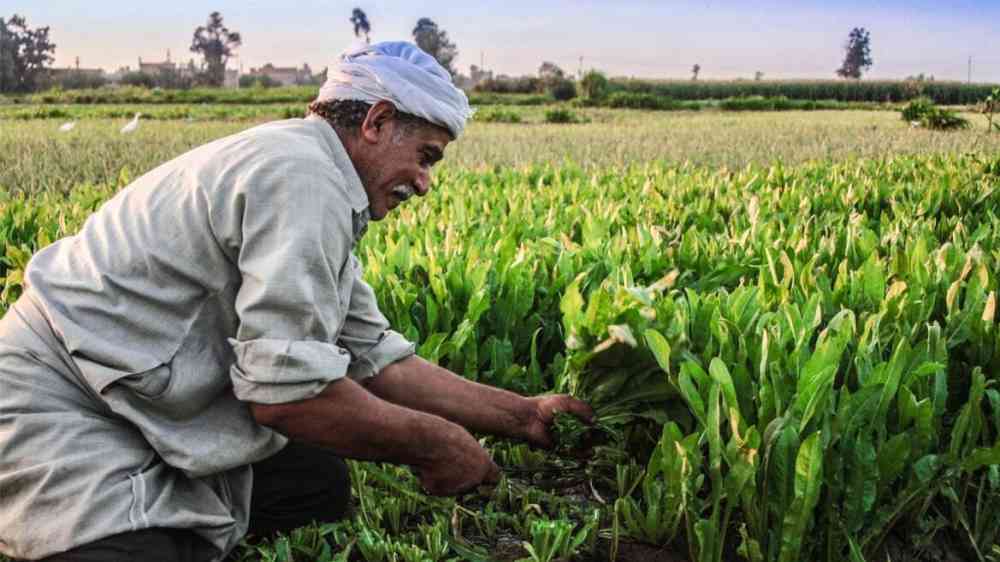
Agriculture continues to be one of the most important parts of Egypt’s economy, because it contributes a significant share of national income while also supporting livelihoods in many regions.
In recent years, data from the World Bank indicates that agriculture, forestry, and fishing have consistently contributed roughly 12 to 15 percent of Egypt’s Gross Domestic Product (GDP), with estimates of around 13 to 14 percent in 2023–2024.
This performance places Egypt above the global average, where agriculture typically accounts for less than 10 percent of GDP, showing the sector’s importance even after efforts of diversification.
Historically, agriculture’s share of GDP was much higher, standing at nearly 30 percent in the 1960s and 1970s. Over time, that share declined largely as other sectors expanded fast.
Nonetheless, Egypt’s agricultural expansion remains visible in official figures. The Ministry of Planning and Economic Development data shows that agricultural GDP exceeded EGP 1.3 trillion (USD 24 billion) by 2024/2025, reflecting both production growth and price effects.
Employment is another major dimension of agriculture’s importance. CAPMAS data, consistent with World Bank findings, indicate that agriculture employs approximately 25 to 30 percent of Egypt’s total labor force.
For millions of Egyptians, particularly in Upper Egypt and the Nile Delta, agriculture is the primary source of household income.
Beyond direct farming, agriculture also sustains indirect employment across supply chains, including food processing, transportation, wholesale trade, and agricultural services.
Geography further strengthens agriculture’s role in Egypt. Virtually all agricultural activity is concentrated along the Nile River and the Nile Delta, which together occupy less than 5 percent of the country’s land area yet support the vast majority of the population. However, domestic production remains insufficient to meet total food demand; for instance, Egypt produces only around 40–50 percent of its wheat needs, relying on imports to cover the deficit.
This concentration makes agricultural productivity highly dependent on water availability and land efficiency. The Food and Agriculture Organization and other international bodies defined the threshold for water scarcity at 1,000 cubic meters per capita per year, below which countries are considered water-poor.
Egypt falls far below this benchmark, with per capita water availability estimated at around 500 cubic meters annually, placing it in a state of absolute water scarcity. This severe constraint is compounded by the country’s near-total dependence on the Nile River for over 90 percent of its freshwater resources, intensifying pressure on agricultural production and making efficient water use a critical determinant of food security and rural livelihoods.
Agriculture also plays an important role in poverty reduction and income distribution. Because the sector is relatively labor-intensive and accessible to lower-skilled workers, it can provide income and employment opportunities that are not easily replaced by more capital industries.
As rural poverty rates remain significantly higher than urban rates, agriculture serves as a first line of economic protection in vulnerable communities. For example, recent estimates show that poverty affects approximately 28 percent of rural populations, compared to around 12 percent in urban areas, underscoring the sector’s critical role in supporting livelihoods.
Research from the International Food Policy Research Institute suggests that agricultural growth tends to reduce poverty more effectively than growth in other sectors, since it raises rural incomes directly and can lower food prices for consumers.
Additionally, Agriculture’s link to food security is consequential in a country with a fast-growing population, now exceeding 100 million.
Even where domestic production has improved, Egypt still relies heavily on imports for key staples, especially wheat. This means agriculture is a strategic priority tied to stabilizing food supplies and reducing exposure to global price shocks and supply disruptions.
Agriculture’s importance, therefore, extends beyond its direct contribution to GDP. It supports other industries related to agriculture, such as food processing, packaging, and logistics, creating value chains that reach far beyond the farm.
With a 12 to 15 percent contribution to GDP, employment of roughly one-quarter to one-third of the workforce, and a central role in rural livelihoods, food security, and trade, the sector remains a cornerstone of Egypt’s development path.




Comments (0)