


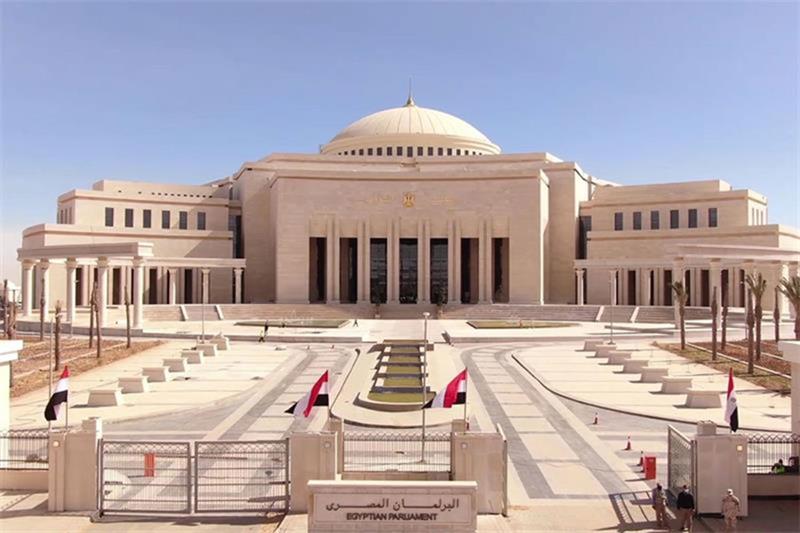
Egypt’s House of Representatives on Tuesday,14 July, approved a government-drafted law granting the Future of Egypt Authority for Sustainable Development administrative, financial, and technical independence and transferring its affiliation from the Ministry of Defense to the Presidency.
The Future of Egypt Authority, also known as Mostaqbal Misr, is one of Egypt’s main state development bodies and oversees projects spanning agriculture, food security, logistics, renewable energy, and commodity distribution.
The legislation establishes a new legal and regulatory framework for the authority, also known as Mostaqbal Misr, as it transitions into an independent body overseeing projects in agriculture, food security, logistics, renewable energy, and investment.
Under the new law, the authority will operate as an independent special-purpose state body with its own legal personality and greater flexibility to manage large-scale development and investment projects, attract local and foreign investment, and increase private sector participation.
The restructuring comes as the Future of Egypt Authority has expanded far beyond its original agricultural mandate since its launch in 2022 as part of the New Delta project under the supervision of the Egyptian Armed Forces.
Today, the authority oversees projects spanning agricultural reclamation, grain storage, livestock production, renewable energy, logistics, retail distribution, technical education, and food processing.
Among its largest projects is Egypt’s 4.5 million feddan agricultural reclamation initiative, one of the country’s biggest land expansion projects aimed at strengthening food security and increasing domestic agricultural production.
The authority also operates a grain silo complex within the New Delta project with a storage capacity of 500,000 tonnes, which parliament described as the largest facility of its kind in the Middle East.
In addition, it manages around 1,500 “Super Tawfeer” retail outlets that sell essential goods, alongside livestock projects targeting annual production of around 180,000 head and an integrated poultry production system that includes 12 slaughterhouses.
In the energy sector, the authority is implementing renewable energy projects with a combined capacity of 2,320 megawatts to support development projects and Egypt’s transition toward cleaner energy sources.
The authority is also working with the Ministry of Education and Italy’s ITSAgro Academy to establish 26 Egyptian-Italian agricultural technology schools aimed at preparing skilled workers for the agricultural sector.
According to parliament, the law aims to support food, water, and energy security, reduce dependence on imports, increase self-sufficiency in strategic commodities, and facilitate the establishment of integrated urban, industrial, and logistics communities.
The legislation also seeks to create a more attractive investment environment by allowing Egyptian and foreign investors, as well as national companies, to participate in managing and operating projects affiliated with the authority.
During parliamentary discussions, Future of Egypt Authority head Bahaa El-Ghannam stressed that the legislation does not grant the authority new powers over land belonging to other state entities, but rather regulates the management of assets already under its jurisdiction.
Lawmakers said the authority’s new status would allow for faster decision-making, improved governance and transparency, and greater institutional flexibility as it continues to expand its development activities in line with Egypt Vision 2030.




Comments (0)