


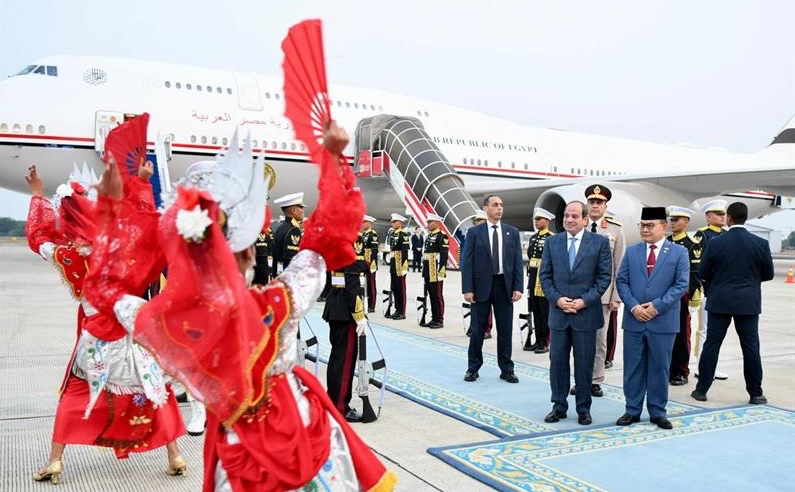
Egyptian President Abdel Fattah El-Sisi announced on 12 October that he secured around 20 agreements and memoranda of understanding during his Asian tour, which included South Korea, Malaysia, and Indonesia from 6 to 11 October, calling for Egyptian officials to move quickly to turn the agreements into projects.
Speaking at the airport upon his return to Egypt on Monday, El-Sisi described the tour as “very successful,” saying the reception he received reflected respect for Egypt’s foreign policy, which he described as balanced and moderate.
El-Sisi said the visits demonstrated political and economic interest in expanding cooperation with Egypt, citing the country’s investment opportunities, infrastructure, and stability as factors behind that interest.
He added that Egypt sought to strengthen economic and trade ties with the three countries while pursuing more balanced trade relationships to ensure mutual benefits.
During his visit to South Korea, Egypt established a strategic partnership covering political, defence, and economic cooperation. The two countries also signed 12 agreements and memoranda of understanding covering trade, industry, energy, technology, maritime affairs, education, social security, and culture.
In Malaysia, the two sides exchanged four cooperation memoranda covering investment, tourism, higher education, and women’s empowerment.
The tour concluded in Indonesia, where El-Sisi and Indonesian President Prabowo Subianto set a target of reaching USD 5 billion (EGP 263 billion) in bilateral trade by 2030.
The two presidents also witnessed the exchange of four memoranda covering maritime affairs and fisheries, statistics, an action plan for their strategic partnership, and visa exemptions for holders of diplomatic, service, and special passports.
El-Sisi said discussions across the three countries covered potential cooperation in petrochemicals, automotive manufacturing, renewable energy, agriculture, fisheries, and nuclear power, including South Korean contributions to some activities at Egypt’s El-Dabaa nuclear power plant.
He called on relevant Egyptian authorities to follow up on the agreements and understandings reached during the tour, stressing that their success would depend on implementation.
The president also said Egypt was ready to support investment from businesses and governments in the three countries, including joint projects involving public and private-sector partners.
Addressing Egyptians upon his return, El-Sisi credited the public’s resilience, patience, and hard work with helping the country maintain stability despite economic pressures that he said had persisted since 2011.
“The heroes of this battle are the Egyptian people, not Egyptian officials,” he said.
El-Sisi added that foreign governments and investors considered Egypt’s political and social stability, infrastructure, geographic location, and economic opportunities when assessing potential investments and strategic partnerships.
He concluded by thanking the leaders who hosted him during the tour, including South Korean President Lee Jae-myung, Malaysian King Sultan Ibrahim, Malaysian Prime Minister Anwar Ibrahim, and Indonesian President Prabowo Subianto.
He also thanked the delegation that accompanied him, expressing hope that the agreements reached during the visits would soon translate into concrete projects.


Comments (0)