


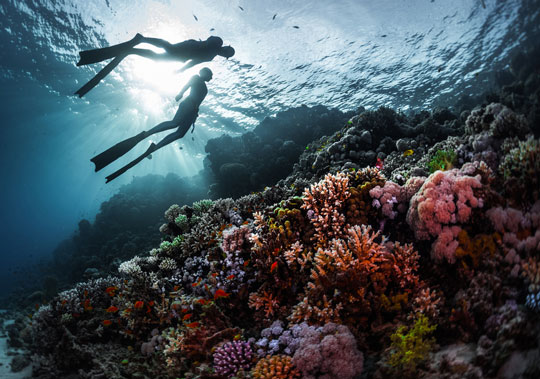
Egypt moved to protect what scientists regard as one of the world’s last great coral strongholds on Thursday, 4 December, designating the entire Great Fringing Reef in the Red Sea as a marine protected area.
Skirting the Egyptian Red Sea coastline, the Great Fringing Reef encompasses nearly 44 islands and is a global biodiversity hotspot. The decision, announced by Minister of Local Development and Acting Minister of Environment Manal Awad, aims to safeguard biodiversity and promote sustainable development.
The designation of the Reef as a protected area, issued under Mostafa Madbouly, the Prime Minister’s Decree No. 4419 of 2025, expands Egypt’s nature reserve boundaries on official maps and tasks the governors of the Red Sea and South Sinai to oversee new conservation and management measures.
It also provides a strong legal framework for conservation under the Law No 102 of 1983 for Nature Protectorates, Professor Mahmoud Hanafy, Chief Scientist at the Hurghada Environmental Protection and Conservation Association (HEPCA), told Egyptian Streets.
The 2000-kilometer-long coral reef is described as “great” for being one of the longest fringing reefs worldwide, which are coral reefs that grow directly from the shoreline, as well as its resilience in the face of climate change, Hanafy explained.
Many scientists suggest that by the end of the century, coral reefs as ecosystems will disappear from Earth.
“But Egypt’s reef could survive,” Hanafy stated, saying that there is clear scientific evidence that the Great Fringing Reef could be one of the last coral refuges in the world. With expectations to show greater tolerance to warming waters and heightened acidification compared with most corals elsewhere on the planet, the Red Sea corals are a “hope spot” for the future.
A teeming sanctuary of corals, fish, invertebrates, and marine mammals, the annual capital of the Great Fringing Reef is about USD 7 billion (EGP 330 million) from diving and snorkelling-related activities, one of the highest reef revenues worldwide, adding economic importance to its global ecological significance.
The Egyptian Red Sea is home to 325 types of reef fish, of which 17 percent are endemic species to the Red Sea.
With Egypt’s new declaration, all consumptive use of biodiversity in the area of the coral reef system would be prohibited, meaning no one should be allowed to fish there, Hanafy said.
“The economic value of a [reef] fish alive is much higher than its value as a catch,” he stressed. One example would be sharks.
A shark as a tourist attraction garners around 200,000 USD a year, while its value as catch ranges between 150-300 USD, according to Hanafy, who stated that continued fishing will reduce the resilience of the reef and its corals, thus reducing its economic value.
As the reef ecosystem continues to be threatened by human activities, Hanafy calls for sustainable tourism regulations. He emphasized the need to establish and monitor clear best practices for determining what he calls the reef’s “carrying capacity” for non-consumptive uses of biodiversity. This includes setting limits on the number of divers, tour boats, equipment, and other activities allowed in the area at any given time.
Encouraging tourism that does not harm the ecosystem, Hanafy emphasized a collaborative management model in which the tourism sector, including hotels, leisure boats, and tour operators, actively participates in conservation efforts and ensures that visitors follow best practices.
This approach involves the private sector working with the Egyptian government and the Ministry of Environment, and developing a network of designated persons for the care of marine protected areas.
By treating conservation as a “win-win situation” to both conservationists and the tourism industry, Hanafy said, the approach makes protecting the reef economically attractive. Ensuring the reef’s health safeguards the long-term value of tourism investments.
As coral reef systems continue to deteriorate globally, especially in the tropics, Hanafy said the area could draw in even more divers in the future.



Comments (0)