


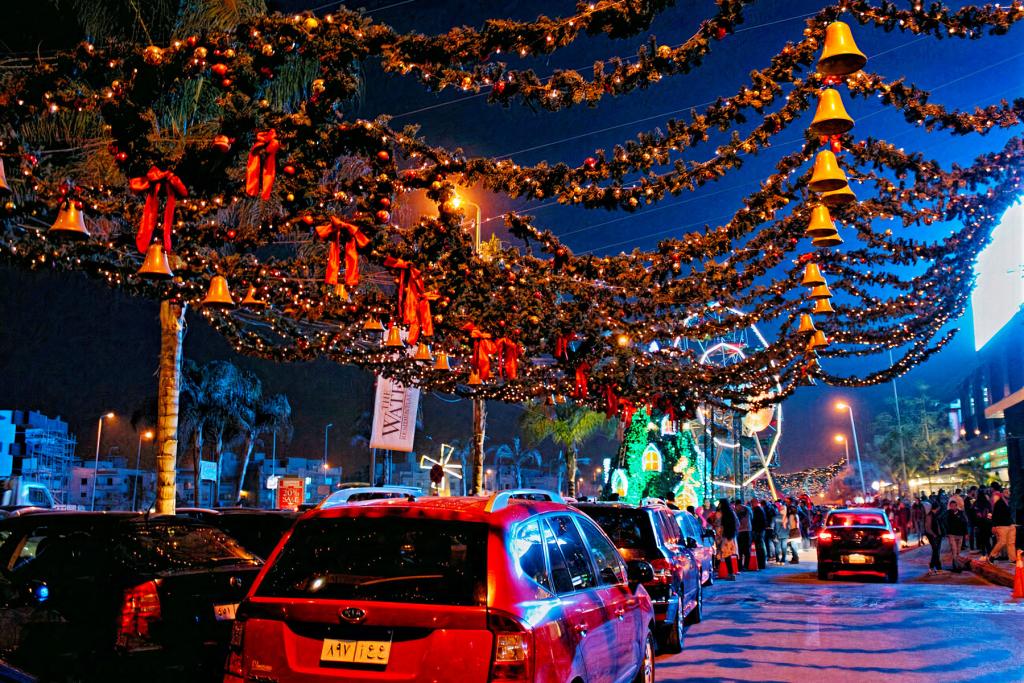
On a winter evening in Cairo, the city feels different. At Christmas Town in Hyde Park in New Cairo, fairy lights stretch overhead, Christmas songs hum through speakers, and the smell of hot chocolate drifts between stalls. Children line up for games, couples pause under glowing arches for photos, and groups of friends linger longer than usual, hands wrapped around warm cups. For a few hours, the city seems to slow down.
Scenes like this are no longer confined to Christian communities or religious spaces. Muslim visitors pose beside Christmas trees, take photos under festive lights, and move easily through decorated cafés and winter markets. Much of this seasonal décor also coincides with New Year celebrations, creating an end-of-year atmosphere that blends global winter aesthetics and public life in the city.
This openness toward festive visuals reflects a generational shift. Younger Egyptians, raised on social media and global visual culture, often engage with Christmas aesthetics as seasonal or cultural markers rather than religious symbols, enjoying the atmosphere without attaching specific religious meaning to it.
For Egypt’s Christian community, Christmas remains a deeply religious and meaningful occasion. Christianity is the second-largest religion in Egypt after Islam, yet Christians remain a minority in the country’s predominantly Muslim population. While there are no official figures, estimates suggest Christians make up a relatively small share of Egypt’s 109 million people, with the vast majority belonging to the Coptic Orthodox Church, which celebrates Christmas on January 7 rather than December 25.
Church services, fasting, and family gatherings remain at the heart of the celebration, particularly within the Coptic Orthodox tradition, one of the world’s oldest Christian communities. Historically, Christmas in Egypt has been intimate and inward-facing, centered on faith rather than public display.
Alongside these traditions, a quieter winter culture has emerged. Influenced by global media, Cairo’s cafés, malls, and other shared spaces, fairy lights, warm drinks, and themed markets now color the city’s public winter landscape.
Indian-American Anthropologist Arjun Appadurai explains that global media and cultural symbols can travel across borders and be reinterpreted locally, helping to show why these seasonal visuals appear in Cairo. This atmosphere exists alongside, not in place of, Christmas’s spiritual significance.
That appeal feels especially pronounced now. Winter in Egypt is mild compared with the intense heat of summer, with daytime temperatures often ranging between about 10 to 20 celsius , conditions that many find comfortable enough to be outdoors or walk through streets and markets without the oppressive heat of other seasons. Seasonal decorations and lighting also play a role in how the environment feels.
According to Deborah Serani, American professor of psychology at Adelphi University, the warm colors and lighting associated with holiday décor can positively influence mood and emotional well-being. In urban settings, seasonal lighting can make public spaces feel more welcoming, offering a subtle psychological lift, especially during times of shorter days and longer evenings.
In this context, the winter season in Egypt is about a shared atmosphere, spaces that feel warm, communal, and inviting, even for people who are not celebrating a specific holiday. This shift is also generational. Younger Egyptians, raised on social media and global visual culture, are comfortable engaging with festive aesthetics without attaching religious meaning to them.
Even without celebrating Christmas, winter in Cairo brings cozy cafés, decorated markets, and a lively city atmosphere that anyone can enjoy.






Comments (0)