They carried her up the stairs first. Then her wheelchair.
The office was on the second floor. There was no lift. The magazine had been impressed by her CV, had called her in for an interview, and had seemed enthusiastic about her experience.
Only when she arrived did the reality set in: access had never been considered. By the time she made it to the interview, having been hauled up two flights of stairs, the verdict was already forming. “You are simply not a responsibility we are willing to take.”
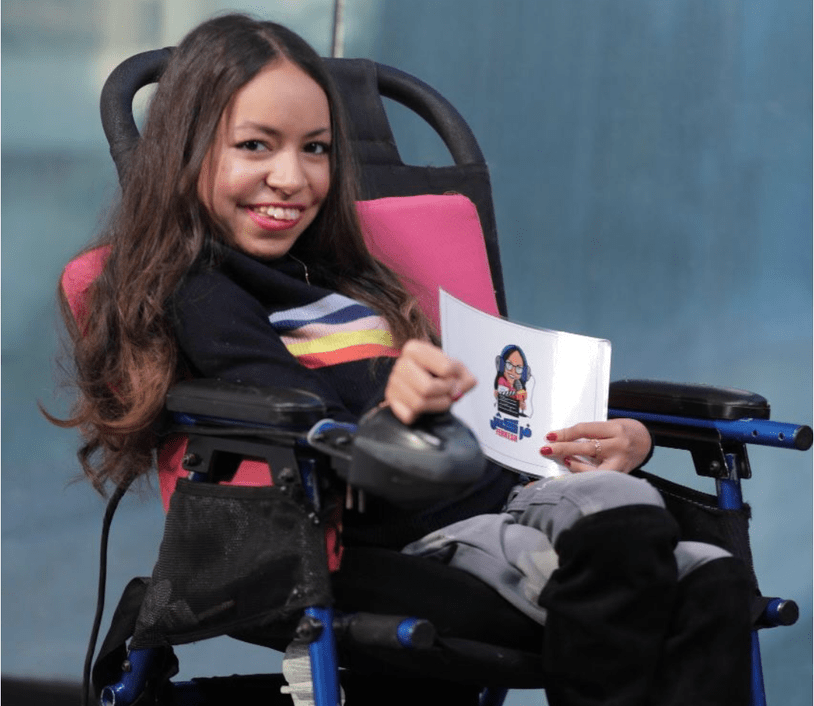
For Nadia Haitham Hasan, this has been the hardest part of building a career in Cairo. Not the work itself. Not the deadlines, the writing, the long hours. Just entering the building.
Nadia is dazzlingly accomplished for a 23-year-old. Yet, despite her manifold successes, her path has been mired by obstacles not of her making. Being diagnosed with Type 2 Spinal Muscular Atrophy (SMA) as a toddler, she tells me, has not diminished her ambitions. Other people’s reactions to her disability have.
Her energy and enterprise shine bright as she skims through her achievements in a conversation with me for Egyptian Streets. She penned her first book aged 13, ran a teen blog, wrote for her first magazine by the age of 16, and started a podcast before podcasts became trendy.
Then onwards, writing more opinion pieces for online magazines during university while mediating awareness-raising initiatives about disability. She juggled internships across the media world, curating a professional portfolio that spans copywriting, content creation, digital marketing, and opinion journalism.
Nadia showcases not only boundless productivity but a desire to be impactful. These are ambitions she has had since she was a child—she wanted to write, whether in books or radio or film, but more than anything, she wanted her words to matter.
In this, she has had considerable success, collecting an impressive array of certificates, accreditations, and work experience to date. Yet at every stage, she has found unwanted, unnecessary, structural obstacles strewn across her path.
Lessons in Underestimation
It started in her early days, at a school purportedly purpose-built with inclusivity in mind. Nadia emphasises that her initial experiences were overall very ordinary, navigating her studies, her friendships, her homework, with their natural ebbs and flows.
Only when she got a bit older, in the last three years of high school, did things begin to change. She suddenly found members of the school trying to pressure her to stop, insisting that it may be too difficult, that she may not succeed in the prerequisite timeframe.
This underestimation took its toll on her, but also spurred her forward. She left school with flying colours—a 90% grade average and 8 O-levels under her belt—all in the required three years. Only to find the same prejudices she faced at school following her into university.
She recounts how difficult it was to find a university that was wheelchair accessible. Many preferred to immediately turn her down rather than carry the responsibility of accommodating her basic needs.
They chose to perceive Nadia as a burden, rather than an asset. Yet, once again, she proved them wrong. She graduated with honours from the British University in Egypt (BUE), ranking second in her class.
Architectures of Exclusion
After graduation, Nadia was confronted with a reality she had already come to recognise: in Cairo, talent is one thing, access is another.
The staircase incident was not an exception. It was a pattern.
The same story was repeated over and over again in different contexts. Applications were met with enthusiasm until accessibility became part of the conversation. Interviews would progress smoothly until she arrived in person.
Too often, she would face flurries of manufactured excuses: “We’re so sorry, the building is not accessible”; “We simply do not have the capacity to support you”. Or thoughtless assumptions: “The work is too fast paced, it will be too difficult for you, you will not be able to cope”.
Most employers were unwilling to accommodate her needs, or would not even take the time to understand what those needs actually were. They would assume she offered less than others, that she would not be worth their time. “That’s just the way a lot of people think,” she observes, frustrated.
What her glittering résumé belies is the myriad disappointments, the emails left unanswered, the immediate shift in tone when companies found out about her disability. “One employer didn’t even have the decency to reject me outright,” she recalls. “He just kept on delaying my start date for months, until I got fed up.”
Going Public
Then, the tipping point. An unpaid internship at an important magazine Nadia was really excited about turned into another inaccessible building. She decided it was not worth the cost. It had already been a difficult period; she was feeling weighed down, suffocated by all these undeserved rejections. Something had to give.
She decided to raise her voice online. On February 11, she posted a video on her social media sharing her experiences. She explained what she was going through because of her disability and called out big companies responsible, hoping her words would resonate, spark a change, and force a reckoning.
“The law exists, but implementation does not, leaving many qualified people excluded,” she explains in her video. “This is not a sympathy story. It is a reality that needs change.”
Nadia is quick to make clear that it is not only for herself that she chose to speak out. It is a broader issue she contends against, on behalf of all people who have faced difficulties studying at their chosen schools or universities, are struggling to find work, or face barriers to access in daily life.
Her video was met with an outpouring of support, not just from friends and family, but from strangers, influencers, and celebrities too. Names including screenwriter Tamer Habib, Cairokee drummer Tamer Hashem, and actress Nelly Karim, who all messaged, commented, and shared her story. Across platforms, it reached over one million people.
As ever with social media, the response was not unilaterally positive.
For all the encouragement, Nadia also faced dismissive comments saying she should just work remotely, should stop demanding more than her due. But the right to work with people, to gain experience from in-person interactions, is a universal one, one especially critical in the field of media and news.
Requesting a flexible, hybrid working arrangement—a banality of our post-COVID reality—is in no way an overstep.
When I ask if anything surprised her about her experience sharing the video, being as vulnerable and honest as she was on a public platform, Nadia’s reply is frank. “Honestly, I wish it had.”
As much as she was moved by the reaction, by the actors, influencers, and celebrities who shared and magnified her story, she feels little has materially changed. Suggestions were made of possible steps to be taken, but nothing has come to fruition. Yet.
She emphasised the word “yet”. Although nothing transformative has happened so far, small changes still matter, and hope is not lost. For her, this is only the beginning.
Looking Ahead
Change, when it comes, will need to be structural. Nadia knows this, and she comes to the conversation with a concrete list of demands.
From the government, she wants more than symbolic gestures. She wants the five percent disability employment quota to be meaningfully enforced—not just be cited in policy—and for mechanisms to exist to hold companies accountable.
The urgency is not abstract. According to Egypt’s last comprehensive census in 2017, just over 10 percent of the population identified as having a disability, amounting to 12 million individuals. Yet a 2020 research paper found an employment rate of only 44 percent among people with disabilities. For Nadia, this disconnect is precisely the problem: the gap between legislation and lived reality is stark.
From private enterprises, Nadia calls for flexibility and accommodation tailored to individuals’ needs. For instance, hybrid arrangements that balance remote and in-person work depending on preference.
She wants accessible streets, hospitals, schools, and universities. She wants public spaces designed with inclusion in mind; spaces that serve not only people with disabilities, but also the elderly, the injured, parents with strollers, and everyone.
But infrastructure alone is not the whole story. Stairs, after all, are a logistical problem. Lifts can be installed. Ramps can be built. Policies can be enforced.
Most of all, Nadia wants to dismantle misconceptions. “If there is one thing I want people to realise,” she insists. “It’s that disability is not the central crisis of every disabled person’s life.”
Her bigger problems might be her career, her relationships, her mental health—just like anybody else. The wheelchair comes after all of that.
She does not want to be carried into rooms, physically or metaphorically. She wants to enter them as a writer. As a colleague. As a professional whose work stands on its own merit.
“Just like anybody else,” she stresses finally. “We are not all the same.” Even two individuals with the same condition can experience their disability in completely distinct ways.
“All of us are different,” Nadia concludes. “So ask us, give us the chance to tell you who we are.”
Comments (0)