


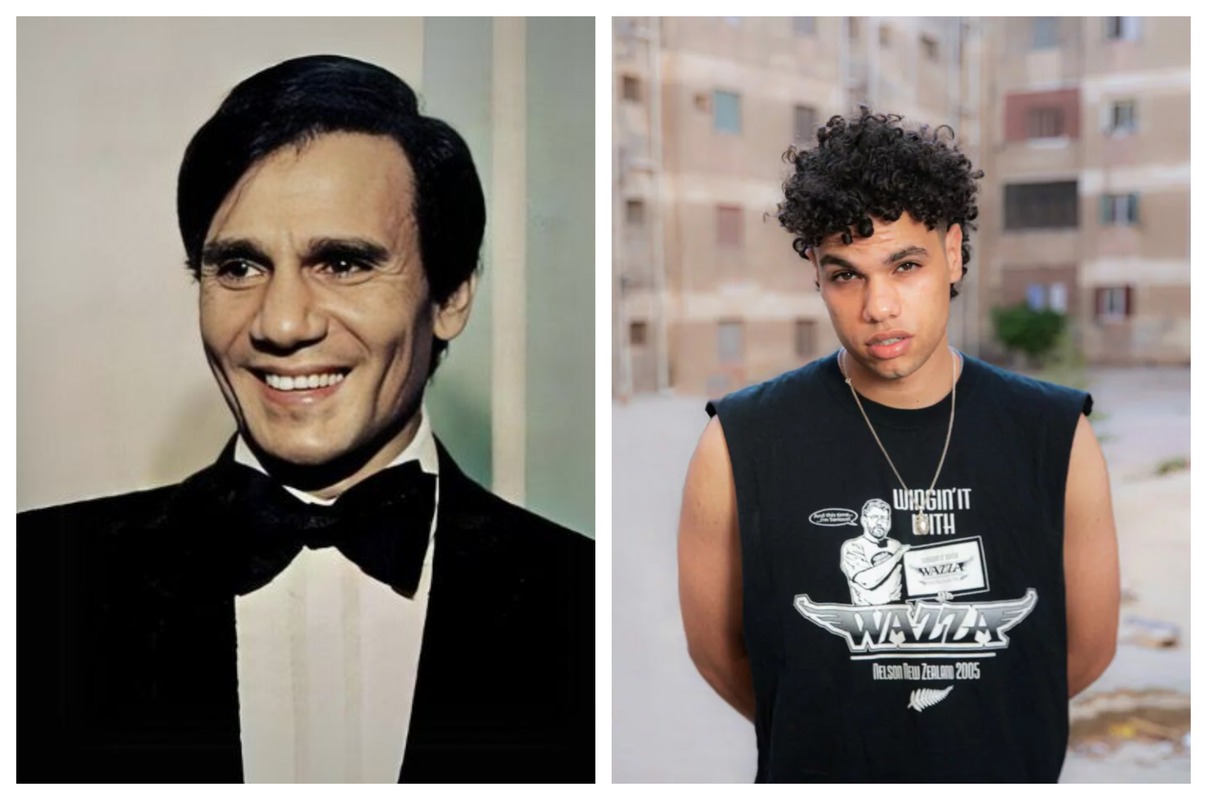
Oum Kalthoum, Abdel Halim Hafez, Asmahan, and Mohamed Abdel Wahab were not simply singers who appeared in films. They were, at the time, the cinema.
Their voices carried the emotional weight of entire films, such as Gana El Hawa (Love is in His Way to Us) in Abi Foq Al-Shagara (My Father On Top of a Tree, 1969). A single song could stretch for forty minutes, while the camera lingered on the expression of faces that seemed to renew with every modulation of the melody.
Yet that marriage between film and music has never really ended. It has only changed with time, and today, a new generation is rewriting Egyptian cinema through music.
At Petit Bain in Paris on Friday, 10 April, the Arab cultural platform Kalam Aflam presented Maqam, a curated program of ten short films that opens the Paris stop of Ziad Zaza and Lege-Cy’s World Tour.
The event is a living manifesto on how young Arab filmmakers are reclaiming music as an essential storytelling device, pushing it beyond performance or playlist fodder into a narrative that carries the emotion of an entire film.
The title itself draws from the Arabic musical scale. A maqam is not a static collection of notes but a path, a way of moving between emotions and microtonal colors.
While the genre may have shifted from classical orchestration to the raw pulse of trap and rap, the instinct remains unchanged, which is to use music as narrative architecture.
Hayat Aljowaily, founder of Kalam Aflam and a filmmaker herself, sees this fusion as both a return and a radical evolution. “The new wave of Egyptian artists taking over the music charts is organically swooping into Egyptian cinema too,” she explains.
“Because they’ve become the soundtrack to the lives of young Egyptians, they’ve naturally also become the soundtracks of the films they make or appear in. Rappers are becoming actors, and actors are becoming music artists. The labels are starting to dissipate.”
Two films in particular speak directly to the evening’s performers, such as 60 Egyptian Pounds (Short 2023), directed by Amr Salama, which stars Egyptian rapper and singer Ziad Zaza himself, while Umm El Donia (Mother of the Country, 2024), directed by Marwan Tarek, incorporates a song by Zaza.
Aljowaily notes that this creative fluidity also extends to the sound itself. “In the same way that this generation is being more fluid with their labels, moving between music and cinema, taking ownership of their visual identity, they’re also more fluid with their sound,” she says.
“Ziad Zaza is a great example. Each of his projects feels distinctly different from the one before, moving from more traditional rap and trap to pop and electronic sounds. What we’re seeing, broadly, is a generation of artists who refuse to be defined or boxed in,” she adds.
In an age when music is frequently reduced to disposable three-minute streams, Maqam returns to the beauty of Arab culture, where music has always helped build entire worlds.
It tells stories when words are not enough, and expresses emotions, like sadness, strength, love, and belonging, in a way that stays with us long after it ends.
While the sounds have changed and become more modern and edgy, the way they move, the emotional, flowing journey that defines a maqam, has stayed the same.


Comments (0)