


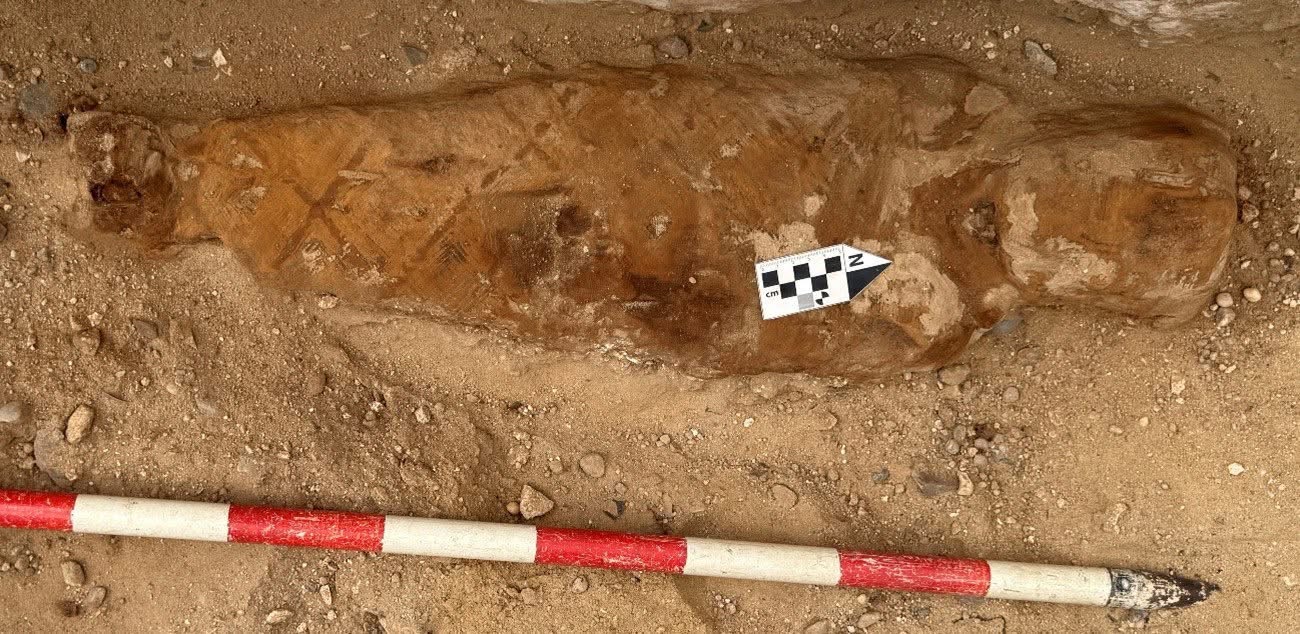
Egypt’s Ministry of Tourism and Antiquities announced that a Spanish archaeological mission from the University of Barcelona along with the Institute of the Ancient Near East working at the ancient site of Oxyrhynchus (modern-day Al Bahnasa in Al Minya governorate) have uncovered, on 18 April, a mummy with a fragment of a literary text from Homer’s “The Iliad” placed on his abdomen.
The Iliad, an ancient Greek epic poem composed around the late 8th or early 7th century BC and is set during the final weeks of the ten-year Trojan War. This marks the first known instance of a non-ritual literary work used in the mummification process.
The discovery dated back approximately 1,600 years to Egypt’s Roman period. The papyrus fragment, though heavily degraded, has been identified as part of the “Catalogue of Ships” from Book II of the ancient Greek epic poem attributed to Homer.
According to Ignasi-Xavier Adiego, a philologist at the University of Barcelona, who is part of the research team, the discovery marks a significant departure from previously known practices. “This is a big development for us,” he said. “Until now, we didn’t know that they would have used literary texts as part of this funerary ritual.”
While papyri have been found in association with mummies before, these typically contained ritualistic formulas or protective spells. The use of a literary passage raises new questions about the symbolic or cultural significance of such texts in burial rites.
Despite the papyrus being in a fragile and fragmented state, researchers have managed to identify its origins. However, further analysis remains limited. “We haven’t had the opportunity to study it using high-tech methods such as X-rays, which might allow us to read it better,” Adiego explained. “We’ve done all we can without destroying the papyrus.”
The broader excavation, led in coordination with Egypt’s Ministry of Tourism and Antiquities, revealed additional intriguing findings. Three limestone tombs were uncovered, containing multiple mummies. Among them, three individuals were found with gold foil placed on their tongues, while another had copper which is an unusual practice believed to hold ritual or symbolic meaning.
The tombs also contained large jars filled with cremated human remains. In one chamber, archaeologists found a vessel holding the burned remains of an adult human, along with the bones of an infant and the head of a feline animal, all wrapped in fabric. A second chamber revealed a similar jar containing the remains of two individuals and animal bones of the same species.
As researchers continue to examine the site, many questions remain unanswered, particularly regarding the role of the Homeric text in the embalming process. One hypothesis suggests that such papyri could have served as a form of signature by the embalmer. Another possibility is that they held a protective function, similar to ritual texts found in other burials.
However, Adiego cautions against premature conclusions. “The idea that a papyrus containing a literary text would have fulfilled this same function is much stranger,” he said. “So to this point we aren’t able to interpret the reason why there is this literary papyrus.”
Beyond the scientific intrigue, the discovery also sheds light on the social status of those buried at the site. Although little is known about their identities, the complexity of the burial process suggests that their families possessed considerable means.
As research continues, scholars hope that further analysis will shed light on the role of literary culture in burial traditions and deepen understanding of the cultural intersections that defined life and death in Roman Egypt.






Comments (0)