


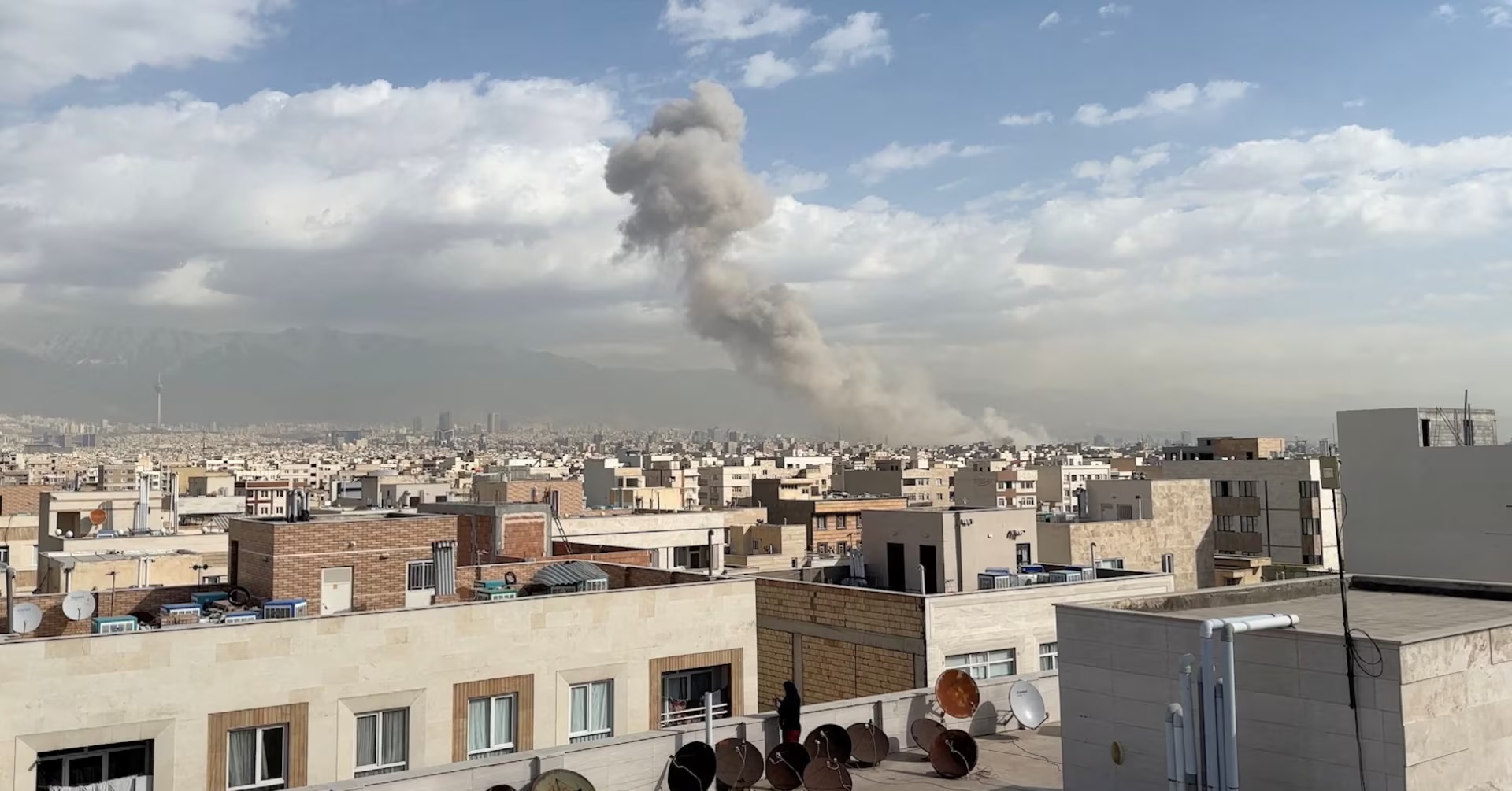
The United States and Israel have launched coordinated military strikes against targets inside Iran on Saturday 28 February. This marks one of the most significant U.S. military actions in Iran in decades.
President Donald Trump announced that the United States has commenced what he called “major combat operations” against Iran, describing the offensive as necessary to eliminate what he termed “imminent threats” posed by Tehran.
Trump warned that American casualties were possible and urged Iranian forces to surrender to avoid “certain death,” framing the campaign as essential for U.S. and global security. A U.S. official told Reuters the air and sea operations are expected to last multiple days, though the full scope of the strikes remains unclear.
Explosions have been reported in multiple Iranian cities, including Tehran, where thick plumes of smoke were seen rising over the capital’s skyline and sirens sounded as authorities closed Iranian airspace.
The escalation follows renewed U.S.–Iran negotiations in February aimed at resolving the longstanding dispute over Iran’s nuclear program. Those recent diplomatic negotiations between Washington and Tehran failed, with indirect talks in Geneva collapsing without a breakthrough to curb Iran’s nuclear ambitions.
The United States had also significantly boosted its military presence in the Middle East, deploying aircraft carriers, warplanes, and other assets amid threats of military action if diplomatic pressure failed. Washington also designated Iran as a “state sponsor of wrongful detention,” escalating diplomatic pressure even as the risk of direct conflict grew.
Prior to Trump’s confirmation of strikes, CNN stated that American forces are actively conducting strikes against Iranian military targets as part of the broader operation and that the American involvement is significant and not limited.
Officials say U.S. aircraft and naval assets are engaging Iranian missile systems, air defenses, and potentially other military infrastructure. The precise scope and damage assessment remain unclear.
Israel declared a state of emergency and closed its airspace ahead of the strikes, warning that retaliatory attacks from Iran could follow.
Iranian officials warned of a “crushing retaliation.” A source told Reuters that Iran’s Supreme Leader, Ayatollah Ali Khamenei, had been moved from Tehran to a secure location.
Meanwhile, regional tensions widened as Bahrain reported that a service facility linked to the U.S. Navy’s Fifth Fleet had come under missile attack. According to a statement from Bahrain’s National Communication Centre, carried by the state-run Bahrain News Agency, the installation was “subjected to a missile attack,” though no country was immediately blamed. Authorities said further information would be released later and urged the public to rely solely on official sources and follow government guidance.
Bahrain hosts the headquarters of the U.S. Navy’s Fifth Fleet, whose operational area spans the Gulf, the Red Sea, the Arabian Sea and parts of the Indian Ocean. There was no immediate comment from the U.S. military, although earlier the U.S. embassy in Bahrain had advised American citizens to shelter in place amid reports of missile and drone threats over the country.
The strikes come after a 12-day conflict in June 2025 between Israel and Iran and repeated warnings from both Washington and Israel that further military action could occur if Iran advanced its nuclear and ballistic missile programs.


Comments (0)