


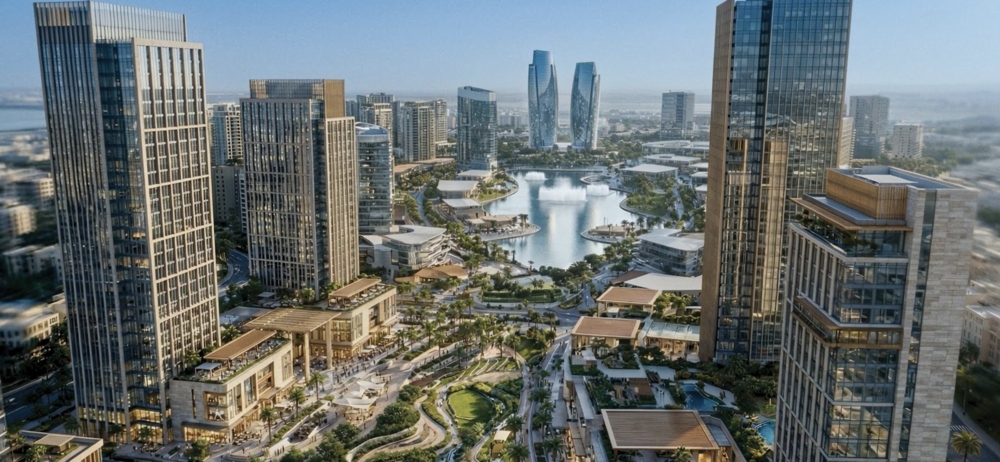
There is a tendency in Egyptian real estate to describe things in superlatives. Every development is a landmark; every master plan is visionary. The Spine, Talaat Moustafa Group’s forthcoming urban corridor at the heart of Madinaty, invites that kind of language, but the details behind it are specific enough to warrant a closer look.
Stretching across five kilometres within Madinaty, the project covers approximately 2.4 million square metres of land and 3.8 million square metres of built-up area, combining residential, commercial, hospitality, retail, entertainment, and public green space within a single continuous urban environment. It is, by any measure, one of the largest and most complex mixed-use developments ever attempted by a private developer in Egypt.
A Corridor, Not a Compound
The framing TMG has chosen for The Spine is deliberate. This is not a gated community, nor a standalone tower cluster. The developer describes it as “the central nervous system of a city”: a linear urban corridor designed around movement, connectivity, and public life rather than enclosure.
At the centre of that vision is a commitment to putting people before vehicles. The Spine is being positioned as Cairo’s first car-free community, with a pedestrian-first public realm, walkable streets, and a network of parks, promenades, and water features extending across more than one million square metres of landscaped area.
Underground, a fully integrated logistics and service network is intended to power the city’s operations invisibly, keeping the surface clear for people, greenery, and what the project describes as a green and blue infrastructure of lakes and water features designed to improve microclimate and urban experience.
The master plan has been developed by OBMI, a globally recognised urban design firm, and the architectural ambition is considerable: 165 towers rising up to 130 metres, intended to establish a new skyline identity for the eastern edge of Cairo.
The Cognitive City
The technology proposition at the heart of The Spine goes further than the “smart city” language that has become commonplace across the region. TMG is describing the development as Egypt’s first cognitive city, one where artificial intelligence, the Internet of Things, and an integrated digital infrastructure work together not just to manage services but to learn from them.
At the operational centre of this system will be The Spine Control Room, a unified command facility coordinating smart energy, water and security systems, data-driven mobility, autonomous transport, and a tram network across the entire development. Residents will interact with these systems through The Spine App, a single interface designed to personalise services, manage access, and connect users to the community platform.
The residential experience has been designed with this integration in mind. Units will feature smart-home connectivity tied into the wider Spine systems, a unified resident identification framework, and AI-enabled digital assistants operating on a permission-based model.
Emergency medical routing, wearable safety systems, and contractual service level agreements for utilities complete a residential offering that positions the development squarely at the premium end of the market.
Connectivity infrastructure runs to 5G readiness, fibre redundancy, satellite backup, and cybersecurity compliance, specifications that reflect the profile of the corporate occupiers The Spine is designed to attract.
A Business District With Regulatory Teeth
One of the more consequential details to emerge from TMG’s latest materials is the confirmation that The Spine will be located within a Special Investment Zone, bringing with it a package of tax, customs and regulatory incentives, accelerated licensing, flexible employment frameworks, and a dispute-resolution structure designed to reduce friction for international investors and businesses.
The 580,000 square metres of Grade A+ office space planned for the development will operate on a fully serviced model, with utilities, internet, security, cleaning and maintenance included in a single operating framework. Formats range from small flexible units to full headquarters configurations, with digital enablement tools covering space analytics, QR-based occupancy tracking, and collaboration infrastructure built in as standard.
TMG has identified the information and communications technology, professional services, corporate headquarters, and financial sectors as its primary targets for the commercial component, a profile consistent with the proximity to the New Capital, where government ministries and embassies have been relocating since 2024.
Scale in Numbers
The hospitality dimension of the project adds a further layer of ambition. The Spine will offer 3,500 hotel rooms and suites across upper-upscale properties, complemented by serviced apartments targeting both business and leisure demand. The retail and entertainment offering, spanning 565,000 square metres, is being positioned as Cairo’s first regional retail and dining destination, incorporating a luxury retail district, experiential fine dining, a theatre, a multi-use arena, a digital art gallery, and adventure sports facilities.
Among the more distinctive anchor features proposed is Cairo’s first swimmable lagoon alongside a landmark dancing fountain, public realm activations, and what the developer describes as AI-powered digital installations within the retail and food and beverage environments.
The location reinforces the logic of the investment. The Spine sits 12 minutes from the New Capital, 20 minutes from Al Rehab, and 25 minutes from Cairo International Airport, placing it within reach of a catchment that TMG projects will reach seven million people by 2040 as Greater Cairo continues its eastward expansion.
Meanwhile, the environmental credentials of the development are framed as structural rather than cosmetic. A centralised cooling system is projected to reduce energy consumption by approximately 30 percent compared to conventional systems. AI-driven building management, eco-friendly materials, and, notably, carbon-credit trading potential are all cited as components of the sustainability framework, the last of which TMG describes as a first-of-its-kind mechanism in Egypt.
Positioning Egypt on the Map
What TMG is attempting with The Spine is a statement as much as a development. The pitch materials describe it as “a future-forward model for integrated development and a statement positioning Egypt at the forefront of next-generation urban design”: language that reflects a deliberate effort to attract not just Egyptian buyers and businesses but international capital and global enterprises looking for a foothold in a market that has, for structural and economic reasons, often remained at the margins of regional investment conversations.
Whether The Spine delivers on that positioning will depend on execution across a long development timeline. But the specificity of what has now been made public, the technology architecture, the investment zone mechanics, the scale of the public realm commitment, suggests a project that has moved well beyond concept stage into something far more defined.
For a corridor conceived as a city within a park, The Spine is beginning to look very much like a city.
Register your interest in The Spine here.



Comments (0)