


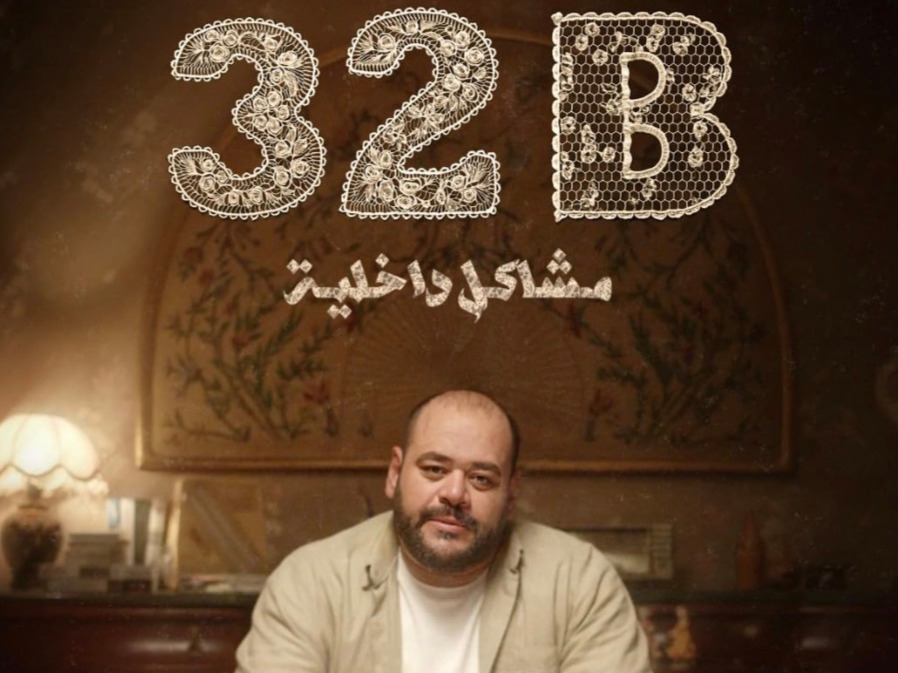
What do spaghetti dinners, awkward shopping trips, and puberty have in common? They are in scenes in one of the best Egyptian short films of the year.
The short film, 32B: Mashakel Dakhilia (32B: Internal Conflicts), 2026, takes a topic Egyptian cinema usually tiptoes around and turns it into something funny, warm, and surprisingly heartfelt. Directed by the Egyptian Mohamed Taher in an impressively confident debut and written by Egyptian scriptwriter Haitham Dabbour, the film follows a widowed father trying and struggling to figure out how to tell his teenage daughter that she has become old enough to start wearing a bra. What unfolds is a refreshingly honest look at fatherhood, vulnerability, and the awkwardness of growing up, all wrapped inside a dark comedy that feels incredibly real.
But, what truly makes 32B stand out is that it gives Egyptian audiences something they rarely see on screen: a man who is emotionally present, actively trying, and completely human. The film takes an intimate look at fatherhood, vulnerability, and the emotional silence that often exists inside Egyptian families.
Produced through a collaboration between the United Nations Population Fund and the Royal Norwegian Embassy alongside Red Star Productions, the film approaches topics like puberty, communication, and emotional masculinity with unusual sensitivity. Rather than treating these conversations as taboo or comedic punchlines, 32B presents them as deeply human experiences that many families quietly struggle with.
In the film, the widowed father, played by Mohamed Mamdouh, finds himself trapped in an internal conflict after realizing his daughter has reached the age where she needs to start wearing a bra. His problem is not a lack of love, but it is the fear and awkwardness of addressing a subject he himself was never taught how to discuss. The mother’s absence hangs heavily over the film, making every parenting decision feel lonelier and more emotionally loaded.
His daughter (Malak), portrayed by Jessica Hosam Eldin, shares a warm and believable relationship with him. Around the dinner table, they laugh, talk, and appear close. Yet, the film brilliantly reveals how even seemingly healthy parent-child relationships can struggle when it comes to vulnerability. So many words are exchanged between them, but the one conversation that truly matters becomes almost impossible to start.
That emotional paralysis is what gives 32B its power.
The film, which runs for 18 minutes, highlights that many fathers were raised in environments where emotional openness, especially around femininity, puberty, or reproductive health, was treated with discomfort or silence. The father is not emotionally absent. He is rather emotionally unequipped. Every attempt to approach the subject feels restrained by years of social conditioning telling men that tenderness should remain unspoken.
One of the film’s strongest scenes comes when the father buys a bra for his daughter and is immediately judged by the people around him. Instead of assuming the obvious that he is buying it for his child, others quickly assume the bra is intended for another woman. In one small interaction, the film exposes how society often projects suspicion onto men before empathy. The father is trying to do something caring and responsible, yet he is still viewed through the lens of scandal.
Despite being Taher’s directorial debut, the film feels remarkably assured. In an interview with Egyptian Streets, Taher stated that the final cut was exactly the film he envisioned, explaining that there were no scenes he wished he had included because everything he wanted to say was already on screen. That confidence is reflected in the film’s restrained storytelling and emotional precision.
What also makes 32B so affecting is not just its subject matter, but the tiny details woven throughout it. Taher understands that intimacy is built in ordinary moments, and the film is at its strongest when it quietly observes everyday life rather than forcing emotion.
Another memorable detail is the dinner table scene between the father and daughter. There is something deeply authentic about watching them happily eat a simple plate of spaghetti together, joking and talking with the kind of comfort that only exists between people who genuinely enjoy each other’s company. The film does not try to romanticize their life or make their relationship unrealistically perfect. Instead, it captures the warmth hidden inside routine moments, which most families overlook.
That simplicity becomes important because it makes the emotional conflict feel real. The father is not distant from his daughter. He is present, loving, and trying, which is exactly why his inability to discuss puberty with her feels so painful to him and creates an inner conflict in his mind. He wants to say the right thing; he just does not know how.
In recent years, many male characters in Egyptian cinema have often been portrayed through extremes: authoritarian, emotionally unavailable, aggressive, or carelessly comedic. 32B offers the complete opposite of that toxic masculine archetype. It gives audiences a man who is soft-spoken, attentive, emotionally invested, and is a good parent, even when he feels completely out of his depth.
The film never mocks him for that vulnerability. Instead, it treats his confusion with dignity.
Mamdouh delivers one of the most nuanced performances of his career here. He plays a “girl dad” with remarkable tenderness, capturing the awkward protectiveness, anxiety, and quiet affection of a father raising a daughter alone. Every glance, hesitation, and failed attempt at conversation feels natural. Even when he says very little, Mamdouh makes the audience understand exactly what the character is feeling.
The brilliance of the performance lies in its restraint. He does not overplay the emotion or turn the father into a dramatic martyr. Instead, he feels like a real Egyptian father who is someone loving enough to try, but unequipped by the culture around him to know how.
That honesty is what gives 32B its emotional weight. Beneath the dark comedy and awkward silences is a deeply compassionate portrait of masculinity rarely shown on Egyptian screens: a man still learning how to express love openly.
After premiering at the Carthage Film Festival on 15 December 2025 in Tunis, 32B went on to become the first Egyptian short film selected for the Tribeca Film Festival in New York City for its North American Premiere in June 2026, marking a major achievement for both the film and Taher’s emerging career. 32B will compete in the festival’s short narrative official competition.
What gives 32B its lasting impact is that its story extends far beyond Egypt. While the film is deeply rooted in Egyptian culture and family dynamics, its emotional core feels universal. Any parent, regardless of nationality, can recognize the fear of saying the wrong thing, the pressure of trying to protect a child, or the quiet desperation of wanting to be a good parent without always knowing how. That universality is what makes the film so affecting. Beneath its specificity is a simple but deeply human story about someone trying their best for the person they love most.





Comments (0)