



The beat dropped. Egyptians listened. And then they did a double-take. That familiar tune was not an old favorite. It was Pitbull’s new song ,released in June 2026, borrowing heavily from “Satalana,” the Egyptian hit that had taken over local feeds in 2023. Within hours of its release, social media feeds in Egypt were filled with comparisons, reactions, and one recurring question: did pitbull give credit to the Egyptian version?
The original version of “Satalana” dates back to 2023, when it first emerged as part of the soundtrack for the Egyptian film Baad El Shar (God Forbid, 2023). It was performed by a lineup of popular shaabi (off the people) and folk artists including Abdel Basset Hamouda and Mahmoud El Leithy, and quickly broke out of the film’s context to become a standalone cultural moment. The track spread rapidly across weddings, street celebrations, parties, and meme pages, becoming one of the most popular Egyptian songs with over 25 million streams on YouTube.
Over time, the song stopped being just a soundtrack and became a digital “meme sound” reused and reshared across social platforms. That online life is what later made it instantly recognizable when listeners heard echoes of it in Pitbull’s version.
Before the current controversy, “Satalana” had already made an unexpected leap into global pop culture. The track was featured in the closing scene of the revival season finale of American series “Malcolm in the Middle”, where it played during the final moments of the episode titled “Life’s Still Unfair”. The placement introduced the Egyptian sound to a wider international audience and sparked surprise among Arab viewers who suddenly heard a familiar street anthem in a Hollywood sitcom ending.
When Pitbull posted his version featuring Lil Jon, the reaction from Egyptian listeners was immediate. The comments section quickly filled with people pointing out that the original song was Egyptian and questioning whether the artists behind it had been properly credited. Comments included, “This was a hit in the summer of ’23 in Egypt,” “Original song is Egyptian ‘Satalana’ published 2 years ago,” and “I hope he gave credit to the Egyptian artist who did this song.” Others were more direct, writing, “Broo give credit to Egypt!!!!! We had this hit for years,” while many jokingly accused Pitbull of “stealing” the song, with comments such as “We got robbed”. The flood of reactions highlighted just how strongly Egyptian audiences associated the track with the viral hit that had already become a cultural phenomenon in Egypt.
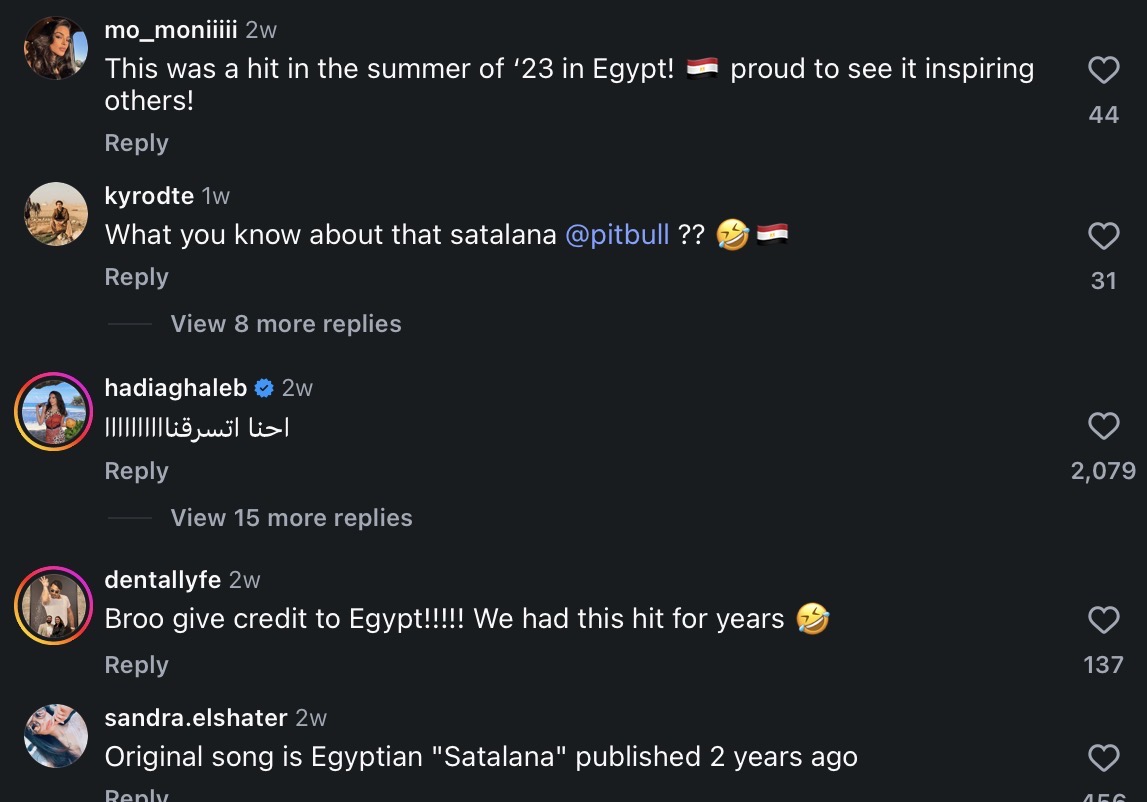
A major part of the online debate focused on attribution. Many posts accused the release of not clearly acknowledging the Egyptian origin of the sound, arguing that the cultural source was being overshadowed in mainstream promotion and no credits were given to the original song. At the same time, others highlighted that official Spotify description does include composer credits, listing Karim Achour and Mostafa Hassan among the credited writers and composers for the track. Yet, the credits were not mentioned in any other platform.
The debate surrounding “Satalana” reflects a broader conversation about what credit means in the streaming era. While music platforms typically provide creator information through metadata, scholars and industry observers have argued that metadata alone does not determine public recognition.
Music metadata influences what becomes searchable, discoverable, and visible online, while the wider public narrative around a song is often shaped by marketing, media coverage, and social media circulation. In cases where a viral sound originates from a specific cultural context, questions of attribution can therefore extend beyond formal credits and into debates about cultural visibility and recognition.
Now, the reaction to Pitbull’s “Satalana” sits at the intersection of pride and frustration. On one hand, there is excitement that an Egyptian sound has reached one of the biggest names in global pop music. On the other, there is concern that the original creators and cultural context are being diluted as the track moves through international platforms.






Comments (0)