


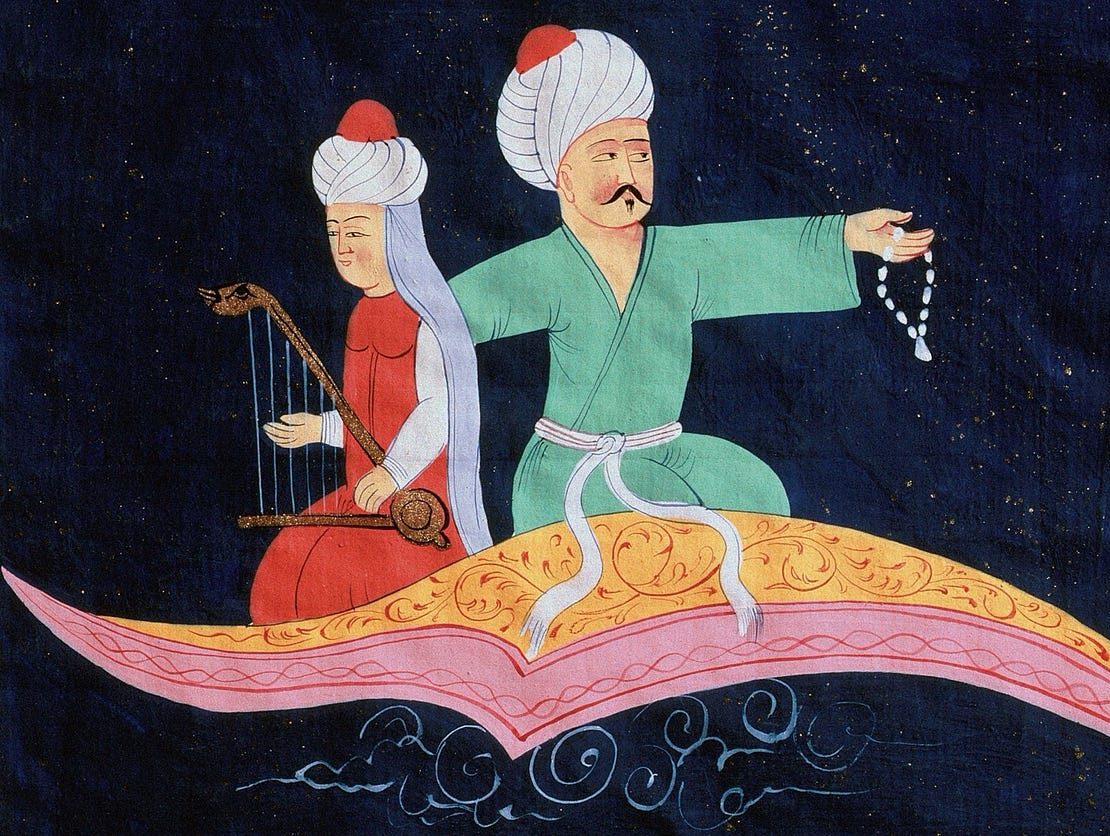
More than a millennium after its earliest tales began circulating, Alf Lela w Lela in Arabic and ‘Arabian Nights’ in English remains, in the literal sense, unfinished. The collection has no verified author, and no fixed table of contents, only a widening ocean of manuscripts, oral performances, and translations that have added, subtracted, and reshaped its stories for centuries, and continue to do so today.
The collection, known in Arabic as Alf Lela w Lela and in English as ‘Arabian Nights’, is a story that contains other stories, drawing on folk traditions across ancient and medieval sources, with Persian, Indian, Greek, Jewish, Turkish, and Arabic folklore, literature, and mythology.
The book’s core premise is that Shahryar, a king embittered by a former wife’s betrayal, marries a new bride each night and has her killed at dawn. When he marries Scheherazade, the daughter of the king’s chief vizier, she saves herself by telling him a story each night and breaking off at a cliffhanger, forcing him to spare her so she can finish the tale the next evening.
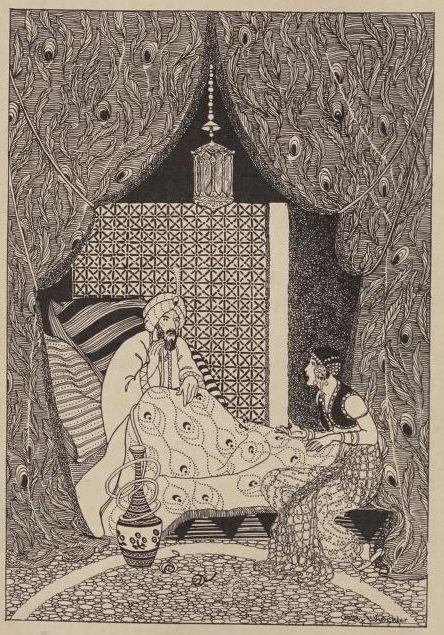
She does this for a thousand and one nights. But Scheherazade’s stories routinely contain characters who tell their own stories.
The main tale opens onto another, which opens onto another, and another, with no clear point of end. According to a book by Richard Van Leeuwen, a lecturer in Islamic studies, the book’s structure of nested narration is its defining formal device, and one that makes the nights resistant to ever being treated as a closed, single object.
Origins of the tradition
The earliest layer of the collection traces back to a Persian book of tales that dates back to the third to seventh century, known as Hezar Afsan (A Thousand Tales), which was translated into Arabic and reworked between the late eighth and early ninth centuries, absorbing material from Indian, Persian, and Arabic storytelling traditions along the way.
Over the following centuries, storytellers and scribes across the Islamic world folded in new material of fables, romances, comic anecdotes, and tales of the Baghdad caliph Harun al-Rashid, compiled during the Islamic Golden Age, roughly the 8th through 13th centuries.
No single Arabic manuscript has ever been identified as complete or authoritative. Even the collection’s most-cited Arabic edition, printed by the Bulaq Press in Cairo in 1835, was itself an editorial assembly of variant material rather than a transcription of one origin.
The book’s Western fame, and much of its modern shape, can be traced to a single translator who took considerable liberties with it. Antoine Galland, a French Arabist, published the first European translation, Les Mille et Une Nuits (One Thousand and One Nights, 1704 – 1717) in twelve volumes, based on an incomplete Syrian manuscript.
One of the book’s most enduring chapters, which includes ‘Aladdin’ and ‘Ali Baba and the Forty Thieves,’ was written in early-18th-century France by a storyteller whose name went largely unrecognized for 300 years.
These stories do not appear in any known Arabic manuscript that predates his translation. Galland added them after hearing them told in Paris by Hanna Diyab, a Syrian storyteller from Aleppo, whose own travel memoirs were only recently translated into English.
Subsequent translators kept reshaping the book rather than simply transmitting it. The English Orientalist Edward Lane produced a heavily annotated translation between 1838 and 1841 while living in Cairo, softening or omitting material he judged indecent.
Four decades later, the explorer Sir Richard Burton went the opposite direction, producing an unexpurgated 16-volume version, ‘The Book of the Thousand Nights and a Night’, sometime between 1885 and 1888, that restored explicit content and layered in his own extensive ethnographic commentary, drawing on an earlier complete translation by John Payne.
The Argentine writer Jorge Luis Borges, tracing this lineage of translators, argued that Galland had effectively “established the canon” of the Nights as the West would come to know it, one that later translators would work with, against, and around.
The pattern has not stopped. Every major translation, into French, English, German and most of the world’s major languages, has arrived with its own additions, omissions and emphases, drawn from a shifting pool of manuscripts that were themselves never standardized.
The result is a work still being assembled by its readers. A book whose thousand and one nights, scholars note, were always meant to suggest an idea of infinity —a story that, by design, never quite ends.






Comments (0)