


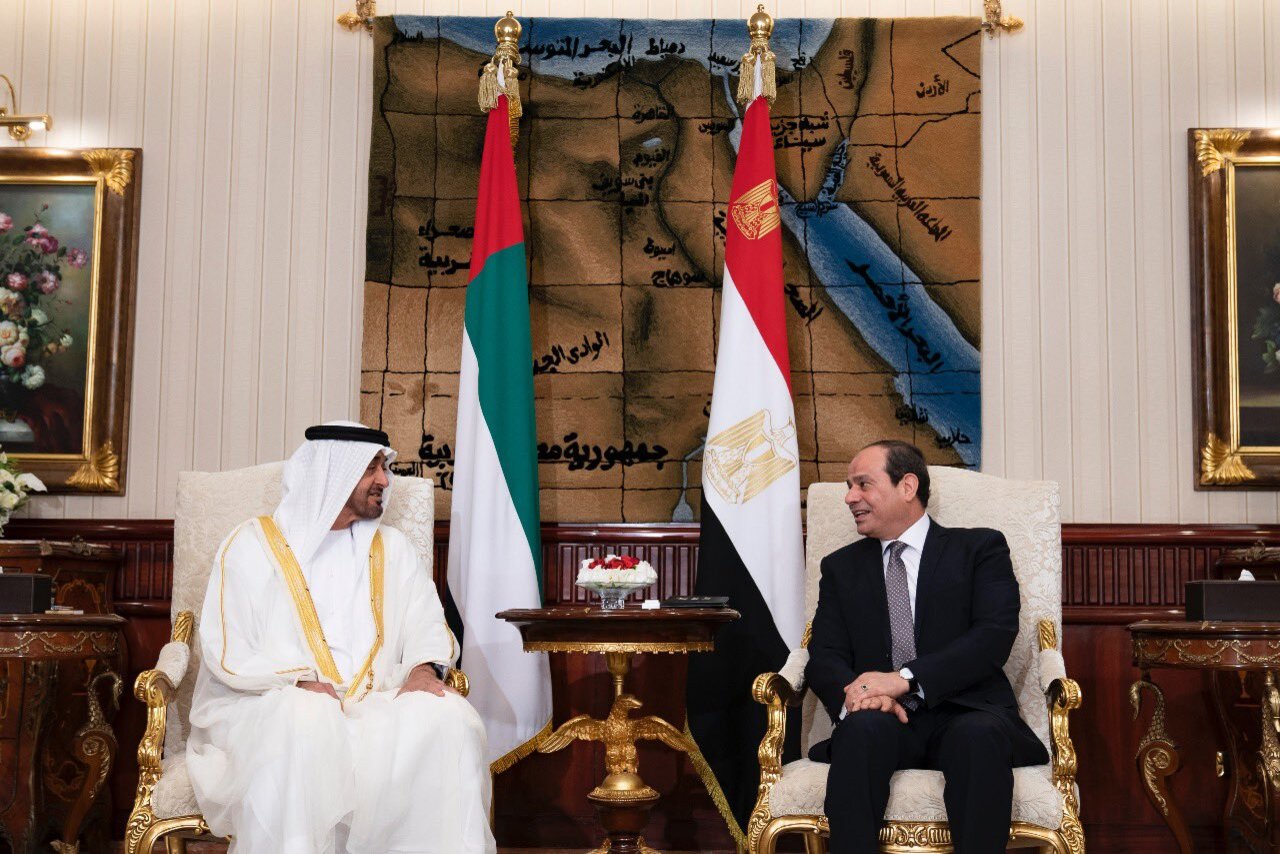
As Cairo and Abu Dhabi multiply joint initiatives for a ceasefire in Gaza and the delivery of humanitarian aid, the visit of Emirati President Mohamed bin Zayed to Egypt at the end of September illustrates a relationship that has become strategic on economic, political and diplomatic fronts.
A historic relationship turned regional model
Relations between Egypt and the United Arab Emirates date back to the UAE’s creation in 1971. At the time, Cairo was among the first to recognise the new state, supporting the union of the seven Emirates led by Sheikh Zayed bin Sultan Al Nahyan. The latter distinguished himself through his support for Egypt during the October 1973 war, declaring that “the blood of an Arab is precious”.
Since then, cooperation has continued to grow, spanning politics, culture, security and the economy. The Emirates have provided Egypt with consistent financial and diplomatic support, including during periods of political transition. Between 2020 and 2025, Emirati investments exceeded USD 60 billion, making Abu Dhabi the leading foreign investor in Cairo. The two countries have also strengthened their security coordination, particularly in combating terrorism and extremist ideologies, through joint programmes and the establishment of an Al-Azhar branch in the Emirates to promote a moderate interpretation of Islam.
This close relationship also reflects a convergence of views on major regional issues: counter-terrorism, the crises in Syria, Libya and Yemen, and opposition to foreign interference in the Arab world. Regular exchanges between leaders maintain tight coordination on sensitive matters, from the Palestinian cause to Gulf security.
An economic relationship in full expansion
These political affinities are matched by an unprecedented economic boom. According to CAPMAS, trade between Egypt and the Emirates rose by 71 percent between January and July 2025, reaching USD 5.4 billion. Egyptian exports to the Emirati market, driven by jewellery, precious stones, food products and electrical equipment, more than doubled in one year.
The Emirates remain one of Egypt’s leading foreign investors, with total investments estimated at USD 65 billion. In February 2024, a record USD 35 billion agreement for the development of the coastal megaproject of Ras Al-Hikma marked a turning point, followed by the launch of the Marassi Red Sea resort project in 2025.
Emirati investment now extends to strategic sectors. In January 2025, the state-owned ADQ and the Holding Company for Maritime and Land Transport signed an agreement to build 32 dry ports and a vast logistics zone in Alexandria, aiming to make Egypt a regional hub for trade and maritime transit. More than 1,600 Emirati companies now operate on Egyptian soil.
During their most recent meeting in Cairo, President Abdel Fattah Al-Sisi reaffirmed his determination to “remove all obstacles” to Emirati capital, while Sheikh Mohamed bin Zayed praised Egypt’s economic reforms and improved investment climate.
A diplomatic alliance serving peace and humanitarian action
On the diplomatic front, both countries present themselves as promoters of stability in a region plagued by crises. Together, they call for greater coordination among Arab states and stronger regional solidarity, particularly in the face of security and humanitarian challenges.
Their joint engagement in the Gaza crisis illustrates this shared will. Since 2023, Cairo and Abu Dhabi have acted in concert to deliver humanitarian aid and encourage a lasting ceasefire. In September 2025, during their summit in Cairo, the two leaders reaffirmed their support for the truce initiative backed by Washington, while defending the implementation of the two-state solution, a position shared by most Arab governments.
The Emirates, with Egypt’s logistical support, also launched a major humanitarian project: the construction of a water pipeline linking an Egyptian desalination plant to the coastal area of Al-Mawasi, in southern Gaza. The infrastructure will provide around 600,000 residents with access to drinking water, independently of Israeli networks. Approved by Israeli authorities, the project stands as an example of active and pragmatic humanitarian diplomacy.
At the same time, the two countries continue their efforts to rebuild and assist Palestinian communities. The Emirates have begun airdropping humanitarian parcels, while Cairo serves as a logistical corridor for transporting equipment and supplies into Gaza.
Beyond the Palestinian issue, this cooperation reflects a shared vision of a Middle East based on dialogue, stability and development. In a geopolitical context marked by fragmentation, Egypt and the Emirates stand out as a tandem for peace, both pragmatic and committed to maintaining balance and stability across the region.



Comments (0)