


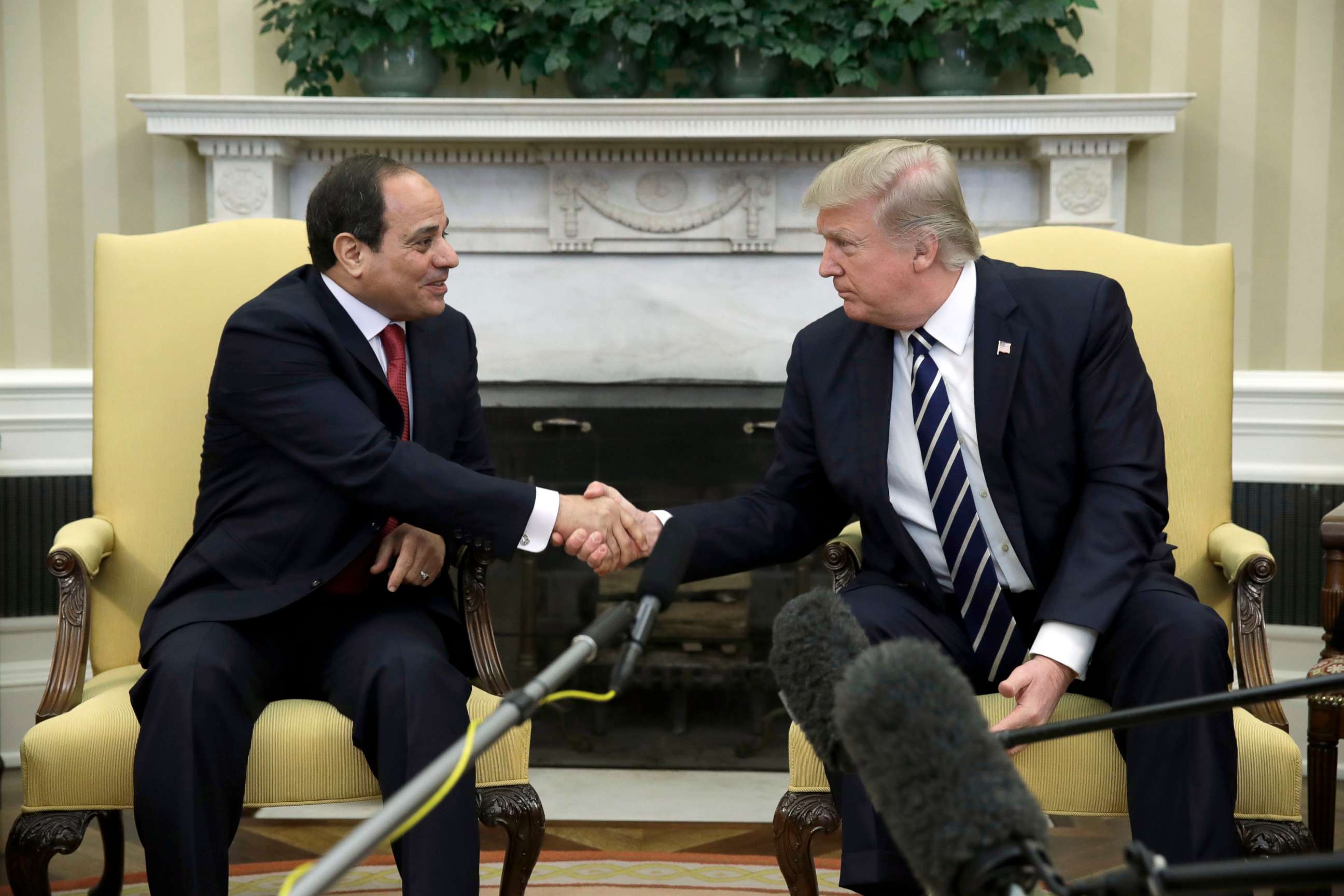
US President Donald Trump has offered to restart American mediation in the long-running dispute over the Grand Ethiopian Renaissance Dam (GERD) in a letter dated 16 January and addressed to President Abdel-Fattah Al-Sisi, placing Egypt’s Nile water security at the centre of renewed diplomatic engagement with Washington.
Trump said he wants to “responsibly resolve the question of Nile water sharing once and for all” as the Nile is viewed as an existential national concern.
The offer came alongside Trump’s praise for Al-Sisi’s role in mediating a ceasefire in Gaza, but it was the explicit reference to Nile waters that stood out as the most politically and strategically significant message for Cairo.
Trump wrote that the United States “affirms that no state in this region should unilaterally control the precious resources of the Nile, and disadvantage its neighbors in the process,” which mirrors Egypt’s longstanding demand for legally binding rules governing the filling and operation of the GERD.
In his response, President Al-Sisi said on facebook that he “appreciate[s] the letter from His Excellency President Donald Trump and his valued efforts to consolidate the foundations of peace and stability at the regional and international levels,” as well as the appreciation it conveyed for Egypt’s “pivotal role in supporting security and stability in the region.”
El-Sisi stressed that the Nile River “represents the lifeline of the Egyptian people,” adding that Egypt remains committed to “serious and constructive cooperation with the Nile Basin countries, based on the principles of international law, in a manner that achieves shared interests without causing harm to any party.”
He further stressed these principles are “the constants upon which the Egyptian position is founded,” noting that he had addressed a letter to Trump expressing his thanks, reaffirming Egypt’s concerns over water security, underscoring Cairo’s support for US efforts, and voicing his aspiration to “continue working closely with him during the coming phase.”
For more than a decade, Egypt and Sudan have warned that unilateral actions by Ethiopia could reduce downstream water flows, particularly during droughts and prolonged dry periods, threatening agriculture, drinking water supplies, and overall economic stability. Ethiopia, for its part, insists that the dam is vital for its development and electricity generation and rejects claims that it will cause significant harm.
Trump’s letter suggests a renewed American willingness to engage with the technical and political core of the dispute. He argued that “fair and transparent negotiations,” backed by strong expertise, could lead to an agreement that guarantees predictable water releases for Egypt and Sudan while allowing Ethiopia to generate “very substantial amounts of electricity.”
Significantly, Trump framed the GERD file not as a bilateral technical disagreement but as a major regional security issue. He wrote that resolving tensions over the dam was “at the very top of my agenda,” linking it to broader efforts to promote stability in both the Middle East and Africa and expressing hope that the dispute would not escalate into military confrontation between Egypt and Ethiopia.
The timing and scope of any renewed US mediation remain unclear. However, Trump’s decision to circulate copies of the letter to Saudi Crown Prince Mohammed bin Salman, UAE President Mohamed bin Zayed, Ethiopian President Taye Atske Selassie, and Sudanese leader Abdel Fattah al-Burhan points to a possible attempt to widen the diplomatic umbrella around future talks by involving influential regional actors.
The GERD is a massive hydroelectric project that began construction in 2011 and became fully operational in recent years, with a reservoir holding about 74 billion cubic metres of water and an installed capacity of over 5000 megawatts, making it Africa’s largest hydroelectric facility. Ethiopia says the dam is essential to meet its energy needs and to foster economic development, but downstream countries Egypt and Sudan have long expressed grave concerns about its impact on Nile water flows, given that Egypt depends on the river for nearly all of its fresh water and fears that uncoordinated filling and operation could disrupt water supplies and agriculture. Despite years of trilateral negotiations, no legally binding agreement has been reached on how to manage the dam’s reservoir releases, leaving GERD as a central point of regional water-security tensions.




Comments (2)
Trump’s Nile Letter, Geopolitical Entanglements, and Ethiopia’s Strategic Imperatives**
The recent communication U.S. President Donald Trump—addressed primarily to Egyptian President Abdel Fattah al-Sisi, with a copy “sent in reverse” to Ethiopia and Gulf states—must not be dismissed as mere diplomatic correspondence. It is, in fact, a **strategic instrument of coercive diplomacy**, deeply embedded in a broader geopolitical conspiracy that seeks to subordinate Ethiopia’s sovereign rights over the Blue Nile to the interests of Egypt, Saudi Arabia, and the United Arab Emirates (UAE). This maneuver is not only biased but also dangerously aligned with external agendas that threaten Ethiopia’s national security, developmental trajectory, and regional autonomy.
—
### **1. Trump’s Letter: A Tool of Coercion, Not Mediation**
At first glance, Trump’s letter appears to offer U.S. facilitation in resolving the Grand Ethiopian Renaissance Dam (GERD) dispute. However, its language and delivery reveal a stark imbalance:
– The letter was **directly addressed to Egypt**, framing the issue as if Ethiopia were the sole obstacle to peace.
– It was **copied to Ethiopia only secondarily**, and notably sent to the Office of the President rather than Prime Minister Abiy Ahmed—a procedural formality that nonetheless signals diminished diplomatic parity.
– Most tellingly, Trump invoked **“our personal friendship”** with Sisi, reducing a complex hydro-political issue rooted in international water law to a matter of interpersonal rapport. This undermines the principle that transboundary water rights must be governed by **equity, scientific evidence, and mutual benefit**, not political favoritism.
This approach echoes Trump’s 2020 statement that “Eguypt will blow up the dam”—a reckless fabrication that damaged U.S. credibility and exposed Washington’s alignment with Cairo’s maximalist stance. Compounding this, the **conviction of U.S. Senator Bob Menendez** for accepting bribes to advance Egypt’s Nile agenda has further eroded trust in American neutrality.
> **Conclusion**: The letter is not an invitation to dialogue—it is **pressure disguised as partnership**, aimed at forcing Ethiopia into a binding agreement that would permanently cap its future use of the Blue Nile beyond GERD.
### **2. Egypt’s Colonial Legal Posture vs. Ethiopia’s Sovereign Rights**
Egypt clings rigidly to the **1929 Anglo-Egyptian Treaty** and the **1959 bilateral agreement with Sudan**—both colonial-era instruments that allocated 87% of the Nile’s flow to Egypt and 13% to Sudan, **excluding upstream states like Ethiopia entirely**. These treaties are legally obsolete under modern international water law, particularly the **1997 UN Watercourses Convention** and the **2010 Cooperative Framework Agreement (CFA)**, which Ethiopia, along with most Nile Basin countries, has endorsed.
Yet Egypt continues to treat the Nile as its exclusive patrimony, using historical usage as justification for veto power over upstream development. Trump’s letter implicitly endorses this outdated doctrine by demanding that Ethiopia “release water to Egypt,” effectively treating the Blue Nile as a **colonial pipeline** rather than a shared resource.
**Ethiopia’s response must be unequivocal**: The Blue Nile originates in Ethiopia; its waters sustain 120 million Ethiopians. Access to this resource is not negotiable—it is a **matter of survival and sovereign right**.
### **3. Strategic Imperative: Enshrine Blue Nile and Red Sea Access in the Constitution**
Given the persistent external threats to Ethiopia’s water security and maritime aspirations, it is no longer sufficient to rely on policy declarations. **Ethiopia must elevate these issues to constitutional status**:
– **Article X**: *“The equitable and reasonable utilization of the Blue Nile River and its tributaries is a fundamental national interest of the Federal Democratic Republic of Ethiopia.”*
– **Article Y**: *“Access to the Red Sea through peaceful, legal, and mutually beneficial arrangements with neighboring coastal states is a strategic objective of the state.”*
Such constitutional anchoring would:
– Prevent future governments from surrendering core national interests under foreign pressure;
– Signal to the international community that Ethiopia’s position is non-negotiable on matters of existential importance;
– Strengthen Ethiopia’s hand in negotiations by demonstrating institutional resolve.
### **4. GERD as Bargaining Power—Not a Concession**
The **Grand Ethiopian Renaissance Dam (GERD)** is not merely a hydroelectric project—it is Ethiopia’s **most potent instrument of strategic leverage**. Having completed construction, filled the reservoir to 88 billion cubic meters, and begun power generation, Ethiopia has already demonstrated that GERD does **not cause significant harm** to downstream nations. In fact, it offers **regulation benefits**: reducing flood peaks, minimizing siltation in Egypt’s Aswan High Dam, and ensuring more consistent dry-season flows.
Rather than viewing GERD as a liability to be compromised, Ethiopia should **leverage its operational success** to negotiate from strength:
– Offer **data-sharing and coordinated operation protocols**—but only within frameworks that recognize Ethiopia’s right to future development.
– Reject any agreement that imposes **permanent restrictions** on additional dams or irrigation projects on the Blue Nile.
**GERD is not the end of Ethiopia’s Nile development—it is the beginning.**
### **5. The Horn’s Entrapment in Gulf Rivalries: A Self-Inflicted Vulnerability**
Herein lies Ethiopia’s gravest strategic error: **allowing itself to be drawn into the Saudi-UAE power struggle** in the Horn of Africa.
– **Saudi Arabia and the UAE are not Nile Basin states**, yet they wield outsized influence due to financial aid, military partnerships, and port investments (e.g., Berbera, Assab).
– Initially, both supported Ethiopia’s engagement in Sudan, but their **alliance has fractured**. Saudi Arabia now backs the Sudanese Armed Forces (SAF), while the UAE covertly supports the Rapid Support Forces (RSF).
– **Prime Minister Abiy Ahmed’s alignment with the UAE**—including alleged weapons transfers to RSF and the establishment of a **military training camp in Benishangul-Gumuz**—has placed Ethiopia directly in the crosshairs of Saudi retaliation.
Recent reports confirm that Saudi Arabia has committed **$1.5 billion in military aid to the SAF**, which has since **destroyed an RSF convoy near Ethiopia’s border**. This escalation transforms Ethiopia from a neutral neighbor into a **proxy battleground**.
**Consequence**: Saudi Arabia, seeking to isolate the UAE, is now **pressuring Egypt to intensify Nile demands on Ethiopia**, using water as a tool to punish Addis Ababa for its Emirati ties.
### **6. The Path Forward: Sovereignty, African Agency, and Strategic Clarity**
Ethiopia must urgently recalibrate its foreign policy to avoid becoming a pawn in Middle Eastern conflicts:
#### **A. Reaffirm “African Solutions to African Problems”**
– Insist that Nile negotiations occur **exclusively under the African Union**, excluding non-riparian powers like the U.S., Saudi Arabia, or UAE unless they commit to impartiality.
– Revive the **Nile Basin Initiative (NBI)** as the primary platform for technical and legal dialogue.
#### **B. Decouple from Gulf Proxy Wars**
– Cease all support to armed factions in Sudan.
– Declare neutrality in the Saudi-UAE rivalry and focus on **economic diplomacy** (e.g., port access, trade corridors) without military entanglements.
#### **C. Build Domestic Consensus on National Interests**
– Launch a national dialogue on water security and Red Sea access.
– Mobilize public, academic, and parliamentary support for a **unified, non-partisan stance** on the Nile.
### **Conclusion: Justice Over Pressure, Sovereignty Over Submission**
Donald Trump’s letter is not a new proposal—it is a **repackaged threat**, leveraging America’s alliance with Egypt and the fractured ambitions of Gulf powers to corner Ethiopia into surrendering its rightful share of the Nile. But Ethiopia is not the same nation it was in 2019. It has built a dam, generated power, and proven its resilience.
The message to Washington, Cairo, Riyadh, and Abu Dhabi must be clear:
**“Ethiopia seeks peace—but not at the cost of justice. We will not trade our sovereignty for foreign favors. The Nile is ours by geography, by law, and by necessity. Any lasting solution must begin with that truth.”**
As Trump eyes a return to the White House, Ethiopia must stand firm—not out of defiance, but out of **dignity, strategy, and unwavering commitment to its people’s future**.
*“A river cannot be negotiated away by letters written in distant capitals. It flows from our mountains, through our soil, and into our destiny.”*
Trump’s Nile Letter, Geopolitical Entanglements, and Ethiopia’s Strategic Imperatives**
The recent communication U.S. President Donald Trump—addressed primarily to Egyptian President Abdel Fattah al-Sisi, with a copy “sent in reverse” to Ethiopia and Gulf states—must not be dismissed as mere diplomatic correspondence. It is, in fact, a **strategic instrument of coercive diplomacy**, deeply embedded in a broader geopolitical conspiracy that seeks to subordinate Ethiopia’s sovereign rights over the Blue Nile to the interests of Egypt, Saudi Arabia, and the United Arab Emirates (UAE). This maneuver is not only biased but also dangerously aligned with external agendas that threaten Ethiopia’s national security, developmental trajectory, and regional autonomy.
—
### **1. Trump’s Letter: A Tool of Coercion, Not Mediation**
At first glance, Trump’s letter appears to offer U.S. facilitation in resolving the Grand Ethiopian Renaissance Dam (GERD) dispute. However, its language and delivery reveal a stark imbalance:
– The letter was **directly addressed to Egypt**, framing the issue as if Ethiopia were the sole obstacle to peace.
– It was **copied to Ethiopia only secondarily**, and notably sent to the Office of the President rather than Prime Minister Abiy Ahmed—a procedural formality that nonetheless signals diminished diplomatic parity.
– Most tellingly, Trump invoked **“our personal friendship”** with Sisi, reducing a complex hydro-political issue rooted in international water law to a matter of interpersonal rapport. This undermines the principle that transboundary water rights must be governed by **equity, scientific evidence, and mutual benefit**, not political favoritism.
This approach echoes Trump’s 2020 statement that “Eguypt will blow up the dam”—a reckless fabrication that damaged U.S. credibility and exposed Washington’s alignment with Cairo’s maximalist stance. Compounding this, the **conviction of U.S. Senator Bob Menendez** for accepting bribes to advance Egypt’s Nile agenda has further eroded trust in American neutrality.
> **Conclusion**: The letter is not an invitation to dialogue—it is **pressure disguised as partnership**, aimed at forcing Ethiopia into a binding agreement that would permanently cap its future use of the Blue Nile beyond GERD.