


A commoner who worked her way to royalty and power, Queen Tiye would be remembered as a formidable New Kingdom figure in ancient Egypt thousands of years later. Tiye, who lived during the 18th Dynasty, was of non-royal origins. Her father, Yuya, served as a priest of Min in Akhmim, Chief of Horses and Commander of Chariots. Her mother, Thuya, was the Superintendent of the Harems of Amun in Thebes and of Min in Akhmim.
Amenhotep III, 1390 BCE – 1352 BCE, married her during the second year of his reign, and she became the Great Royal Wife.
For nearly 38 years, Tiye stood at Amenhotep III’s side as an equal partner. Together, they presided over a vast and prosperous empire, a reign defined by stability, during which Egypt grew rich, confident, and largely at peace with the world.
The Leading Woman
She was believed to be a woman of a strong personality and sharp intelligence, which may have helped her earn a seat at the table in both domestic governance and international diplomacy.
Theodore M. Davis, an American lawyer and businessman, recovered several seals bearing Queen Tiye’s royal cartouche during his 1907 excavations in the Valley of the Kings. In the Amarna Letters, a trove of diplomatic correspondence between Egypt and its foreign allies, foreign rulers addressed her by name, acknowledging her counsel and her acumen as though she were a head of state in her own right.
Their joint reign left a monumental physical record. Amenhotep III and Tiye commissioned as many as 250 large-scale structures, palaces, temples, mortuary complexes, and monuments adorned with artwork that chronicled the arc of their rule.
Their diplomatic record was equally well-preserved and has found in those exchanges a portrait of a kingdom that was as engaged with the wider world as it was with building its own legacy at home.
The span of Tiye’s rising influence can be traced through the art of the period itself. Early depictions render her as a smaller, secondary figure, but as the reign progressed, her representations grew in stature and elaborateness. In later statuary of the royal couple, she and Amenhotep stand at equal height, which, without words, speaks to the nature of their partnership.
Family Life
The couple had four daughters, Sitamun, Henuttaneb, Isis, and Nebetah, and two sons.
When their firstborn, Thutmosis, died young, it fell to the second, Amenhotep IV, later known as Akhenaten, and the father of King Tutankhamun, to inherit the throne, ascending as Amenhotep IV.
During his reign, Amenhotep III expressed his devotion and love to his queen in stone and water. At Malqata in Thebes, he built Tiye a grand palace with a sprawling lake and installed monumental statues of her in temples on a scale typically reserved for kings.
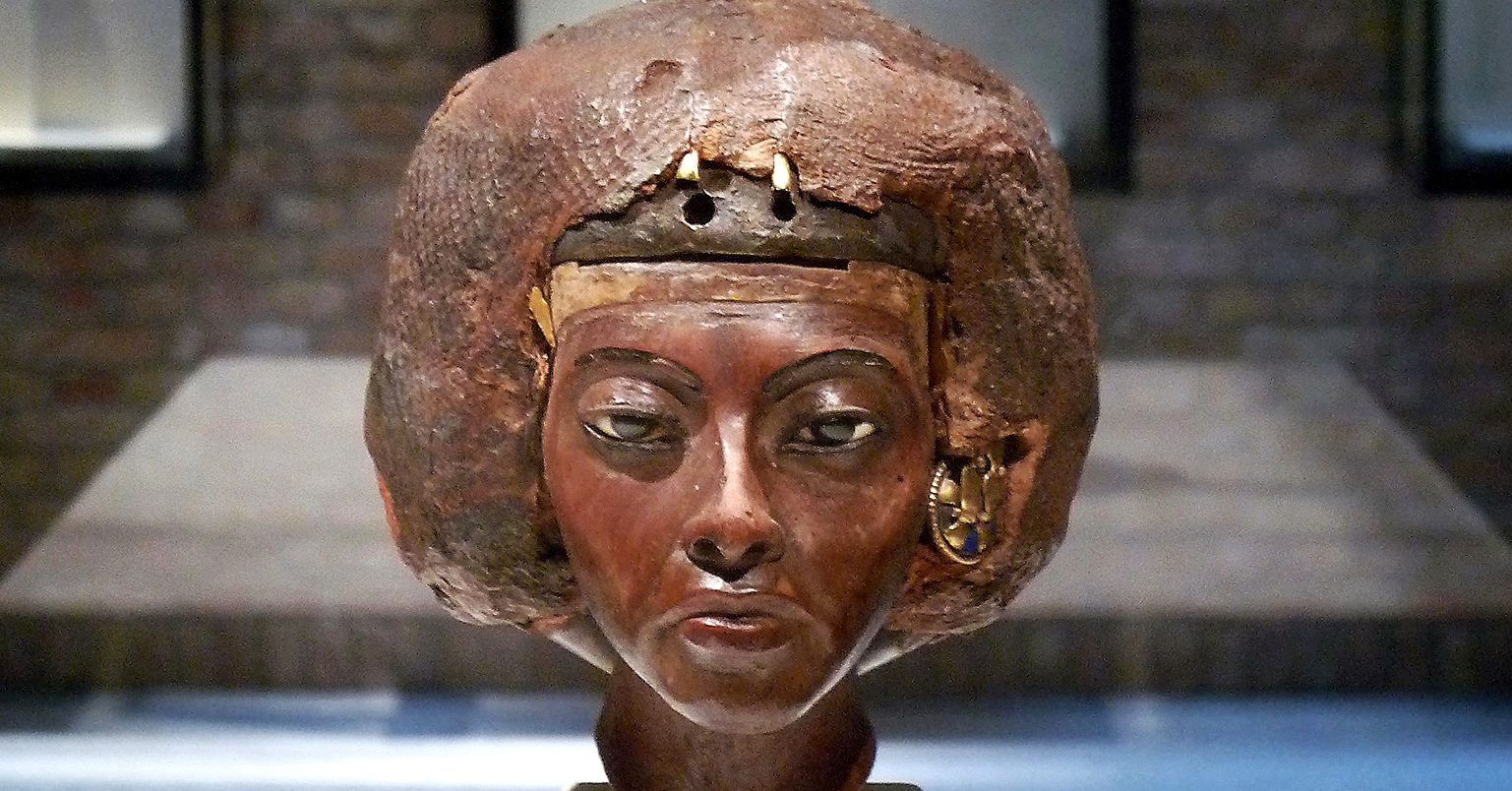
After Amenhotep III’s death, Akhenaten honored his mother in unprecedented ways. While the usual fate of the new pharaoh’s mother was removal, banishment from court, and stripping of influence, Akhenaten prevented that fate for her. She wore a crown to Queen Tiye’s famous bust, currently held at the Egyptian Museum in Berlin (Neues).
Queen Tiye in Art
The Portrait of Queen Tiye with a Crown of Two Feathers bust was created by an unknown artist sometime during the 18th Dynasty. Scholars believe the bust was created in the final years of Amenhotep III’s reign, naturalistically depicting the queen at an advanced age, with deep furrows around her mouth, and flesh sagging over her cheeks.
The sculptor rendered a strikingly realistic face that offers a rare and telling glimpse into how she was perceived, appearing to be powerful and respectful.
The sculpture currently consists of a head and the crown of goddesses and deified queens that Akhenaten added, complete with a solar disk, horns, and a pair of feathers. Akhenaten added the crown to declare his mother as a goddess so that her influence could continue for the rest of her days.
For three millennia, her mummified body lay unidentified in a side chamber of another king’s tomb, stripped of her coffins and her name. That she has since been found, recognized, and restored to history is a testament to her influence and remaining legacy.
Currently, her body resides in the National Museum of Egyptian Civilization (NMEC).



Comments (0)