


“I’ve got nature and art and poetry, and if that isn’t enough, what is?” Vincent Van Gogh, a Dutch painter, once said.
It takes only a couple of minutes after stepping into the Van Gogh exhibition, running until June 2026 at District 5, to truly and wholeheartedly understand what he meant when he said that nature, art, and poetry can sometimes, and often, be all one needs to feel content.
Once you walk into the exhibition, you feel completely separated from the world that all of us inhabit, and you enter the world of a painter who, despite the grueling, ugly, and dehumanizing experiences he went through, still created a world of his own that looked at nature with a close eye, and still chose to love the beauty of nature even amidst the ugliness of his world.
So far, in just the first few weeks since its opening, the exhibition has drawn in many admirers, particularly from Egypt’s artistic community. Egyptian artists like Yousef Hanbal, who has spent years studying Van Gogh’s work at university and his relationship with nature, have long been waiting for an exhibition like this to take place in Egypt.
“I’ve always wanted something like this to be done in Egypt. Van Gogh’s story is incredibly emotional, and it’s very exciting for this exhibition to finally be happening for artists like me here,” he said.
“In one of my university projects, I explored AR-documented reality to reimagine the works of Egyptian artists and how Egyptian paintings could be presented through virtual reality. I would love to see something like this done for Egyptian artists as well.”
A Sincere Love for Nature
The story of the Van Gogh exhibition is not really about his life story as much as it is his story about falling in love with nature, and in turn, falling in love with the simple pleasures of existence.
Whatever happened to him in his own personal life, and regardless of all the challenges he endured, somehow all of these events and emotions disappear when they are met with the grandeur and beauty of nature.
One of his favourite places to paint was in the nearby olive groves, right outside the Saint-Paul asylum in southern France. The olive trees, through his eyes, become an expression of an existence that is larger than himself and larger than the present moment he is in, where he sits to paint them.
Even as he sits to paint their beauty, the olive trees feel as though they exist beyond his own measure of time, as they have lived for hundreds, even thousands, of years, holding memories or a presence that existed long before him and his painting.
“The murmur of an olive grove has something very intimate, immensely old about it. It’s too beautiful for me to dare paint it,” Van Gogh said while writing to his brother.
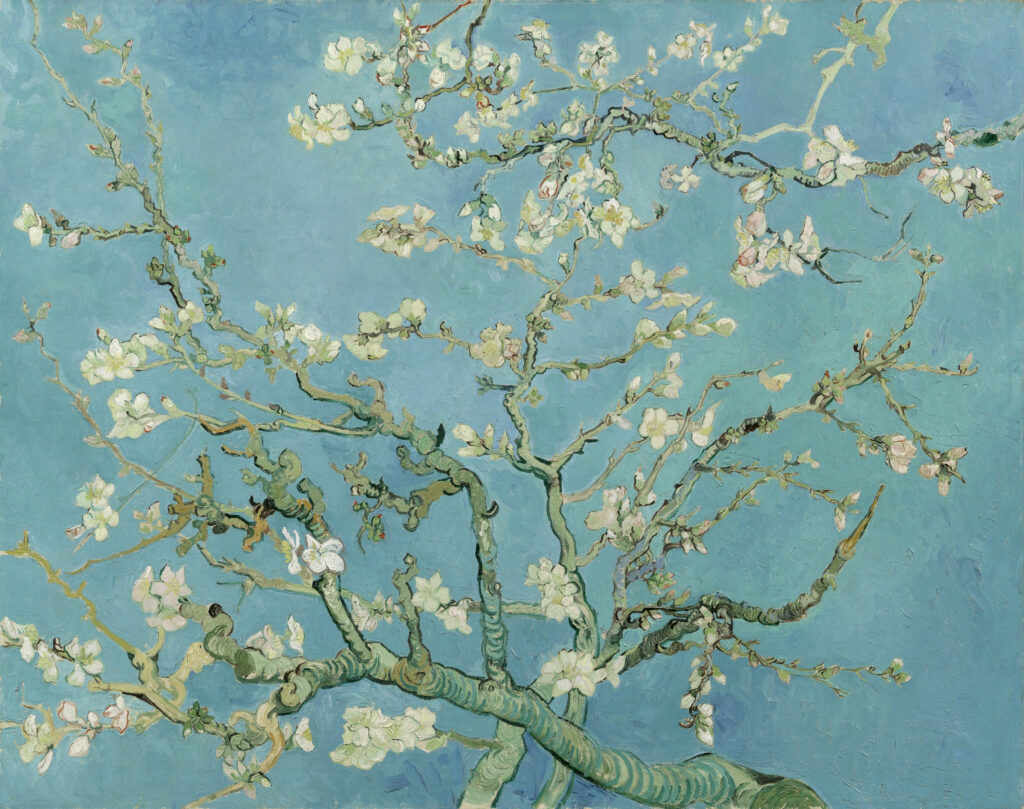
And in his paintings of nature, whether in the dense, burning yellow of a sunflower or the fragile bloom of almond branches against a clear blue sky, there is a sense of rawness and emotion that an artificial being cannot quite generate.
To look at nature, as he did, is to be returned to that same rawness within ourselves, such as the uneven edges, the broken lines, and the imperfections that reveal how intricately layered the world truly is. It would be sheer folly to view nature superficially or to fail to ponder at least how it came into being.
Even as his mind grew more troubled, he did not turn away from this world. If anything, he moved closer to it, losing himself in the textures of leaves, in the symmetrical lines of branches, and in the order that nature seemed to hold.
He never ceased to look at the sunrise every morning and believe that it was greeting him; to look at nature with the eyes of a familiar friend who never gets tired of thanking it for its beauty, never gets tired of feeling grateful simply to exist beside the beauty of a sunrise.
And in that moment, he realizes that this is the most powerful expression of living, which is to be in love with nature.
“If I felt no love for nature and my work, then I would be unhappy,” he once said.
There could not be a more relevant time for this exhibition to take place, at a moment when the rawness of nature is increasingly overshadowed by the artificial, and when it is so often destroyed and exploited rather than nurtured.
If Van Gogh were alive today, he might remind us never to forget, or grow tired of, admiring nature, because no matter how familiar or predictable a sunrise may seem, it still feels more beautiful than the one before it.
And there is nothing more powerful than simply falling in love with a sunrise.





Comments (0)