


The Ministry of Tourism and Antiquities has announced on Sunday, 31 May, a major archaeological breakthrough at the tomb of “Panehsy” in Matariya, Ain Shams, revealing new details from the historic necropolis of Heliopolis.
The discovery was made during excavations carried out by an Egyptian archaeological mission affiliated with the Supreme Council of Antiquities (SCA), which uncovered what officials described as the first nearly complete funerary furniture set identified in the area.
According to the Egyptian authorities, the excavation initially revealed a burial constructed from mudbrick containing human skeletal remains.
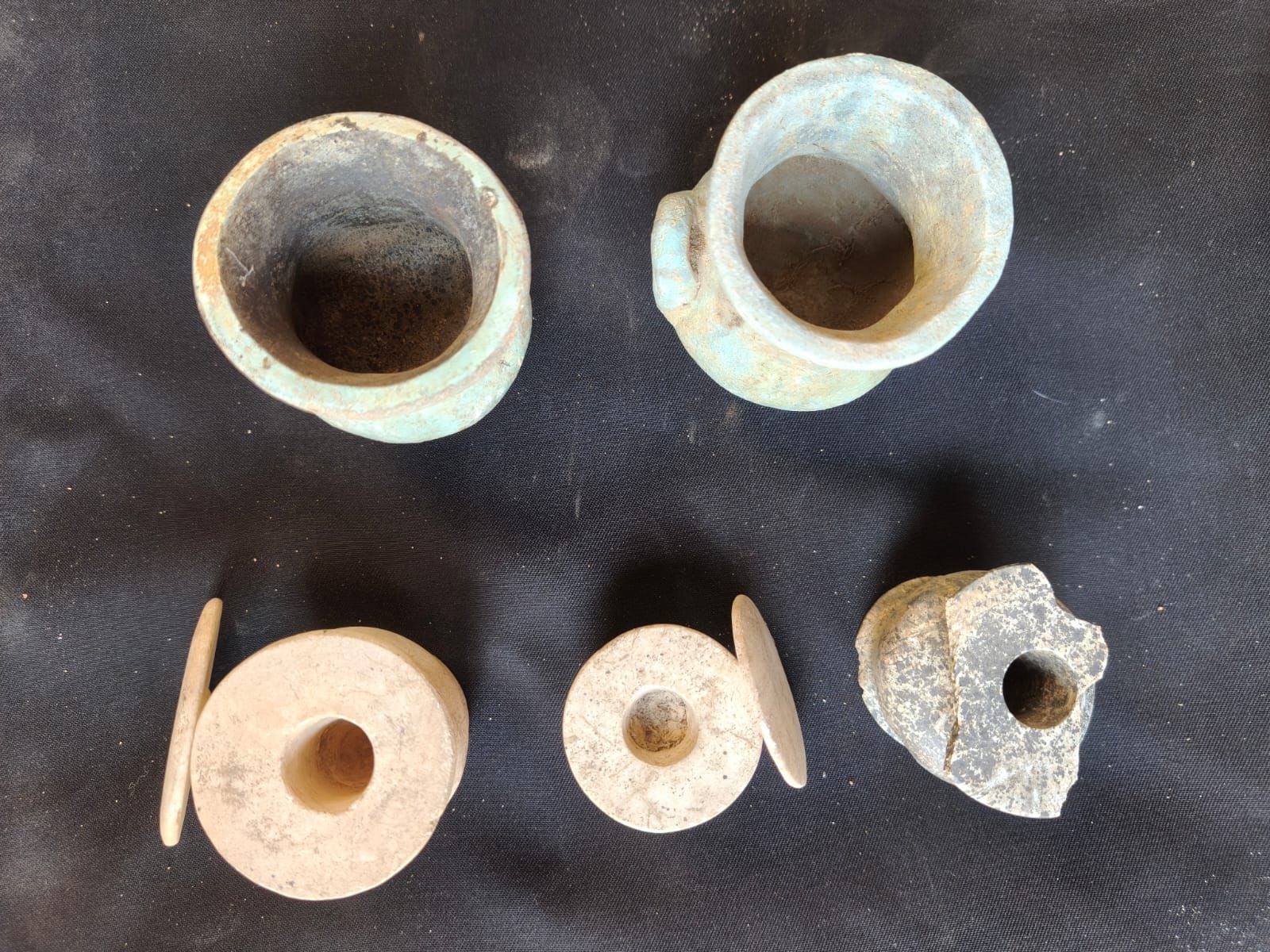
With continued careful excavation beneath the structure, the team uncovered a concealed archaeological cachette containing a collection of cosmetic tools and symbolic items associated with funerary practices.
Among the most prominent finds was a copper mirror, as well as two alabaster kohl containers that still preserved traces of cosmetic material.
A third container, made from rare black obsidian, was also discovered along with two light-blue faience vessels, one of which contained six intricately inscribed scarabs, including two encased in yellow metal frames believed to be made of gold.
Officials also noted that the discovery builds upon results from earlier excavation seasons at the site, which had already revealed funerary structures made of mudbrick and limestone, as well as two coffins found in a stacked, fragmented state.
One coffin was made of pottery, while the other was constructed from plaster with a gilded appearance and decorated with red inscriptions, containing gilded remains believed to belong to a military figure, alongside a coin possibly dating to the Roman period.
Additional limestone blocks bearing hieroglyphic inscriptions were also uncovered, further strengthening the importance of the site for studying the area’s evolving historical and cultural timeline.
Authorities stated that the Panehsy necropolis represents a living archaeological record documenting different phases of occupation in the region, having served as a burial ground for prominent individuals from the Late Period through the Roman era and into the Christian period.
The tomb site forms part of the greater ancient necropolis of Heliopolis, historically known as “Oun,” the principal religious center devoted to the worship of the sun god Re, making the discovery especially valuable for understanding how funerary practices, religious beliefs, and social structures developed over time.



Comments (0)