


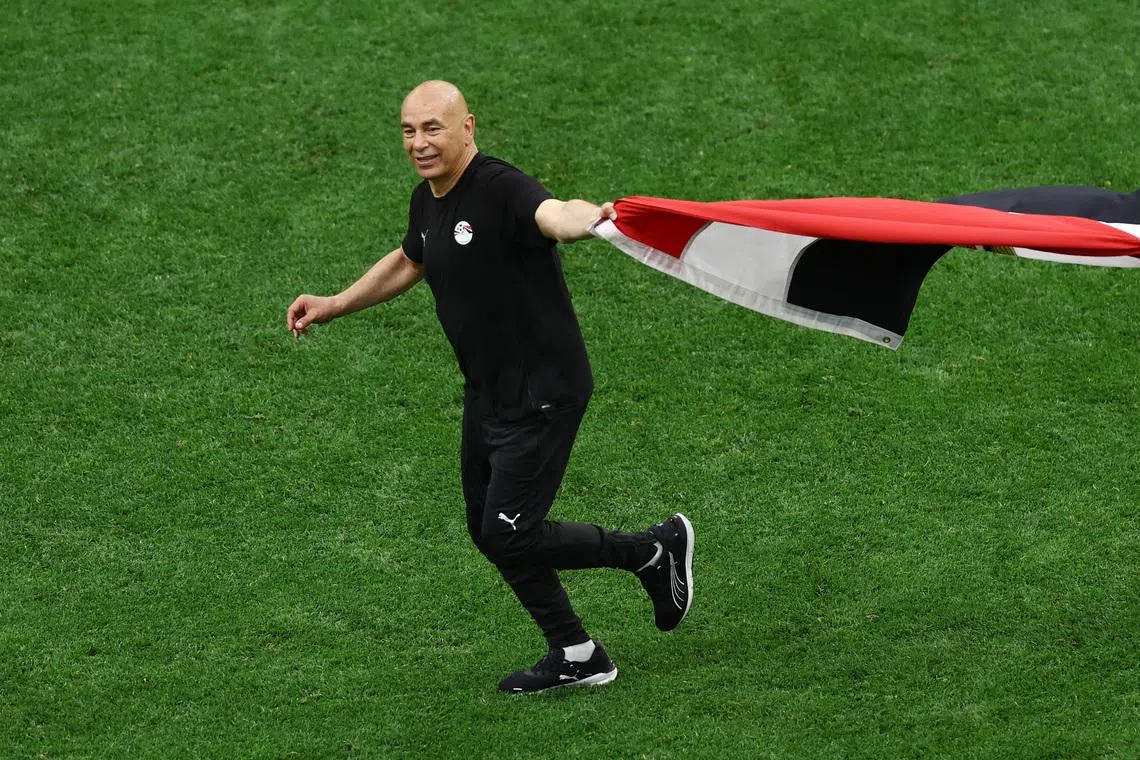
Most Egyptians have an opinion about Hossam Hassan.
To some, he is the greatest striker Egypt has ever produced. To others, he is football’s ultimate fighter and a player who never stopped running, never stopped arguing, and certainly never stopped scoring. Love him or criticize him, one thing has always been true: when Hassan is involved, Egyptian football pays attention.
Now, decades after scoring one of the most important goals in Egypt’s football history, the legendary Hassan is once again carrying the nation’s hopes, but this time from the touchline rather than the penalty box as he leads the Pharaohs through their latest FIFA World Cup campaign.
For younger fans, Hassan may simply be Egypt’s current head coach, but for generations who watched him play, he is much more than that. His career is one of records, rivalries, controversy, and unforgettable moments that have shaped Egyptian football for more than four decades.
Born on 10 August, 1966, Hassan began his professional career with Al Ahly in 1984. He went on to play for PAOK in Greece, Neuchâtel Xamax in Switzerland, Al Ain in the UAE, Zamalek, Al Masry, Tersana, and Al Ittihad Alexandria, according to the Egyptian Football Association’s official profile.
Few Egyptian footballers can claim success wearing both red and white, but Hassan did exactly that.
He remains one of only a handful of players to become an icon at both Al Ahly and Zamalek Sporting Club (SC). During his club career, he scored 168 Egyptian Premier League goals, making him the second-highest scorer in league history. His 109 league goals for Al Ahly still leave him tied with Mahmoud El Khatib as the club’s all-time top league scorer. He also remains the highest scorer in Cairo Derby league matches, netting nine goals against Egypt’s fiercest rivals.
Across his club and international career, Hassan lifted 41 trophies, including a record 14 Egyptian league titles. Alongside his twin brother, Ibrahim Hassan, he also became the only player to win the CAF Champions League 15 years apart, first with Al Ahly in 1987 and again with Zamalek in 2002.
But while his club achievements are extraordinary, it was in Egypt’s red shirt that Hassan truly became a national hero.
Between 1985 and 2006, he officially made 176 appearances and scored 69 goals for Egypt, making him the country’s all-time leading goalscorer. The Egyptian Football Association (EFA) also notes that another 20 international appearances and seven goals were omitted from FIFA’s official tally due to administrative issues, bringing his total to 196 matches and 76 goals.
His defining moment came on 17 November, 1989.
Against Algeria, Hassan scored the goal that sent Egypt to the 1990 FIFA World Cup, ending a 56-year wait to return to football’s biggest stage. It remains one of the most iconic goals in Egyptian sporting history.
Hassan went on to represent Egypt in seven Africa Cup of Nations tournaments, winning the title in 1986, 1998, and 2006. He finished as the tournament’s top scorer in the 1998 edition with seven goals.
At 39 years old, Hassan became the oldest player ever to score at the Africa Cup of Nations when he found the net against DR Congo in the 2006 quarter-finals.
In 2001, after becoming the world’s most-capped international player at the time, then-FIFA President Sepp Blatter presented Hassan with the “World Dean of Players” armband before a packed crowd in Cairo.
Since hanging up his boots in 2008, retirement did not mark the end of his football journey, and Hassan coached Al Masry, Telecom Egypt, Zamalek, Ismaily, Misr El-Makkasa, Al Ittihad Alexandria, Pyramids, Smouha, and Jordan’s national team before being appointed Egypt’s head coach on 6 February 2024 following the departure of Rui Vitória.
The appointment immediately divided opinion. Some saw his unmatched passion and winning mentality as exactly what Egypt needed, while others questioned whether his fiery personality would translate into international success.
Throughout his career, he has rarely taken the easy path. He has been celebrated, criticised, adored, and doubted, but never ignored.
Thirty-five years after firing Egypt to Italy in 1990, the country’s most iconic No. 9 is once again chasing another World Cup dream. Only this time, he is doing it from the dugout.





Comments (0)