


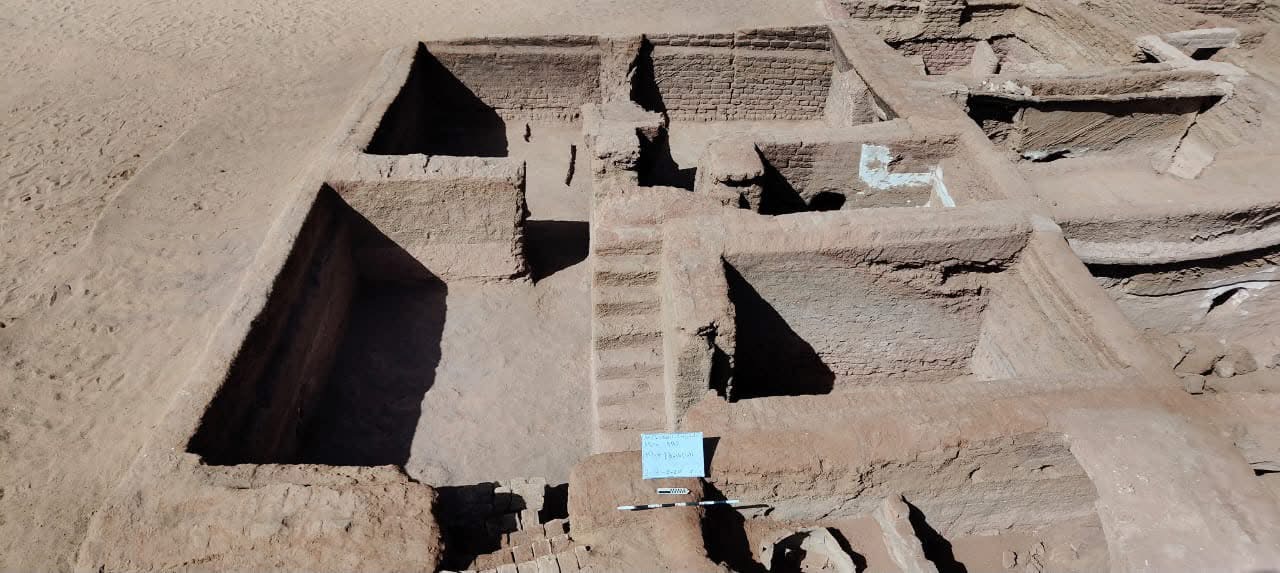
Egyptian archaeologists uncovered on Saturday 4 July a remarkably well-preserved Byzantine-era residential city in Egypt’s Dakhla Oasis, offering new insights into daily life in one of the country’s ancient desert settlements.
The discovery was announced by the Ministry of Tourism and Antiquities following excavations by an Egyptian archaeological mission at the Ain El-Sabil archaeological site in the New Valley Governorate.
According to the ministry, the city dates back to the Byzantine period (330–1453 AD) and was built entirely from mudbrick. The excavation has revealed a complete residential settlement, providing archaeologists with new evidence of the urban, social and economic life of communities living in the oasis more than 1,600 years ago.
Minister of Tourism and Antiquities Sherif Fathy described the discovery as an important addition to Egypt’s growing list of archaeological finds, saying it highlights the cultural diversity of the country’s desert oases throughout history. He added that the discovery is expected to strengthen New Valley’s archaeological attractions and support ongoing efforts to promote the governorate as a cultural tourism destination.
The city’s layout follows an organized urban plan, featuring main streets running north to south intersected by east-west roads, creating a network of open squares and public spaces. At its centre stands a basilica church overlooking one of the settlement’s principal streets.
Archaeologists also uncovered a range of architectural features that point to a fully functioning residential community, including a fourth-century basilica, the remains of two watchtowers at the city’s outskirts, a fortified structure with thick defensive walls, spacious homes with vaulted ceilings, bread ovens, kitchens and stone tools used for grinding grain.
Among the most notable discoveries are the House of Tisous, identified as belonging to a church deacon and dating to the second half of the fourth century CE, and the House of Tapibos, which dates to the early fourth century and is believed to have served as a house church before the construction of the city’s basilica.
Excavations also yielded a collection of artifacts reflecting the settlement’s daily life and economic activity. These include pottery used for household purposes, small vessels for storing oils and perfumes, oil lamps and stone grinding tools.
One of the most significant finds is a collection of nearly 200 ostraca, inscribed pottery fragments, written in both Coptic and Greek. According to the ministry, the texts document commercial transactions, correspondence and other aspects of everyday life, offering a rare glimpse into the administration and economy of the Byzantine-era community.
The archaeological mission also uncovered a large number of well-preserved bronze coins bearing portraits of Byzantine emperors, Latin inscriptions and Christian symbols, alongside gold coins dating to the reign of Emperor Constantius II, who ruled the Byzantine Empire between 337 and 361 CE.
The discovery adds to a growing body of archaeological evidence from Egypt’s Western Desert and offers fresh insight into how communities in the Dakhla Oasis developed during the Byzantine period, reinforcing the region’s historical importance beyond the Nile Valley.





Comments (0)