


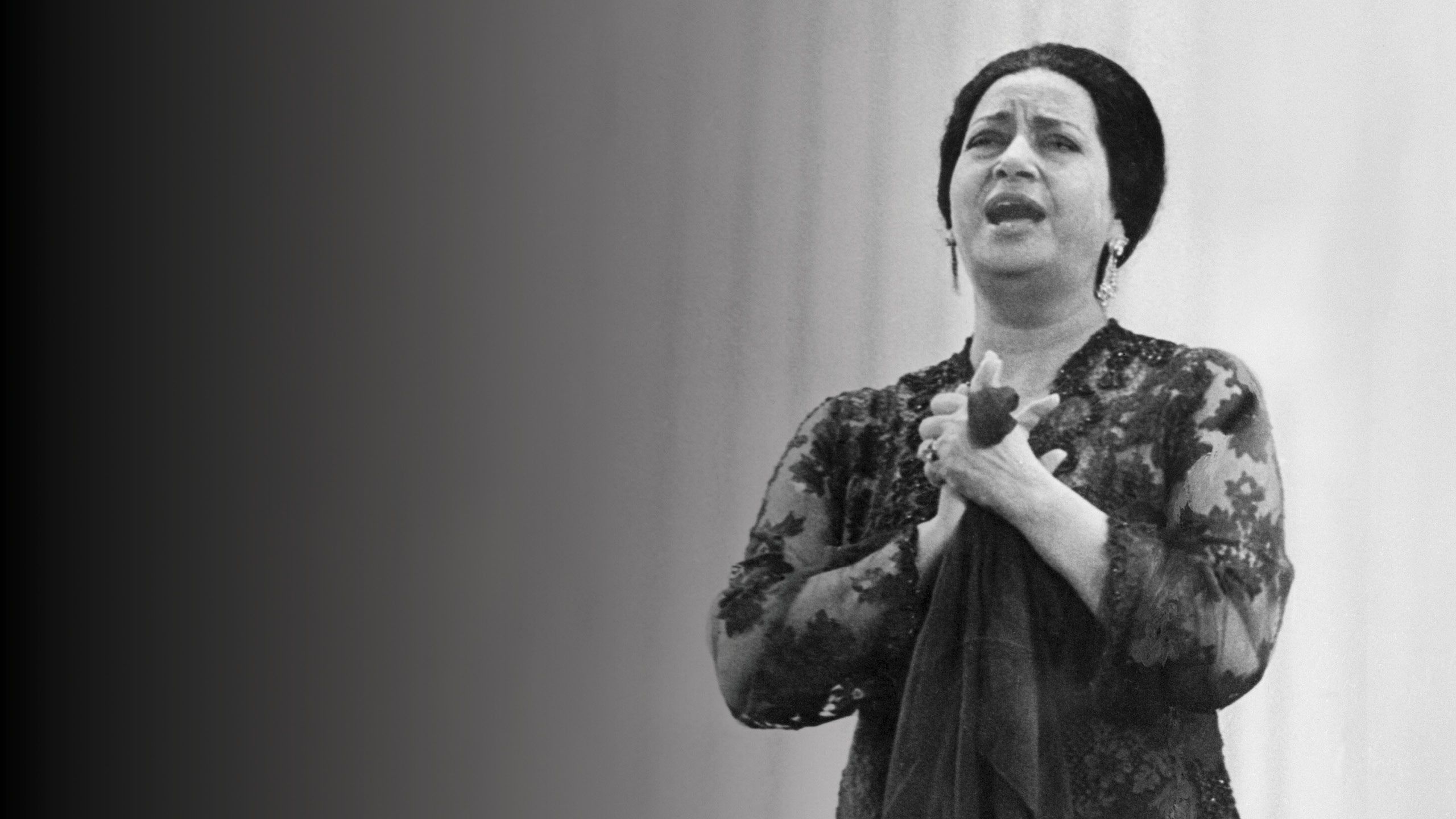
Recent Egyptian blockbuster, El Set (The Woman, 2025), opens in 1967 at Om Kalthoum’s iconic concert at the Olympia in Paris. The camera drifts across a packed theatre, with faces tilted upward, eyes fixed on the stage, and an audience comprising different nationalities brought together by a single voice. Applause swells, the lights are dim, and before a note is sung, the film establishes a space charged with reverence, awe, and collective pride. In these first moments, it becomes clear just how far Om Kalthoum’s influence had traveled in the 20th century.
The opening scene serves also as a reminder that she was not just a singer, but a symbol of Egypt itself. Known as the “Kawkab al-Sharq”, meaning star of the East, the Egyptian singer embodied nationalism on a global stage.
The power of the opening scene is in its visual language as the film constantly transitions between real archival footage from the concert and recreated scenes that mirror it almost exactly. The only distinction was time itself: black-and-white images faded into color, past into present. To the audience, this seamless interplay signals the intelligence of the film’s direction from the outset, grounding the biopic in both historical truth and cinematic imagination.
From village beginnings to a global icon
Rather than structuring itself around a chronological retelling of events, El Set centers on emotional experiences. The black-and-white flashbacks emphasize memory and vulnerability, allowing the audience to feel the uncertainty and fear behind Om Kalthoum’s early success. Music wove through these moments, creating a sense of warmth and familiarity, particularly for viewers who grew up with her songs as part of everyday life.
Understanding the film also requires an awareness of its genre. The film is not a documentary aimed at presenting a comprehensive historical record, but a biopic; a narrative form that dramatizes the life of a real figure by selectively focusing on emotions, relationships, and defining moments rather than exhaustive facts.
Within this framework, the filmmakers exercised creative license to emphasize aspects of Om Kalthoum’s inner life, using dramatization to convey emotional truth rather than strict chronology. At 155 minutes (a little over two hours), the film’s length can feel demanding at times, but the extended runtime allows it to linger on atmosphere and emotion rather than rush through events. Every scene is given space to breathe, with pacing and dramatic choices clearly deliberate.
From the opening, the film moves into a series of retrospective flashbacks, taking the viewer back to 1906 in Senbellawein, in Egypt’s Dakahlia Governorate, Om Kalthoum’s home village. Here, the story shifts from grandeur to humble constraint. As a child, her father dressed her as a boy so she could sing at weddings for money, one of the few ways her voice could be heard in a society that did not allow women to perform publicly.
Early scenes capture the upbringing and emotions that defined her journey: the anxiety of her first performance, the financial? hardship endured by her family, and the slow shaping of the artist she would become.
A turning point occurs when a talent agent hears her sing at a village wedding and urges her father to take her to Cairo. The film then shifts to 1920s Cairo and her first performance in a casino. The scene unfolds quietly, and only afterward does Om Kalthoum’s real voice enter, recalling that night in her own words. The decision to let her narrate what had just been shown added weight to the moment, anchoring it in her memory.
One of the film’s most pivotal moments is set in 1924, when Om Kalthoum decides to perform dressed as a woman for the first time. This choice unfolds against the backdrop of Egypt’s feminist movement, which links women’s rights with national identity.
The film captures this shift through a character played by Amina Khalil, who introduced Om Kalthoum to a world of women asserting their presence and power. In a room adorned with images of women fighting for their rights, she helps Om Kalthoum step into a new public identity.
The emotional weight of this transformation was palpable. The camera lingers on her father’s expression as she defies, for the first time, the rules that had shaped her entire life. That night, at Shams El Din Pasha’s palace, she sings a poem by Ahmed Rami, marking her first performance of non-religious music. Rami, present among the guests, becomes a central figure in her life and artistic journey, writing the poetry that would later define much of her repertoire.
From here, El Set traces Om Kalthoum’s relationships with sensitivity rather than spectacle. Her bond with her father (played by Sayed Ragab) and brother (played by Ahmed Khaled Saleh), her deep emotional connection with Ahmed Rami (played by Mohamed Farrag), and her engagement to musician Mahmoud El Sherif (played by Sedky Sakhr) are all explored through her inner conflicts.
The performances are subtle and respectful, capturing the essence of Om Kalthoum without exaggeration.
The engagement draws a strong reaction from the public, revealing how closely her private life became tied to her public image. The film does not dramatize the end of the relationship, but allows it to pass as part of the larger trajectory of a life shaped around music.
When a voice became a nation
The film also delves into her later romantic life, including her engagement to one of King Farouk’s uncles, an engagement rejected by the royal family and one that leaves a visible emotional wound. This period becomes especially significant after the 1952 Free Officers’ Revolution, when Om Kalthoum is briefly banned from radio and public performance due to her association with the monarchy. The decision, imposed by the Musicians’ Syndicate, reflects the uncertainty of the moment and left her visibly shaken.
The ban does not last long, as a crucial shift occurs when Gamal Abdel Nasser intervenes, rejecting the idea of sidelining a voice so deeply tied to the nation’s identity. Soon after, she gets invited to sing for Nasser and the Free Officers. Her performance of Misr Tatahaddath ‘an Nafsiha (Egypt Speaks for Itself, 1951) carries a renewed sense of national purpose and portrays a sense of pride to viewers through a national song that continues to be celebrated in Egypt to this day.
That moment captures how art and politics briefly align, reinforcing collective identity and patriotism.
From this point on, her relationship with Nasser grows into one of mutual recognition, as her voice gives emotional weight to the new republic’s nationalist vision, while his support secures her place as a unifying figure for the Egyptian people.
Later, the film shows her getting married to her doctor, offering a rare glimpse of personal stability. But history soon intrudes again. After Egypt’s defeat in the 1967 Naksa, Om Kalthoum embarks on a series of concerts across the Arab world and Europe, including the Paris concert that opens the film, whose proceeds she donates to support the Egyptian military during the war. The film’s deliberate pacing mirrors the weight of its subject, allowing emotional moments to unfold without urgency.
The circular structure of the film gives this moment added weight, transforming the opening scene into a testament to resilience rather than spectacle.
El Set closes with Om Kalthoum’s death in 1975 at the age of 76, followed by real footage of her funeral. An estimated 4.5 million Egyptians flooded the streets as Alf Leila w Leila (One Thousand and One Nights, 1969) plays in the background of the movie. The final images leave the viewer with a profound sense of collective loss and pride, underscoring how deeply she was woven into the fabric of Egyptian life.
By the time the film ended, Om Kalthoum was no longer just a historical figure or a legendary voice. She emerged as a woman shaped by struggle, choice, and devotion to her art, her people, and her country.
Comments (0)