


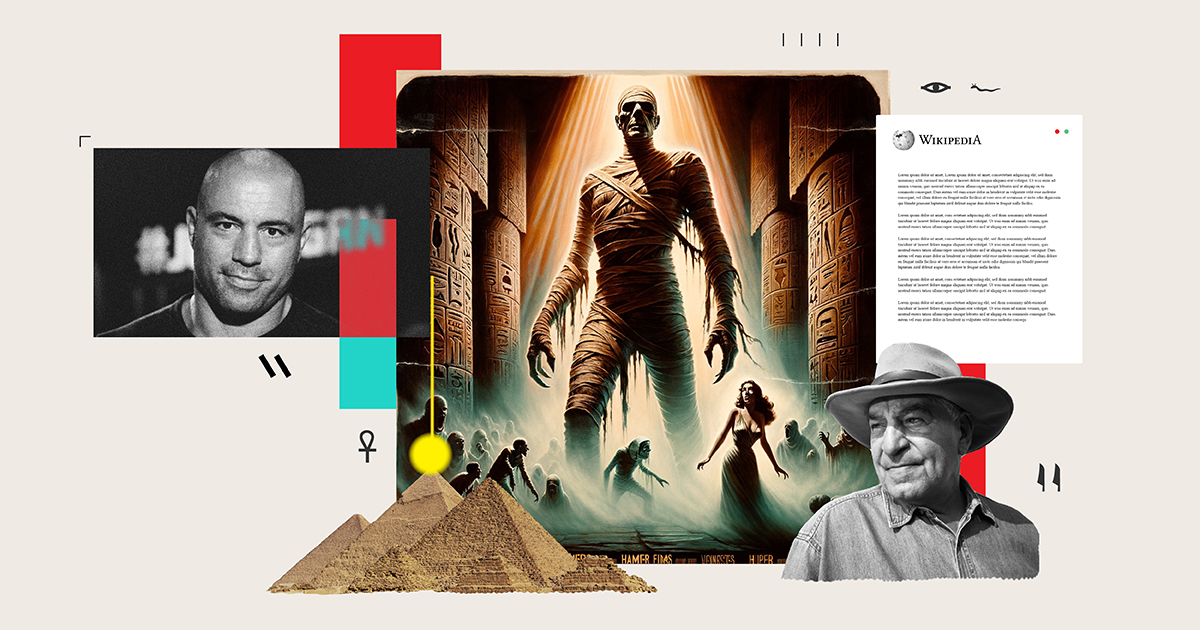
Artwork © Amr Rahma
In May 2025, Egyptian Egyptologist Zahi Hawass went on a video podcast episode with famed American podcaster Joe Rogan to talk about Egyptology and discoveries. When the episode aired, the public went wild for various reasons: many viewers were upset that Hawass promoted his book Giza and the Pyramids (2017), co-authored with American Egyptologist Mark Lehner; that he lacked proof and visuals to accompany certain theories while live; and that there was a testy dynamic between Rogan and Hawass. Yet the video, which was almost two hours long, garnered 2.1 million views since.
When the controversy erupted, I was flooded with snippets of criticism videos by random content creators, Egyptian and foreign. Memes, jokes, and YouTubers took turns to chime in on the content of the interview, which tackled the construction of the pyramids of Giza, the pyramids’ interior, the validity of satellite tomography, the Osiris shaft, pseudoscientific theories, and more.
One specific moment really stood out in the interview for me, and that is when Rogan asks Hawass about a concept on the origin of time called “zep tepi” as well as a king’s list goes back 30,000 years (possibly the Ramesside King’s List or the Abydos Kings list). He asks if Hawass has come across both concepts in “hieroglyphs” to which the Egyptian Egyptologist assertively says no, and refutes both concepts. Unyielding, Rogan then proceeds to read an AI-conjured explanation: “in ancient Egyptian, ‘zep tepi’ refers to the first time or the first occasion. It refers to a golden age of Egypt where gods lived on earth and civilization was in its infancy. This period is often associated with the beginning of creation and the establishment of societal structures. Have you never heard of that before?”
There is a brief moment of contentious debate between both figures, concluded by this subsequent dialogue on the matter:
“Listen Joe, why do I have to go to [resort to] a myth, of people creating stories?” asks Hawass.
“If you go to Wikipedia–”
“I don’t care about Wikipedia. I care about what I see with my eyes as an archaeologist.”
Never mind who was right or how experts actually interpret an ancient Egyptian royal kings’ list – that was it for me, that landing moment I had experienced numerous times before as an early career Egyptologist.
Often times, the trigger was a story, a myth, an interpretation, a Wikipedia entry, an esoteric blogspot page, some hearsay on Reddit, an AI-curated video circulating on TikTok which were all packaged to me as a fact. Regular folks with an interest in ancient Egypt will dabble in theories written by amateurs and confront me with them. Exactly as Hawass says, “when someone comes to you with a theory, they have to have an Egyptology background,” and armed with an ideally copious list of published scientific articles at minimum.
The truth is, I do not know a single Egyptologist who hasn’t struggled, at some point, with how to present Egyptology to a general audience. As a relatively junior scholar with ten years in the field, I have often found it challenging—much to the indomitable chagrin of my family—to answer questions with real confidence.
And that is because, two key truths about Egyptology stand strong: it is a scientific discipline, and like any science, its theories can be tested, and either supported or disproven.
At Odds with Public Imagination
Egyptology has been framed in the public mind, and remains to be, a sort of narnia-esque escapade of fantasy and exotification, which is why most people refuse to acknowledge the scientific basis of the study.
Glossing over news of red mercury in tabloid magazines, the mass wants to know if curses were real, if slaves built the pyramids, or the ‘secrets’ of mummification, but they do not want to know or hear about the nitty-gritty details of excavation work, reports, documentation, security clearances, and citation preference. For them, these are the unsexy facts that do not align with their first interaction with ancient Egypt, which could be Indiana Jones’ “Raiders of the Lost Ark” (1981) film, “The Mummy” (1999) featuring Brendan Fraser, vintage posters of the discovery of Tutankhamun, Discovery Channel documentaries, old Cook’s Tourists’ Handbooks, or even that dreamy picture their parents took on their once-in-a-lifetrip to Egypt.
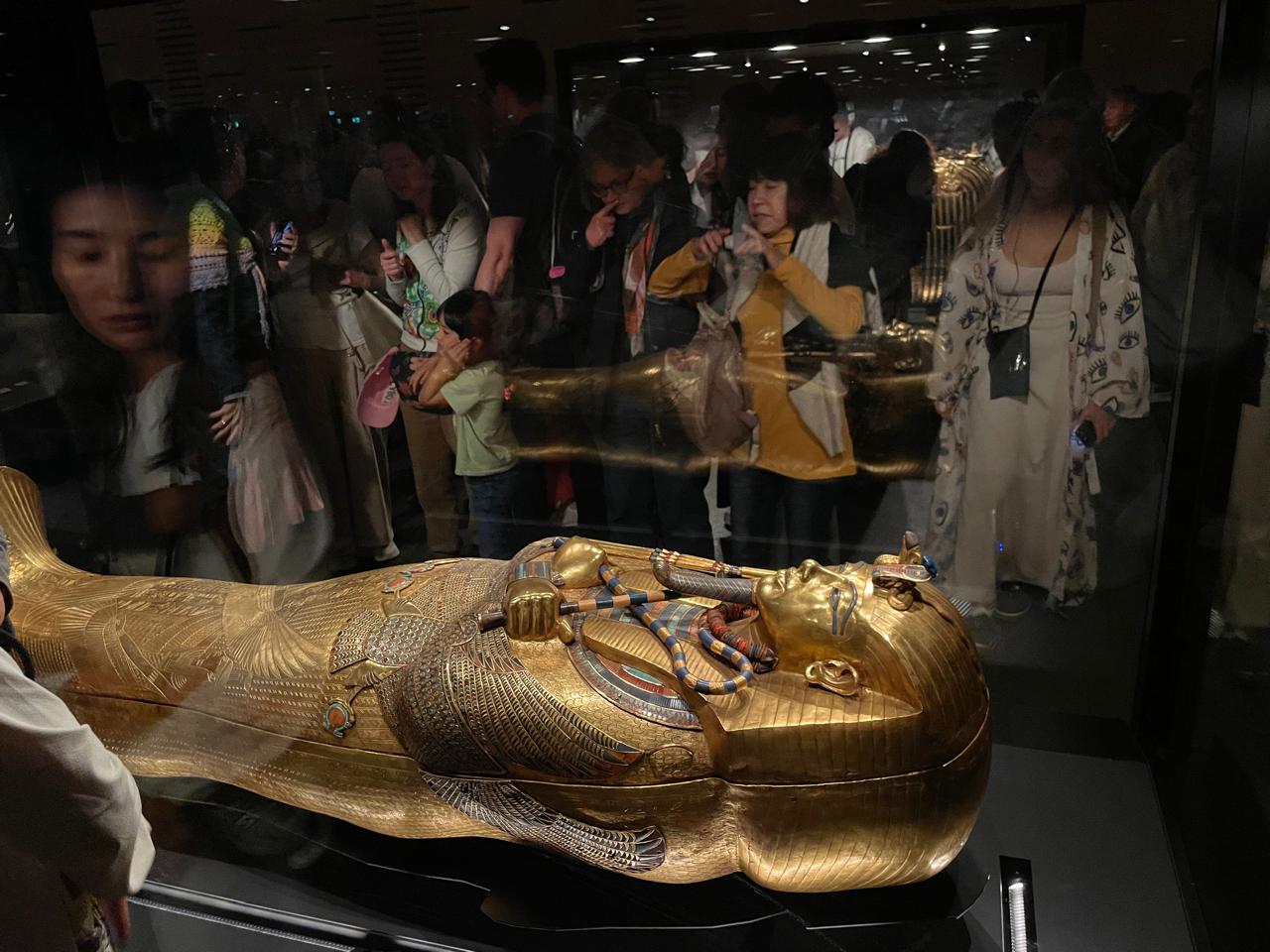
Enthusiasts want swathes of the mystified ancient Egyptian lore of times past.
They yearn for tangible correlations with the mystery and a soft return to the Orientalism that sparked the beginning of Egyptology.
But they forget (or maybe they do not know?) that to be a ‘proper’ Egyptologist, you have to conduct at least 10 years of undergraduate and graduate studies, master a minimum of three modern languages, one ancient language, as well as scientifically publish and present your work. Yet, the public does not want accurate, factual answers to their specific questions, which can range from “it depends on the time period,” “new interpretations have disproven that”, “it depends on which evidence you’re looking at,” or “according to the theory…”
It is incredible to note that in medicine, for instance, a doctor can provide an answer on a case by case basis, or that there are different specializations to begin with, but in Egyptology, there has to be a surefire answer to all questions, almost as if nuances and variables, development, new discoveries, and contingencies no longer exist.
It is also as if ancient Egyptians experts did not specialize in ancient language (philology), art history, architecture, or specific time periods.The field is replete with ceramicists (specialists in pottery), archaeobotanists (experts on ancient plants), zoo archeologists (experts on faunal remains), physical anthropologists (experts on human remains), conservators, historians and in many more subfields, yet, most people are not aware of this fact. And why is this the case? Because there is significant misunderstanding as to what Egyptology constitutes as a study.
Muddling of Expertise
No other field that I know of, other than Egyptology, can gather so many pseudo-historians and alleged experts. A long-life reader or avid enthusiast can pass as an expert, amassing millions of subscribers on YouTube or enjoying airtime on television. We would never treat any other profession the same way.
My friends and acquaintances take pleasure in sending me YouTube videos of ‘pyramids generating electricity’ or ‘evidence of long civilizations’.
Every other video I received has to have the word ‘secret’ or ‘mystery’ slapped on it as if Egyptologists and archeologists are steadfast gatekeepers of what is actually widely disseminated knowledge.
When I contest these concepts as being at odds with Egyptological findings, folks are quick to retort that the theories make sense, utterly sidelining the decades on decades of research and work that have cemented other foundational theories.
I sometimes wonder if short attention spans spurred by rampant use of technology is to blame. Would non-professional be able to read a 400-500 page book about ancient Egypt? Perhaps, a 10-15 minute video would be the more popular choice, which is not entirely surprising considering the common use of screen-time for learning as per UNESCO’s 2021 report.
Even in Arabic, which has entered the Egyptological rat-race of publications (popular or scientific), ambiguously edited manuscripts have become prolific in bookshops and online, completely muddling a reader’s capacity to discern legitimate from illegitimate information.
In Defense of Romanticism
We like to speak of ‘Egyptomania’ rather than Egyptology.
Historian and pseudohistory critic Ronald H. Fritze defines Egyptomania as a “global phenomenon” and “the widespread and persistent aspect of popular culture in his book Egyptomania: A History of Fascination, Obsession and Fantasy (2016).
The roots of this Egyptomania are older than we would believe: some would easily say they go back to ancient Egypt when ancient Egyptians were fascinated by their own Dynastic history.
With time, due to desires to intersect Biblical studies of ancient Egypt, followed by archaeological discoveries in the 19th to 21st centuries — such as the 1922 discovery of the tomb of Tutankhamun — public imagination continued to be hooked on ancient Egypt, relying on the rich culture for inspiration in art, literature, fashion, architecture, music, and entertainment.
By all means, there will never be any reason to kill the vivid imagination and curiosity that comes with loving ancient Egypt
. Without the romantic appeal of ancient Egypt, much of – although not all – Egyptology would be lost to begin with. It is impressive that museums worldwide continue attracting millions of thousands of visitors every year solely due to their Egyptian collections, for documentaries to continue gripping public imagination, and for the world, at large, to remain besotted with Egypt’s ancient past so much so that they continue to visit it.
It is both a privilege and an honor. Without this fascination, there would have never been Naguib Mahfouz’s novella Thebes at War (1944) or Agatha Christie’s Death on the Nile (1937).
What may be needed is a gentle reminder to return to the field’s roots: a genuine commitment to understanding, guided by those who have dedicated their lives to studying history. There are fantastic general books about ancient Egypt that can be accessed easily, such as Ancient Egypt: An Introduction by Salima Ikram, An Introduction to the Archaeology of Ancient Egypt by Kathryn Bard, The Rise and Fall of Ancient Egypt by Toby Wilkinson or A History. of Ancient Egypt by Marc Van De Mieroop.
Ultimately, this is not a criticism of personal perspectives or reflections—on the contrary, communities and non-experts are always encouraged to join the conversation—but there is a clear necessity to distinguish fact from fiction and to prevent the spread of misinformation. Without this boundary, we risk entangling the study of ancient Egypt in a maelstrom of debates, one bigger than it is already currently facing.
The opinions and ideas expressed in this article are the author’s and do not necessarily reflect the views of Egyptian Streets’ editorial team.
To submit an opinion article, please email [email protected].





Comments (0)